



Information and Strategy
Collection and analysis of international information; strategic planning and strengthening of intelligence functions
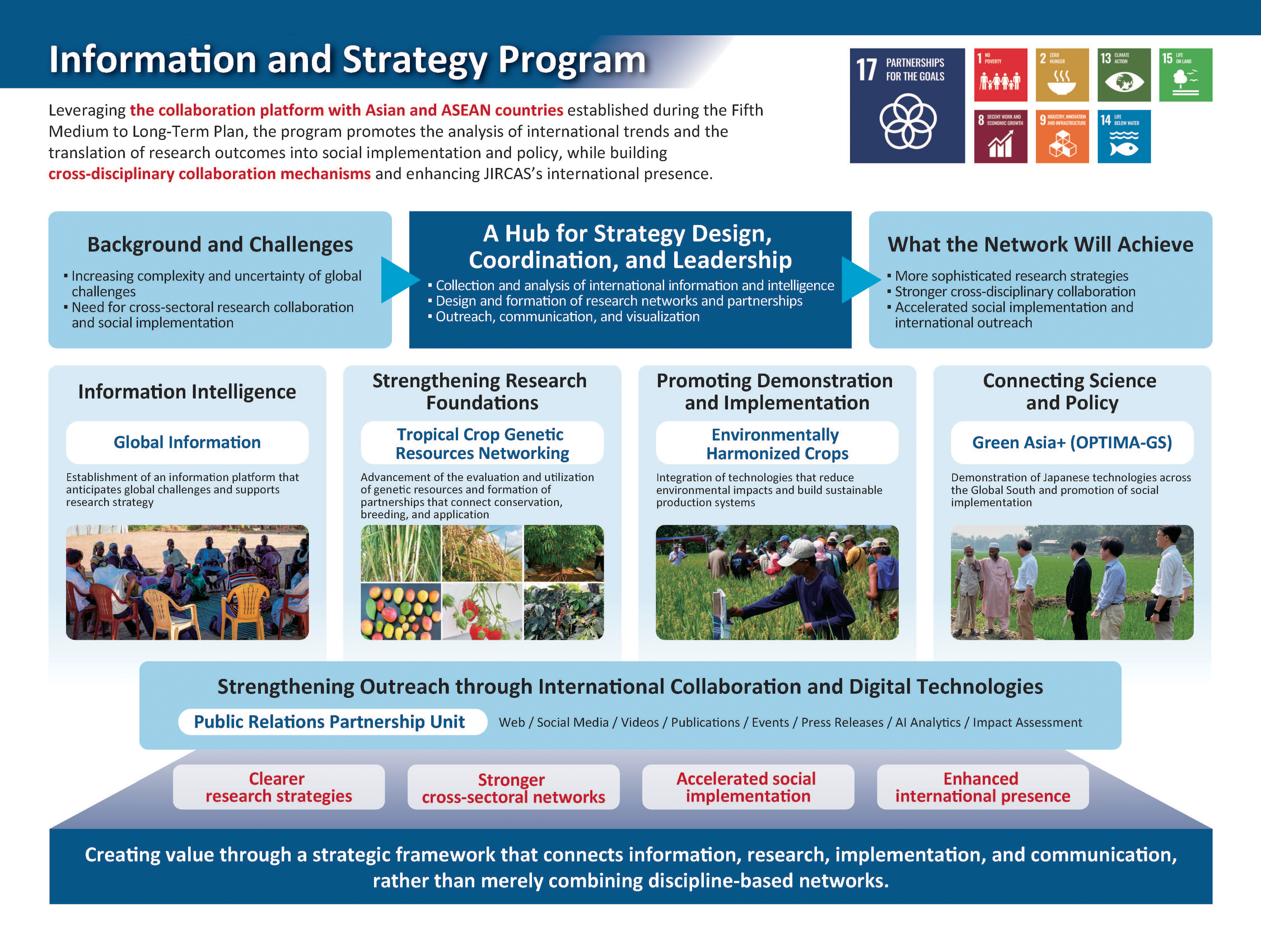
The international environment surrounding global food security is becoming increasingly uncertain due to climate change, infectious diseases, geopolitical risks, disruptions in logistics, and fluctuations in food supply and demand. In developing regions, where food systems and institutional foundations are often vulnerable, these risks directly affect livelihoods and nutrition security. As a result, the importance of evidence-based policymaking and international cooperation is growing. To translate research outcomes into practical applications and policy measures, it is essential to strengthen intelligence functions that can accurately identify and strategically utilize changes in the external environment, international rules, and policy trends.
The Information and Strategy Program focuses on the collection and analysis of international information, strategic planning, and the enhancement of intelligence functions. In addition to monitoring and analyzing global trends, the program promotes the strengthening of information platforms for genetic resources of tropical crops, the acceleration of research implementation based on the needs of the food industry and evolving institutional frameworks, and the field demonstration of climate change adaptation and mitigation technologies as well as environmentally sustainable technologies. Working in collaboration with research institutions in partner countries and with companies in Japan and abroad, the program advances demonstration activities that combine crop varieties and production technologies and develops implementation strategies to bridge research outcomes with policy, practice, and business. Through the Green Asia+ initiative, the program also seeks to accelerate the dissemination of Japanese agricultural, forestry, and fisheries technologies, in Global South, including ASEAN countries, and enhancing both local adoption and Japan's international presence.
In addition, the program leverages international collaborative networks, digital technologies, and artificial intelligence to implement integrated communication and outreach activities through websites, social media, and events. By visualizing the social impact of research outcomes and feeding the resulting insights back into research planning and content development, the program aims to advance intelligence functions that connect research, demonstration, and communication.
Related JIRCAS Report

Report on the Exhibit and Lecture on Palm Oil and Environmental Issues at the “Children’s Kasumigaseki Tour Day 2026”
On July 29, 2026, the “Children’s Kasumigaseki Tour Day 2026,” hosted by the Ministry of Education, Culture, Sports, Science and Technology (MEXT), was held at the ministry’s headquarters in Chiyoda Ward, Tokyo. The event attracted numerous visitors, particularly families with children. The Japan International Research Center for Agricultural Sciences (JIRCAS) cooperated in the Tsukuba City exhibition booth titled “Save the Earth with Potato Chip Oil! An SOS from the Tropical Rainforest: Solving Tough Challenges with Cutting-Edge Technology and Innovative Ideas.” Dr. OMORI Keisuke, Director of the Information and Strategy Program at JIRCAS, served as lecturer.

JIRCAS, NARO, and FFTC Hold Joint International Workshop on Soil Health and Multifunctionality
On July 13, 2026, the Japan International Research Center for Agricultural Sciences (JIRCAS), in collaboration with the National Agriculture and Food Research Organization (NARO) and the Food and Fertilizer Technology Center for the Asian and Pacific Region (FFTC), held the international workshop entitled “2026 JIRCAS-NARO-FFTC Joint International Workshop on Soil Health and Multifunctionality: Integrating Science and Practice for a Sustainable Future” at the Tsukuba International Congress Center.
Events
Japan–IRRI Strategic Forum and Technical Workshop on Heat-Resilient Rice Systems
Registration period:
-
(JST)
- Place
-
2026-10-13: Hitotsubashi Hall (2F, National Center of Sciences Building, 2-1-2 Hitotsubashi,Chiyoda-ku,Tokyo 101-8439, Japan) 2026-10-14: IINO Conference Center (4F, IINO BUILDING, 2-1-1 Uchisaiwaicho, Chiyoda-ku, Tokyo 100-0011, Japan) *All sessions will be held in person

Field
-
 Pick Up
1573. Considering the Impacts on Thai Agriculture amid Forecasts of a Major El Niño Event
In a previous Pick Up article titled “A Potentially Unprecedented El Niño and Global Weather Risks,” we introduced an El Niño forecast by the UK Met Office. This article reviews the potential impacts of a major El Niño event on Thai agriculture, based on weather information from the Thai Meteorological Department (TMD) and information reported as estimates by Krungthai COMPASS. -
 Pick Up
1572. Development and Global Impact of International “Measuring Tools” for Pathogenicity
A review article has been published in The Plant Genome describing the development history, global dissemination, and use of internationally shared “measuring tools” for evaluating the pathogenicity of the bacterial blight and rice blast pathogens. These tools have been developed and used over many years by JIRCAS and the International Rice Research Institute (IRRI), building on the knowledge of Japanese researchers and international collaborative research. The article comprehensively reviews the roles of the “measuring tools” and international research networks, developed and strengthened through international collaboration, in monitoring pathogen populations, analyzing resistance genes, and breeding rice varieties with durable disease resistance. -
 Pick Up
1571. IRRI: Supporting Rice Research Worldwide—Working with Japan to Address Rice Production under Climate Change
Rice, an essential part of the Japanese diet, is not immune to the effects of climate change. Rice production worldwide must simultaneously address multiple challenges, including high temperatures, water scarcity, pests and diseases, and the need to reduce environmental impacts and greenhouse gas emissions. One institution that has long tackled these issues internationally is the International Rice Research Institute (IRRI), headquartered in the Philippines. Japan and IRRI have worked together for more than 60 years through rice research and exchanges among researchers.
In October 2026, IRRI, the Japan International Research Center for Agricultural Sciences (JIRCAS), and the National Agriculture and Food Research Organization (NARO) will jointly hold the International Strategy Forum and Technical Workshop on Heat-Resilient Rice Production Systems in Tokyo. This article introduces IRRI’s role and the history of its cooperation with Japan, while considering the research partnerships that will be important for rice production under a changing climate.
-
 Pick Up
1570. Protecting Rice from Heat: Understanding Heat-Induced Sterility and Building Heat-Resilient Rice Production Systems
Japan’s annual mean temperature has risen over the long term, and the Japan Meteorological Agency reports that unusually warm years have occurred frequently since the 1990s. How do rising temperatures and heat waves associated with climate change affect rice yield and quality? This article explains how heat-induced sterility occurs and why it is important to combine heat-tolerant varieties, crop management, climate-impact assessment, and future projections. On October 13 and 14, the International Rice Research Institute (IRRI), JIRCAS, and the National Agriculture and Food Research Organization (NARO) will jointly hold an international forum and technical workshop to discuss research priorities and directions for international collaboration toward heat-resilient rice production systems. -
 Pick Up
1569. August 2026 tied as the world’s hottest month on record, at 1.65°C above pre-industrial levels
On 10 September 2026, the European Union’s Copernicus Climate Change Service (C3S) announced that the global-average surface air temperature in August 2026 was 16.96°C, tying July 2023 as the hottest month on record across all calendar months. This was 0.85°C above the 1991–2020 average and 1.65°C above the estimated 1850–1900 pre-industrial average. It was the first month since November 2025 in which the monthly global-average temperature exceeded the pre-industrial level by more than 1.5°C.