


Pick Up
1577. 1.5°C Exceedance Now Virtually Certain—Turning Climate Information and Adaptation into Action on the Ground
Related Research Program
Information and Strategy
1577. 1.5°C Exceedance Now Virtually Certain—Turning Climate Information and Adaptation into Action on the Ground
2026 is now virtually certain to exceed 1.5°C above pre-industrial levels and is likely to be the second-warmest year on record. With El Niño also intensifying, the question is how to turn climate information and adaptation efforts into preparedness and action on the ground. This article introduces the latest climate information and a United Nations report, and highlights JIRCAS International Symposium 2026, which will discuss responses to multiple and compounding risks in agriculture.
The Copernicus Climate Change Service (C3S) reported that October 2026 was the warmest October on record, with a global average temperature 1.75°C above the pre-industrial level (1850–1900). It was the third consecutive month to exceed 1.5°C. A prediction based on its ERA5 reanalysis dataset indicates that 2026 is virtually certain to exceed 1.5°C for the year as a whole and is most likely to be the second-warmest year on record, after 2024. Sea surface temperature outside the polar regions was also the highest on record for October, and the Niño 3.4 anomaly in the tropical Pacific exceeded the peaks of previous very strong El Niño events. In Europe, exceptionally low river flows persisted across much of central and eastern Europe, while heavy rainfall and flooding affected several countries, showing that drought and heavy rain can occur side by side.
Meanwhile, the United Nations Environment Programme (UNEP), in its Adaptation Gap Report 2026, points out that preparedness for adaptation remains insufficient as global warming is now set to exceed 1.5°C. Adaptation finance continues to fall short of needs, institutional barriers constrain implementation, and losses and damages are mounting as climate impacts intensify. The report stresses that effective and well-financed adaptation is crucial to reduce risks and losses and damages, strengthen resilience, and support more inclusive development. When further warming cannot be avoided, it becomes even more important to steadily advance adaptation suited to local and on-the-ground conditions, alongside mitigation.
When extreme heat, drought, and floods overlap, responding to a single hazard or a single crop is not enough to protect agriculture. What is needed is adaptation that uses climate information in on-the-ground decisions and prepares for risks in which multiple hazards cascade and intensify.
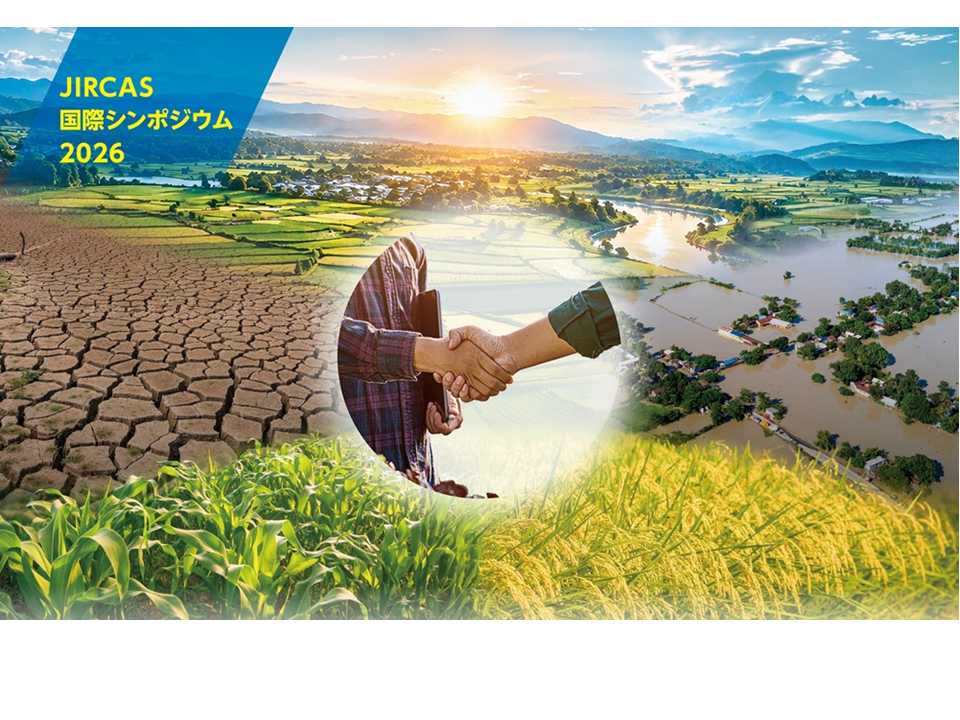
JIRCAS International Symposium 2026, Addressing Agricultural Risks in an Era of Multiple Hazards—Learning from Science, Technology and Innovation and Their Implementation in the Field, organized by JIRCAS, takes up exactly these challenges. It will be held in a hybrid format at Akihabara Convention Hall and online on Thursday, 26 November 2026. In the keynote presentations, Joseph Daron of the UK Met Office will discuss climate services and multi-hazard early warning systems for strengthening resilience in Africa and Asia, and Hideki Kanamaru of the Food and Agriculture Organization of the United Nations (FAO) will speak on integrated risk management for climate-resilient agriculture. The following session will draw on cases such as climate information and farmers’ decision-making to share challenges and lessons in delivering information and technologies to farmers and enabling their practical use, and the symposium will discuss scaling up implementation and advancing international collaboration. We warmly invite you to join us.
JIRCAS International Symposium 2026
“Addressing Agricultural Risks in an Era of Multiple Hazards—Learning from Science, Technology and Innovation and Their Implementation in the Field”
Date and time: Thursday, 26 November 2026, 13:30–17:30
Venue: Halls A and B, 2nd floor, Akihabara Convention Hall (1-18-13 Sotokanda, Chiyoda-ku, Tokyo)
Format: Hybrid, combining in-person and online participation
Languages: Japanese and English (simultaneous interpretation provided)
Participation fee: Free (open to all)
Registration: Please register through the JIRCAS website.
URL: https://www.jircas.go.jp/ja/symposium/2026/e20261126_jircas
References
Copernicus Climate Change Service (C3S). “Copernicus: Warmest October on record with 2026 virtually certain to exceed 1.5°C.” 5 November 2026. https://climate.copernicus.eu/copernicus-warmest-october-record-2026-vi…
United Nations Environment Programme (UNEP). “Adaptation Gap Report 2026: Ready? Not.” https://www.unep.org/en/publications/report/adaptation-gap-report-2026