



Environment
Development of agricultural technologies for climate change, resource recycling and environmental conservation


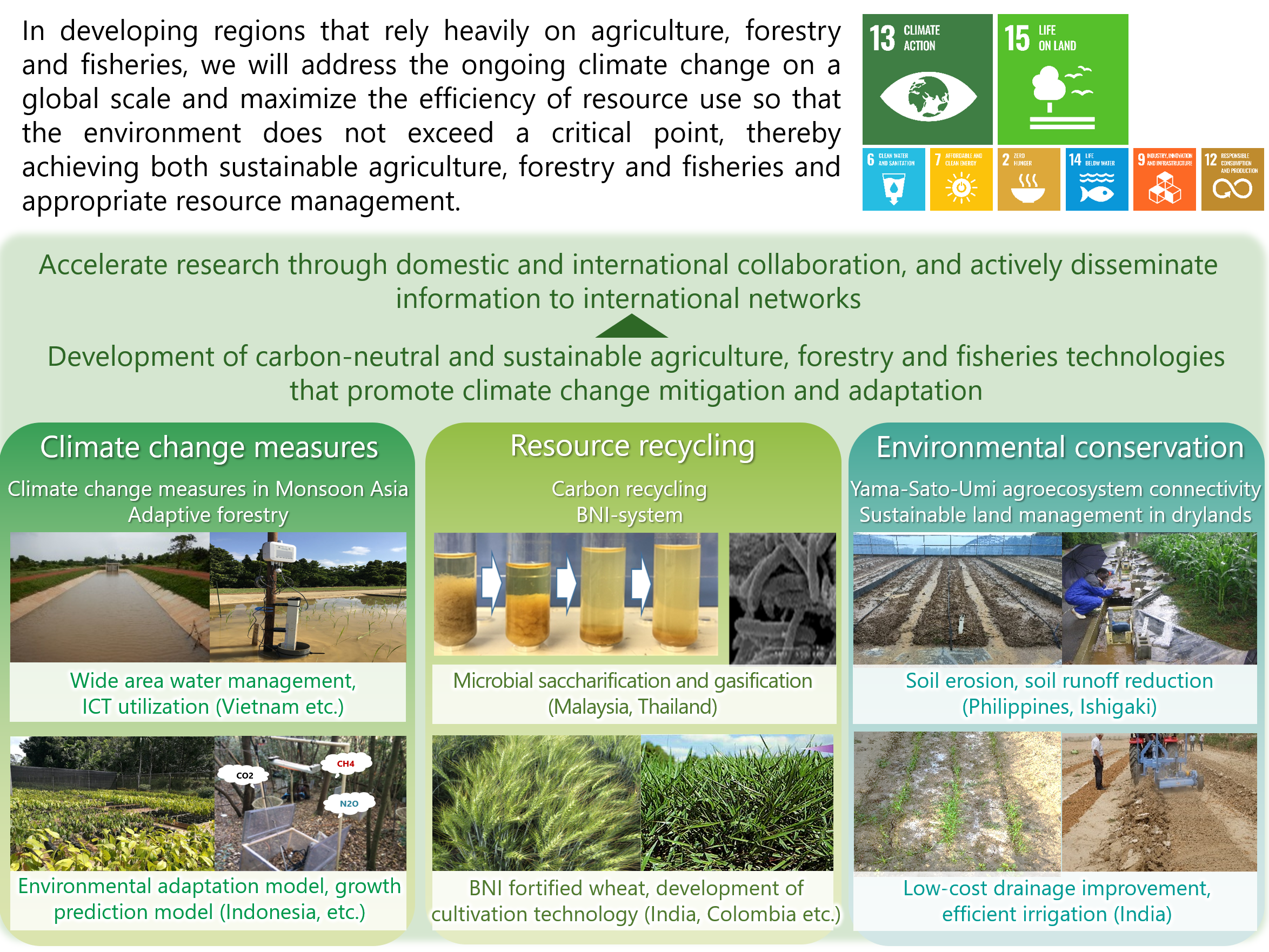
Research Highlights
Related JIRCAS Report

Project for Advancing Nationally Determined Contributions Targets through Innovative Mangrove Blue Carbon Management as a Nature-based Solution —JIRCAS Proposal on Mangrove Conservation in Indonesia Conditionally Selected for FY 2026 SATREPS Program—
A research proposal submitted by a researcher from the Japan International Research Center for Agricultural Sciences (JIRCAS) has been conditionally selected as a new research project for FY2026 under SATREPS (Science and Technology Research Partnership for Sustainable Development), a program jointly implemented by the Japan Science and Technology Agency (JST) and the Japan International Cooperation Agency (JICA).

JICA Thematic Training Participants Visit JIRCAS
On May 18, 2026 (Monday), a total of 21 participants, including 12 trainees, 2 accompanying staff members from the Japan International Cooperation Agency (JICA) Tsukuba, and 7 staff members from JICA Headquarters, visited JIRCAS as part of the FY2026 thematic training course titled “Prospective Agricultural Technologies as Solutions to Climate Change.” This course aims to strengthen the capacity of developing countries to utilize agricultural technologies that contribute to climate change adaptation and mitigation.
Press Release
Events
JIRCAS International Symposium 2023
“Innovations to enhance the resilience of tropical forests and sustainability of the forest industry”
“Innovations to enhance the resilience of tropical forests and sustainability of the forest industry”
Registration period:
-
(JST)
- Place
-
U Thant International Conference Hall + Online(United Nations University 3F, 5-53-70 Jingu-mae, Shibuya-ku, Tokyo 150-0001)

Field
-
 Pick Up
1571. IRRI: Supporting Rice Research Worldwide—Working with Japan to Address Rice Production under Climate Change
Rice, an essential part of the Japanese diet, is not immune to the effects of climate change. Rice production worldwide must simultaneously address multiple challenges, including high temperatures, water scarcity, pests and diseases, and the need to reduce environmental impacts and greenhouse gas emissions. One institution that has long tackled these issues internationally is the International Rice Research Institute (IRRI), headquartered in the Philippines. Japan and IRRI have worked together for more than 60 years through rice research and exchanges among researchers.
In October 2026, IRRI, the Japan International Research Center for Agricultural Sciences (JIRCAS), and the National Agriculture and Food Research Organization (NARO) will jointly hold the International Strategy Forum and Technical Workshop on Heat-Resilient Rice Production Systems in Tokyo. This article introduces IRRI’s role and the history of its cooperation with Japan, while considering the research partnerships that will be important for rice production under a changing climate.
-
 Pick Up
1570. Protecting Rice from Heat: Understanding Heat-Induced Sterility and Building Heat-Resilient Rice Production Systems
Japan’s annual mean temperature has risen over the long term, and the Japan Meteorological Agency reports that unusually warm years have occurred frequently since the 1990s. How do rising temperatures and heat waves associated with climate change affect rice yield and quality? This article explains how heat-induced sterility occurs and why it is important to combine heat-tolerant varieties, crop management, climate-impact assessment, and future projections. On October 13 and 14, the International Rice Research Institute (IRRI), JIRCAS, and the National Agriculture and Food Research Organization (NARO) will jointly hold an international forum and technical workshop to discuss research priorities and directions for international collaboration toward heat-resilient rice production systems. -
 Pick Up
1545. The Future of Sustainable Mangrove Management on the International Day of Mangroves — New Opportunities for International Collaboration Emerging from MMM7 and the JIRCAS Workshop
Every year on July 26, UNESCO observes the International Day for the Conservation of the Mangrove Ecosystem. The day serves as an opportunity to raise awareness of the value of mangrove ecosystems, which play vital roles in climate change mitigation, biodiversity conservation, coastal protection, and the sustainable development of local communities. This article highlights discussions from the 7th Mangrove Macrobenthos and Management Conference (MMM7) and a workshop organized by the Japan International Research Center for Agricultural Sciences (JIRCAS), exploring future prospects for international collaboration toward sustainable mangrove management. -
 Pick Up
1473. Meeting with IRRI to Strengthen Research Collaboration
On April 3, 2026, we welcomed Dr. Virender Kumar (Research Director), Dr. SAITO Kazuki (Senior Scientist), and Dr. IWANAGA Masa (Board Member) from the International Rice Research Institute (IRRI) for a courtesy visit and technical exchange. During the visit, we introduced our institutional framework and research projects, followed by broad discussions on strengthening future collaboration with IRRI. -
 Pick Up
1391. Carbon is a Wonderful Partner for Nitrogen in Protecting the Earth
Now that we can use more fertilizer, we no longer have to worry about food. But it's not all good. If too much fertilizer is added to fields, the reactive nitrogen that plants don't use can pollute rivers and the air, causing various environmental problems. This is becoming more common, so we need to take action quickly. We will introduce a study that investigates whether adding charcoal to soil can keep the nitrogen in fertilizer in the soil for longer, allowing nitrogen to be used without waste.
Article and Publication
2026
-
田中, 憲蔵 , 諏訪, 錬平 , MANDAL, Mohammad Shamim Hasan , 大谷, 達也 , NUR HAJAR, Zamah Shari (2026) マレーシアにおける植栽方法の異なる郷土樹種の30年後の成長と生存特性. 関東森林研究, 77 :41-44.
kantoforest77_41-44524.0 KB
-
ONISHI, Junya , KAMEOKA, Taishin , MATSUI, Kayo , LEE, Guenwoo , Chaudhari, S. K. , Yadav, R. K. , Yadav, Gajender , Rai, A. K. , Kumar, Suresh , Kumar, Satyendra , Narjary, Bhaskar (2026) Technical Manual for mitigating soil salinization with Preferential shallow sub-surface drainage and Sub-surface irrigation. , 0 https://doi.org/10.64096/jircas2025.006
JIRCAS2025_00610.2 MB
-
Asaduzzaman, Md , Mandal, Mohammad Shamim Hasan , Koetz, Eric , Rahman, Azizur (2026) Prediction to Prevention: Comparative Machine Learning Models for Early Intervention of Dactyloctenium radulans in Australia. Rangeland Ecology & Management, 106 :108-119. https://doi.org/10.1016/j.rama.2026.02.004
-
Otaka, Junnosuke , Venkata Subbarao, Guntur , Matsumiya, Shigeki , Wada, Naoki , Wada, Yuki , Kawano, Masaki , Kutsuwada, Keisuke , Ono, Hiroshi , Yoshihashi, Tadashi (2026) Discovery of Coracanols A and B, Two Biological Nitrification Inhibition Diterpenoids from Finger Millet. Organic Letters, 28 :3430-3434. https://doi.org/10.1021/acs.orglett.6c00300
-
Hamada, Kosuke , Nakamura, Satoshi , Yoshida, Takahiro (2026) Properties and nitrate leaching mitigation effect of thermally treated biomass-a case study of tropical and subtropical islands. Scientific Reports, 16 :11861-. https://doi.org/10.1038/s41598-026-41496-1
s41598-026-41496-12.3 MB
-
Fischer, Fabian Jörg , Chave, Jérôme , Tanaka, Kenzo (2026) Beyond species means – the intraspecific contribution to global wood density variation. New Phytologist, :70860-. https://doi.org/10.1111/nph.70860
-
Tran, Sy Nam , Leon, Ai , Tran, Hoang Kha , Nguyen, Van Cong , Huynh, Van Thao , Dinh, Thai Danh , Huynh, Thi Diem , Huynh, Cong Khanh (2026) Feasibility evaluation of using cattle manure for biogas production : A case study under household conditions in the Vietnamese Mekong Delta. Journal of Ecological Engineering, 27 :69-79. https://doi.org/10.12911/22998993/210922
-
Tani, Naoki , Volkaert, Hugo , Himmapan, Woraphun , Prompen, Benjarat , Wattansuksakul, Saroj , Matsuo, Ayumi , Suyama, Yoshihisa , Tangmitcharoen, Suwan (2026) Narrow-sense heritability of heartwood variation in a teak (Tectona grandis) clonal trial and its potential for tree improvement. Forest Science and Technology, :1-16. https://doi.org/10.1080/21580103.2025.2609602
-
Maung, Win Sithu , Tsuyuki, Satoshi , Hiroshima, Takuya (2026) DECDNet: A dual encoder change detection network for monitoring mangrove gain and loss using Sentinel-2 data. Remote Sensing Applications: Society and Environment, 41 :101867-. https://doi.org/10.1016/j.rsase.2025.101867
2025
-
KANDA, Takashi , TERAJIMA, Yoshifumi , NAKAMURA, Satoshi (2025) Use of Sugar Mill By-Products as a Substitute for Chemical Fertilizers and Soil-Specific Impacts on Early Sugarcane Growth. Tropical Agriculture and Development, 69 :143-153.
Trop.Agri.Develop.69(4)_143-153399.2 KB