



"Adaptive forestry"
Evaluation of genetic resources for strengthening productivity and adaptability of tropical forests
Related Research Program
Environment

2025-09-25
Background
Tropical forests are rich in diversity and have trees with a variety of excellent properties for timber. However, the harvesting of natural forest timber is not sustainable due to the uncertainty of subsequent resource regeneration, and the depletion of resources is limiting natural forest timber production and switching production to plantation timber. Therefore, there is a need to develop afforestation technologies for degraded secondary forests, abandoned cultivated lands, and other areas with high afforestation needs, in order to restore timber production capacity. Furthermore, many of the major tree species in natural forests are susceptible to the effects of climate change, and it is necessary to establish sustainable tropical forest management using diverse forest genetic resources with high environmental adaptability.
Objectives
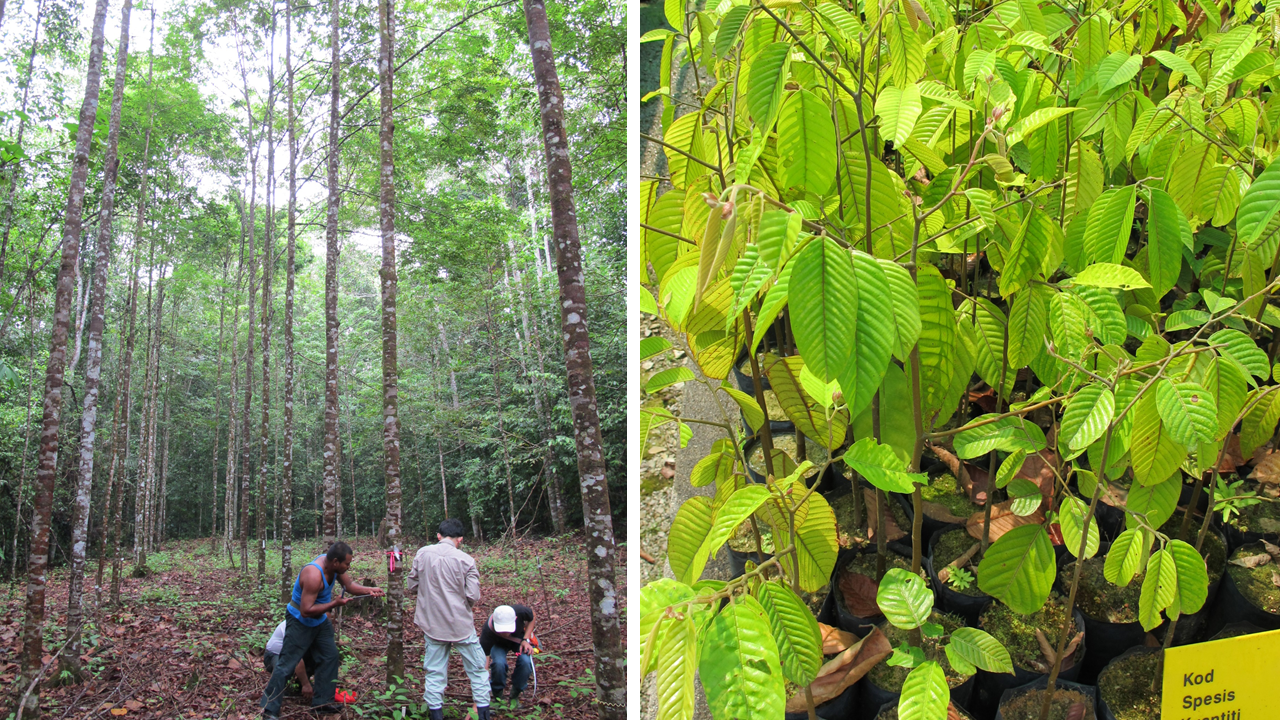
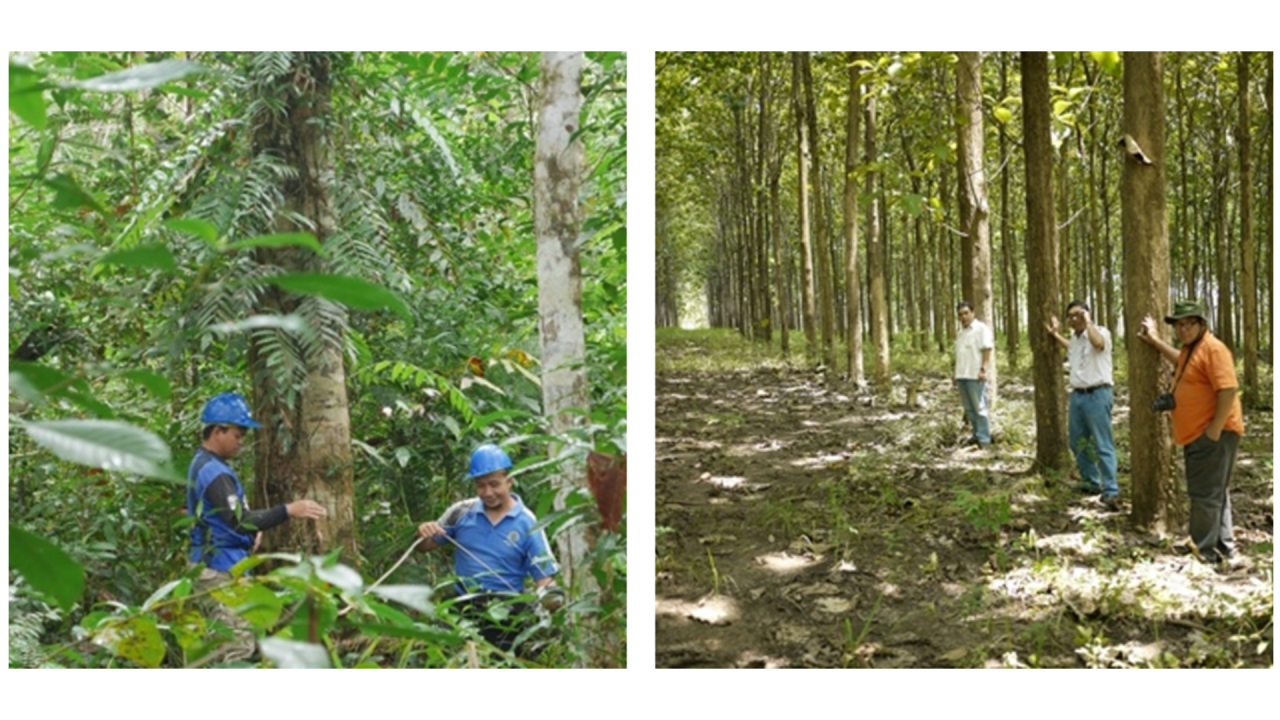
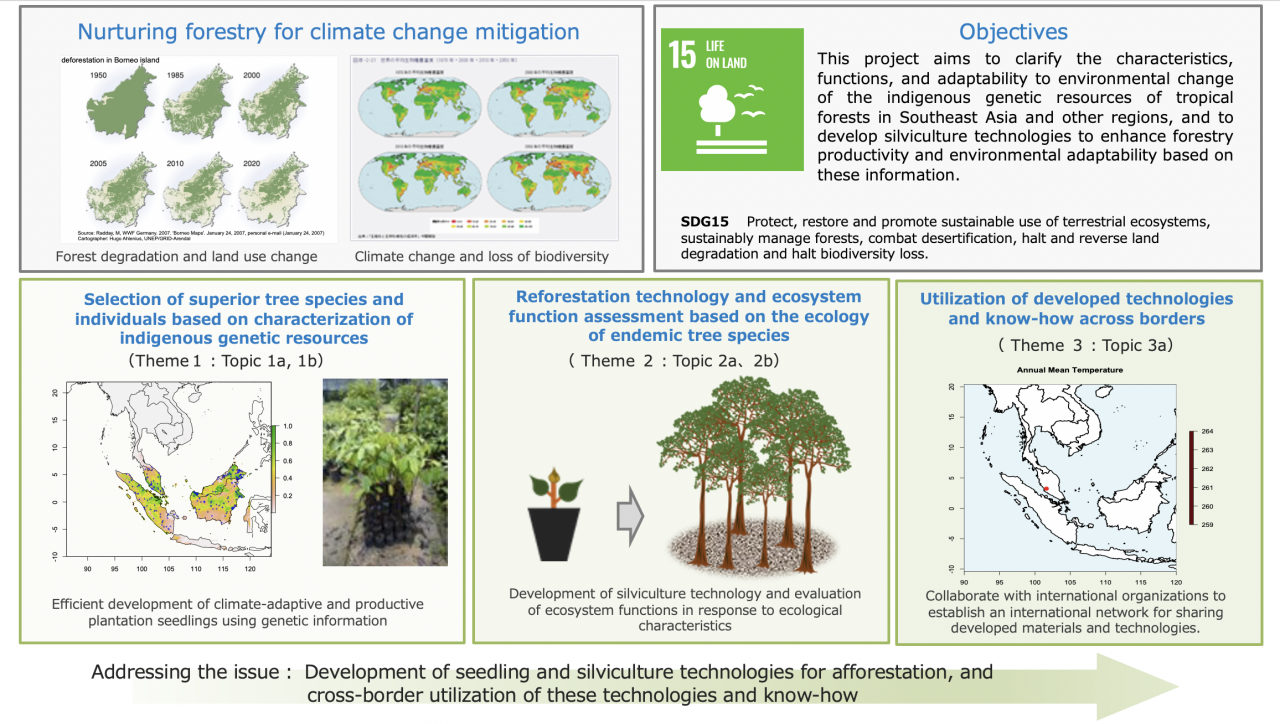
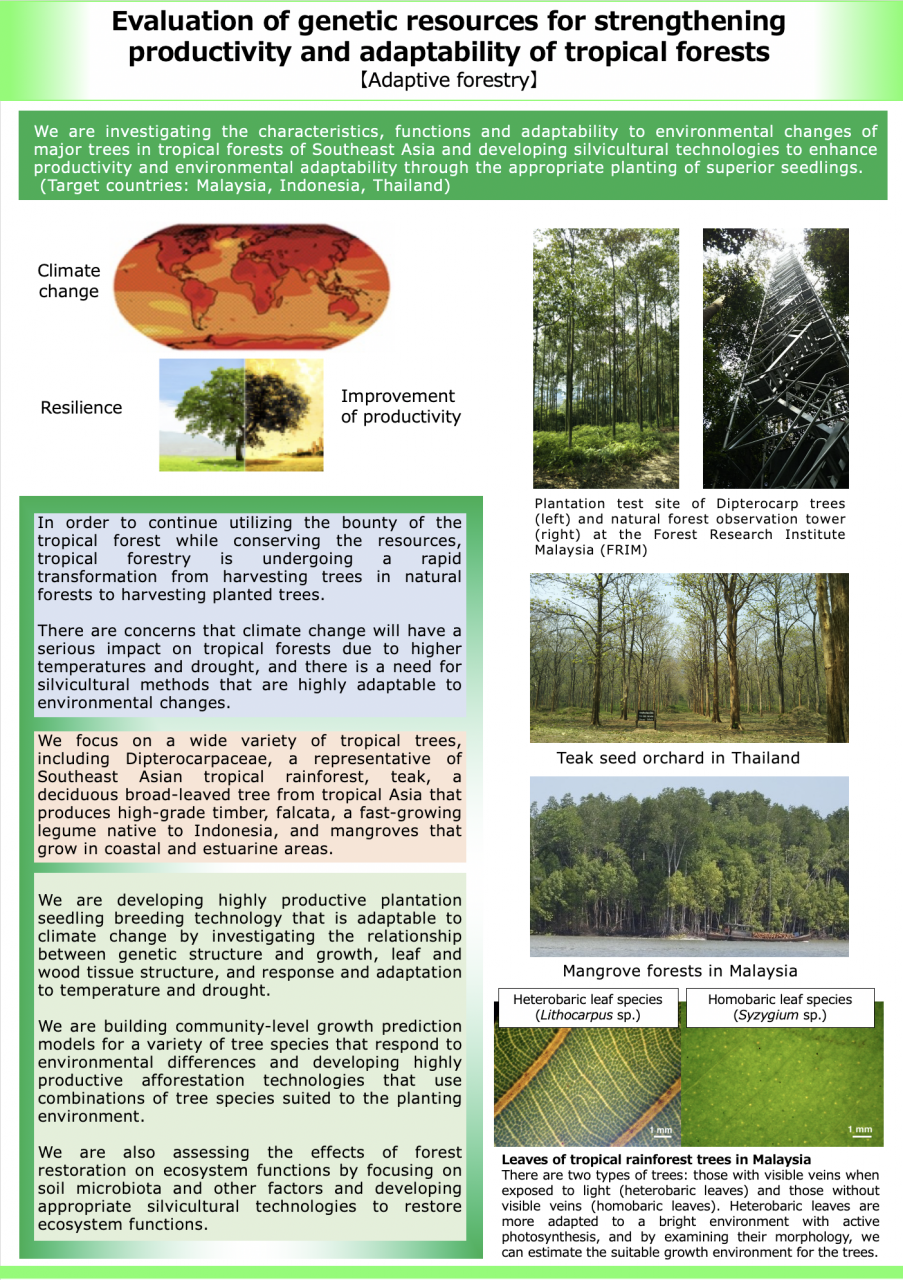
This project aims to clarify the characteristics, functions, and adaptability to environmental changes of the indigenous genetic resources of tropical forests in Southeast Asia and other regions, and to develop silviculture technologies to enhance forestry productivity and environmental adaptability based on this information.
Research Themes
- Characterization of tropical forest genetic resources for enhanced productivity and environmental adaptability
- Development of silviculture techniques that take into account the impact of vegetation change on ecosystem functions
- Networking of indigenous genetic resource management information and sharing of utilization methods
Target Countries
Malaysia, Indonesia, Thailand
Target Beneficiaries
Government of partner countries, state forest agencies, foresters and forestry enterprises
Project Leader
ABE Hisashi (Forestry Division)
Poster
Related Pages
JIRCAS Report

JIRCAS Forestry Division Researchers Tanaka and Katsuura Receive Awards from the Japanese Forestry Society
On March 16, 2026, the award ceremony for the Japanese Forestry Society was held during the 137th Annual Meeting of the Society at the Tsukuba International Congress Center.
At the ceremony, Dr. TANAKA Kenzo, Senior Researcher in the Forestry Division of JIRCAS, received the Society Award, while Dr. KATSUURA Hiiragi, Researcher in the same division, received the Young Scientist Encouragement Award.

International Workshop on Environmentally Adaptive Forestry Held at Gadjah Mada University, Indonesia
On February 9–10, 2026, an international workshop titled “Environmentally Adaptive Forestry Techniques for Southeast Asian Tree Species” was held in Yogyakarta, Indonesia. The workshop summarized the achievements of the medium- and long-term plan under the grant-funded project “Environmentally Adaptive Forestry.” Launched in fiscal year 2021, this project aims to develop technologies for the restoration of forest resources in tropical forests degraded by overharvesting and to establish methods for selecting tree species and varieties with enhanced environmental adaptability.

Attendance at the Executive Committee Meeting of the Asia Pacific Association of Forestry Research Institutions (APAFRI)
On January 28, 2026, Dr. ABE Hisashi, Director of the Forestry Division at JIRCAS, attended the 30th Executive Committee Meeting of the Asia Pacific Association of Forestry Research Institutions (APAFRI) held in Coimbatore, India. The meeting took place as part of a session within the International Conference on Population and Conservation Genetics 2026.
Press Release
Event, Symposium
JIRCAS International Symposium 2023
“Innovations to enhance the resilience of tropical forests and sustainability of the forest industry”
“Innovations to enhance the resilience of tropical forests and sustainability of the forest industry”
Registration period:
-
(JST)
- Place
-
U Thant International Conference Hall + Online(United Nations University 3F, 5-53-70 Jingu-mae, Shibuya-ku, Tokyo 150-0001)

The 69th Annual Meeting of the Ecological Society of Japan (ESJ69)
Symposium ”Global Warming and Methane Uptake in Upland Soils as Key Processes for Future Climate”
Symposium ”Global Warming and Methane Uptake in Upland Soils as Key Processes for Future Climate”
Registration period:
-
(JST)
- Place
-
Hybrid format (online + on-site in Fukuoka + on-demand streaming)
Research Highlights
Article and Publication
2026
-
田中, 憲蔵 , 諏訪, 錬平 , MANDAL, Mohammad Shamim Hasan , 大谷, 達也 , NUR HAJAR, Zamah Shari MANDAL, Mohammad Shamim Hasan (2026) マレーシアにおける植栽方法の異なる郷土樹種の30年後の成長と生存特性. 関東森林研究, 77 :41-44.
kantoforest77_41-44524.0 KB
-
田中, 憲蔵 , 諏訪, 錬平 , MANDAL, Mohammad Shamim Hasan , 大谷, 達也 , NUR HAJAR, Zamah Shari 大谷, 達也, OTANI, Tatsuya (2026) マレーシアにおける植栽方法の異なる郷土樹種の30年後の成長と生存特性. 関東森林研究, 77 :41-44.
kantoforest77_41-44524.0 KB
-
田中, 憲蔵 , 諏訪, 錬平 , MANDAL, Mohammad Shamim Hasan , 大谷, 達也 , NUR HAJAR, Zamah Shari 田中, 憲蔵, TANAKA, Kenzo (2026) マレーシアにおける植栽方法の異なる郷土樹種の30年後の成長と生存特性. 関東森林研究, 77 :41-44.
kantoforest77_41-44524.0 KB
-
田中, 憲蔵 , 諏訪, 錬平 , MANDAL, Mohammad Shamim Hasan , 大谷, 達也 , NUR HAJAR, Zamah Shari NUR HAJAR, Zamah Shari (2026) マレーシアにおける植栽方法の異なる郷土樹種の30年後の成長と生存特性. 関東森林研究, 77 :41-44.
kantoforest77_41-44524.0 KB
-
田中, 憲蔵 , 諏訪, 錬平 , MANDAL, Mohammad Shamim Hasan , 大谷, 達也 , NUR HAJAR, Zamah Shari 諏訪, 錬平, SUWA, Rempei (2026) マレーシアにおける植栽方法の異なる郷土樹種の30年後の成長と生存特性. 関東森林研究, 77 :41-44.
kantoforest77_41-44524.0 KB
-
Asaduzzaman, Md , Mandal, Mohammad Shamim Hasan , Koetz, Eric , Rahman, Azizur Mandal, Mohammad Shamim Hasan (2026) Prediction to Prevention: Comparative Machine Learning Models for Early Intervention of Dactyloctenium radulans in Australia. Rangeland Ecology & Management, 106 :108-119. https://doi.org/10.1016/j.rama.2026.02.004
-
Asaduzzaman, Md , Mandal, Mohammad Shamim Hasan , Koetz, Eric , Rahman, Azizur Koetz, Eric (2026) Prediction to Prevention: Comparative Machine Learning Models for Early Intervention of Dactyloctenium radulans in Australia. Rangeland Ecology & Management, 106 :108-119. https://doi.org/10.1016/j.rama.2026.02.004
-
Asaduzzaman, Md , Mandal, Mohammad Shamim Hasan , Koetz, Eric , Rahman, Azizur Rahman, Azizur (2026) Prediction to Prevention: Comparative Machine Learning Models for Early Intervention of Dactyloctenium radulans in Australia. Rangeland Ecology & Management, 106 :108-119. https://doi.org/10.1016/j.rama.2026.02.004
-
Asaduzzaman, Md , Mandal, Mohammad Shamim Hasan , Koetz, Eric , Rahman, Azizur Asaduzzaman, Md (2026) Prediction to Prevention: Comparative Machine Learning Models for Early Intervention of Dactyloctenium radulans in Australia. Rangeland Ecology & Management, 106 :108-119. https://doi.org/10.1016/j.rama.2026.02.004
-
Fischer, Fabian Jörg , Chave, Jérôme , Tanaka, Kenzo Tanaka, Kenzo (2026) Beyond species means – the intraspecific contribution to global wood density variation. New Phytologist, :70860-. https://doi.org/10.1111/nph.70860
-
Fischer, Fabian Jörg , Chave, Jérôme , Tanaka, Kenzo Fischer, Fabian Jörg (2026) Beyond species means – the intraspecific contribution to global wood density variation. New Phytologist, :70860-. https://doi.org/10.1111/nph.70860
-
Fischer, Fabian Jörg , Chave, Jérôme , Tanaka, Kenzo Chave, Jérôme (2026) Beyond species means – the intraspecific contribution to global wood density variation. New Phytologist, :70860-. https://doi.org/10.1111/nph.70860
-
Tani, Naoki , Volkaert, Hugo , Himmapan, Woraphun , Prompen, Benjarat , Wattansuksakul, Saroj , Matsuo, Ayumi , Suyama, Yoshihisa , Tangmitcharoen, Suwan Tangmitcharoen, Suwan (2026) Narrow-sense heritability of heartwood variation in a teak (Tectona grandis) clonal trial and its potential for tree improvement. Forest Science and Technology, :1-16. https://doi.org/10.1080/21580103.2025.2609602
-
Tani, Naoki , Volkaert, Hugo , Himmapan, Woraphun , Prompen, Benjarat , Wattansuksakul, Saroj , Matsuo, Ayumi , Suyama, Yoshihisa , Tangmitcharoen, Suwan Wattansuksakul, Saroj (2026) Narrow-sense heritability of heartwood variation in a teak (Tectona grandis) clonal trial and its potential for tree improvement. Forest Science and Technology, :1-16. https://doi.org/10.1080/21580103.2025.2609602
-
Tani, Naoki , Volkaert, Hugo , Himmapan, Woraphun , Prompen, Benjarat , Wattansuksakul, Saroj , Matsuo, Ayumi , Suyama, Yoshihisa , Tangmitcharoen, Suwan Volkaert, Hugo (2026) Narrow-sense heritability of heartwood variation in a teak (Tectona grandis) clonal trial and its potential for tree improvement. Forest Science and Technology, :1-16. https://doi.org/10.1080/21580103.2025.2609602
-
Tani, Naoki , Volkaert, Hugo , Himmapan, Woraphun , Prompen, Benjarat , Wattansuksakul, Saroj , Matsuo, Ayumi , Suyama, Yoshihisa , Tangmitcharoen, Suwan Matsuo, Ayumi (2026) Narrow-sense heritability of heartwood variation in a teak (Tectona grandis) clonal trial and its potential for tree improvement. Forest Science and Technology, :1-16. https://doi.org/10.1080/21580103.2025.2609602
-
Tani, Naoki , Volkaert, Hugo , Himmapan, Woraphun , Prompen, Benjarat , Wattansuksakul, Saroj , Matsuo, Ayumi , Suyama, Yoshihisa , Tangmitcharoen, Suwan Himmapan, Woraphun (2026) Narrow-sense heritability of heartwood variation in a teak (Tectona grandis) clonal trial and its potential for tree improvement. Forest Science and Technology, :1-16. https://doi.org/10.1080/21580103.2025.2609602
-
Tani, Naoki , Volkaert, Hugo , Himmapan, Woraphun , Prompen, Benjarat , Wattansuksakul, Saroj , Matsuo, Ayumi , Suyama, Yoshihisa , Tangmitcharoen, Suwan Suyama, Yoshihisa (2026) Narrow-sense heritability of heartwood variation in a teak (Tectona grandis) clonal trial and its potential for tree improvement. Forest Science and Technology, :1-16. https://doi.org/10.1080/21580103.2025.2609602
-
Tani, Naoki , Volkaert, Hugo , Himmapan, Woraphun , Prompen, Benjarat , Wattansuksakul, Saroj , Matsuo, Ayumi , Suyama, Yoshihisa , Tangmitcharoen, Suwan Prompen, Benjarat (2026) Narrow-sense heritability of heartwood variation in a teak (Tectona grandis) clonal trial and its potential for tree improvement. Forest Science and Technology, :1-16. https://doi.org/10.1080/21580103.2025.2609602
-
Tani, Naoki , Volkaert, Hugo , Himmapan, Woraphun , Prompen, Benjarat , Wattansuksakul, Saroj , Matsuo, Ayumi , Suyama, Yoshihisa , Tangmitcharoen, Suwan Tani, Naoki (2026) Narrow-sense heritability of heartwood variation in a teak (Tectona grandis) clonal trial and its potential for tree improvement. Forest Science and Technology, :1-16. https://doi.org/10.1080/21580103.2025.2609602