



Pick Up
1579. Turning Warnings into Action: The State of Early Warning Systems Worldwide and Implementation in Agriculture, as Discussed at an International Symposium
Related Research Program
Environment and Resources
Food and Nutrition
Information and Strategy
Information
1579. Turning Warnings into Action: The State of Early Warning Systems Worldwide and Implementation in Agriculture, as Discussed at an International Symposium
Progress in early warning, but challenges remain for the most vulnerable countries
On 11 November, UNDRR and WMO released the report "Global Status of Multi-Hazard Early Warning Systems 2026". Below, the main contents are introduced based on the joint release by the two organizations.
The number of countries reporting at least some capacity for multi-hazard early warning systems, which address multiple types of hazards, reached 136, an increase of 17 since March 2025. This is equivalent to 70% of the world's countries, and represents a 143% increase in reporting countries compared with 2015, when reporting began.
The joint release states that there is a strong link between the comprehensiveness of early warning systems and the scale of disaster impacts. In countries rated as having "substantial" to "comprehensive" early warning capacity, the disaster mortality ratio was about one-sixth (1/6.1) and the number of people affected about one-third (1/3.2) of those in countries rated "limited" to "moderate".
Meanwhile, significant challenges remain in the countries with the least capacity to adapt to rising climate risks. Small Island Developing States (SIDS) have the lowest share of countries reporting at least some capacity for such systems. Least Developed Countries (LDCs) show the largest improvement from initial assessments, but still have the lowest overall scores for system comprehensiveness.
In light of this, UNDRR stated in the joint release that strengthening early warning and early action in the most vulnerable countries must be made one of the world's top priorities in order to reduce losses and damage.
Progress in observation and information dissemination
According to the joint release, in all regions more than 50% of countries reported at least some capacity for early warning systems. In Africa, 11 more countries reported over the past year, bringing the share to 77%. The region with the most comprehensive systems is Europe and Central Asia, and the least comprehensive is the Arab States, showing that regional differences exist not only in whether capacity exists but in how well developed it is.
Observation and data sharing, which underpin forecasts and warnings, have also improved. The share of WMO Members sharing data from at least one station that meets the requirements of the Global Basic Observing Network (GBON) rose from 37% in 2023 to 52% in 2025. In addition, as of June 2026, 38 countries had fully operational cell broadcast systems, which deliver alerts simultaneously to a target area via mobile phones, and a further 17 countries were in the final stages of deployment.
Turning warnings into "action"
The report was released amid growing concern about a strengthening El Niño. According to the joint release, WMO seasonal forecasts indicate that this El Niño could be of unprecedented strength in the observational record. WMO says that even if El Niño itself cannot be stopped, early warning can help anticipate risks and enable action before extreme weather turns into a humanitarian crisis, preventing much of the severe human impact.
The joint release states that the true measure of an early warning system's effectiveness is whether it prompts timely action. This requires planning and preparedness across government agencies, community engagement and secured funding. One mechanism that supports such action is "anticipatory action", which responds to forecasts and warnings before the severe impacts of a disaster materialize. According to the joint release, the number of operational anticipatory action frameworks grew by 70% in a single year in 2025, from 154 to 262, spread across 75 countries. That year, 146 anticipatory actions were triggered in 54 countries, delivering direct assistance to 9.6 million people. The pre-arranged financing that supported these responses totaled US$119.9 million.
Connecting early warning with the agricultural field
Considering these international trends in the context of agriculture, it is important to advance the development of early warning together with the conditions that allow it to be used in the field. Risk is reduced only when climate information and warnings not only reach farmers but are also used in decisions on planting and harvest timing, stockpiling and more. When heatwaves, droughts, floods and other hazards occur simultaneously or in succession, it is necessary to consider multiple risks and their interactions, in addition to responding to a single hazard or crop. To that end, it is important to consider together technologies suited to the natural, social and economic conditions of each region, and the people, institutions and financing mechanisms that put them to use. We believe that paying attention not only to those who deliver information and technology but also to the decisions and constraints of the farmers who use them is the key to promoting on-the-ground use.
At the international symposium, we will discuss pathways to implementation in the field
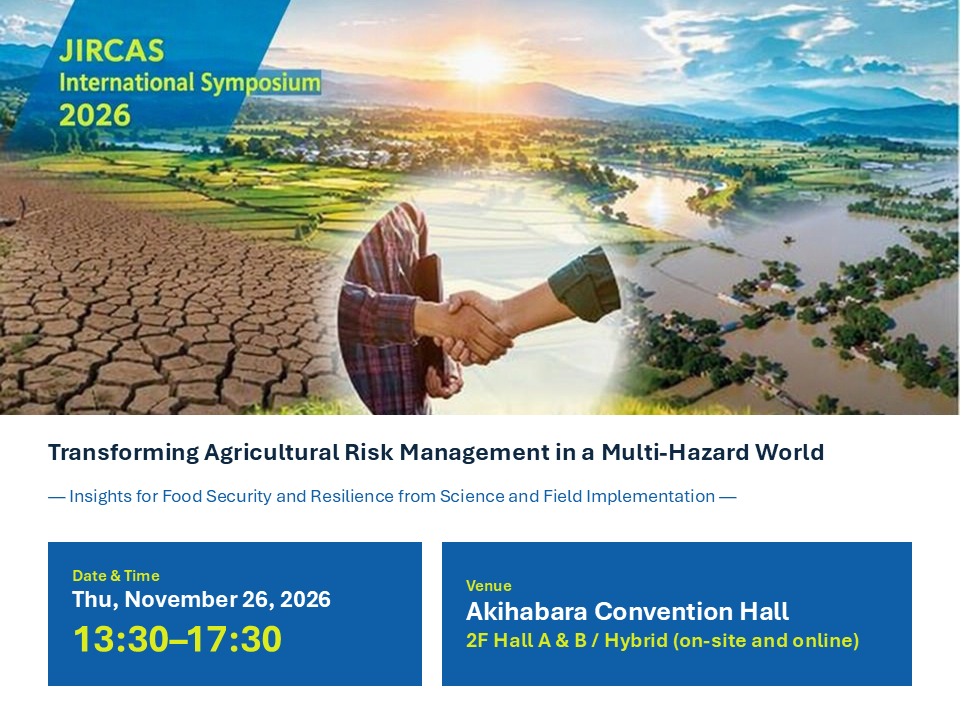
To share knowledge and practical examples related to these challenges, JIRCAS will hold the JIRCAS International Symposium 2026, "Tackling Agricultural Risks in the Era of Multi-Hazards: Learning from Science, Technology and Innovation and On-the-Ground Implementation", on Thursday, 26 November.
The keynote lectures will address the role of climate services and multi-hazard early warning systems, and integrated risk management for climate-resilient agriculture. The following sessions will present cases on extreme weather in Japan, climate information and farmers' decision-making in Nepal, and the development of yield-enhancing technologies for smallholder rice farmers in sub-Saharan Africa. In addition, the panel session will discuss scaling up on-the-ground implementation and promoting international collaboration.
We hope this will be an opportunity for everyone to consider together what is needed to connect climate information and science and technology to action in the agricultural field and to build resilient food and agricultural systems. We look forward to your participation.
JIRCAS International Symposium 2026: Event Overview
Title: Tackling Agricultural Risks in the Era of Multi-Hazards – Learning from Science, Technology and Innovation and On-the-Ground Implementation –
Date and time: Thursday, 26 November 2026, 13:30–17:30 (JST)
Venue: Akihabara Convention Hall, 2F Halls A and B (1-18-13 Sotokanda, Chiyoda-ku, Tokyo) / Hybrid format with online participation
Languages: Japanese and English (simultaneous interpretation provided)
Participation fee: Free (open to everyone)
How to register: Please apply using the registration form in the event announcement on the JIRCAS website.
Registration deadline: Tuesday, 24 November 2026, 17:00 (JST)
URL: https://www.jircas.go.jp/ja/symposium/2026/e20261126_jircas
References
UNDRR & WMO. “Early warning protection expands worldwide.” Press Release, 11 November 2026. / Global Status of Multi-Hazard Early Warning Systems 2026.
UNFCCC. “UN Climate Change Conference - Antalya, November 2026.” https://unfccc.int/cop31