



Environment and Resources
Development of technologies for environmental impact reduction and resource recycling
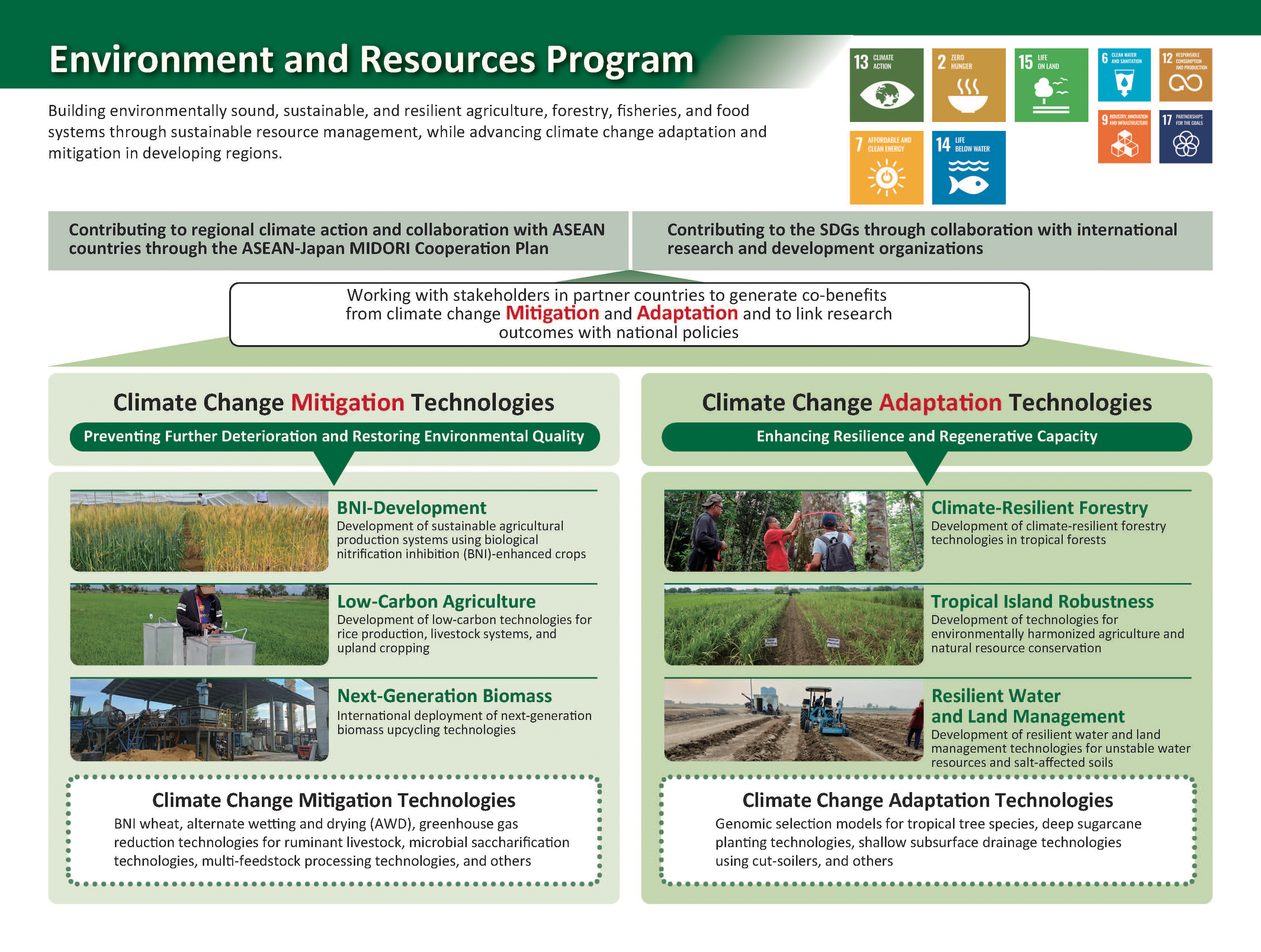
The global environment is currently facing unprecedented challenges. Many of the planetary boundaries that define the Earth's safe operating limits have already been exceeded, reducing the resilience of environmental systems. At the same time, growing geopolitical instability has made international cooperation on environmental protection and resource management more difficult, while environmental degradation and food insecurity are becoming increasingly severe in developing regions.
The Environment and Natural Resources Program focuses on the interconnections among agriculture, forests, water resources, and other natural resources, recognizing that these challenges must be addressed through an integrated approach rather than in isolation. The program explores pathways to advance both climate change mitigation and adaptation while balancing environmental conservation and agricultural production. By linking field-level technological innovation with policy development and contributing to international frameworks such as the Sustainable Development Goals (SDGs) and the ASEAN-Japan MIDORI Cooperation Plan, the program aims to support sustainable resource management and build environmentally sound, sustainable, and resilient agri-food systems in developing regions.
Specifically, the program conducts research on the development of environmentally friendly crops, efficient resource use through integrated rice, upland cropping, and livestock systems, utilization of underused biomass resources, climate-resilient forest management, natural resource management in island regions, and water-saving agricultural technologies.
The outcomes of this research will be disseminated as practical technologies that can be applied in the field and will also contribute to international policy development. Through collaboration with researchers, local communities, and other stakeholders around the world, the program seeks to advance sustainable food systems that are in harmony with the environment.
Related JIRCAS Report

Exhibit at MAHA 2026 Highlights Progress Toward Social Implementation of Next-Generation Biomass Technologies
The Japan International Research Center for Agricultural Sciences (JIRCAS), in cooperation with Universiti Sains Malaysia (USM), exhibited at the “Malaysia Agriculture, Horticulture and Agrotourism Show 2026 (MAHA 2026),” held in Malaysia from August 28 to September 1, 2026. JIRCAS showcased research achievements and recent initiatives aimed at the social implementation of next-generation biomass technologies that promote the effective utilization of underutilized biomass resources.

Report on the Exhibit and Lecture on Palm Oil and Environmental Issues at the “Children’s Kasumigaseki Tour Day 2026”
On July 29, 2026, the “Children’s Kasumigaseki Tour Day 2026,” hosted by the Ministry of Education, Culture, Sports, Science and Technology (MEXT), was held at the ministry’s headquarters in Chiyoda Ward, Tokyo. The event attracted numerous visitors, particularly families with children. The Japan International Research Center for Agricultural Sciences (JIRCAS) cooperated in the Tsukuba City exhibition booth titled “Save the Earth with Potato Chip Oil! An SOS from the Tropical Rainforest: Solving Tough Challenges with Cutting-Edge Technology and Innovative Ideas.” Dr. OMORI Keisuke, Director of the Information and Strategy Program at JIRCAS, served as lecturer.
Press Release
Events
Japan–IRRI Strategic Forum and Technical Workshop on Heat-Resilient Rice Systems
Registration period:
-
(JST)
- Place
-
2026-10-13: Hitotsubashi Hall (2F, National Center of Sciences Building, 2-1-2 Hitotsubashi,Chiyoda-ku,Tokyo 101-8439, Japan) 2026-10-14: IINO Conference Center (4F, IINO BUILDING, 2-1-1 Uchisaiwaicho, Chiyoda-ku, Tokyo 100-0011, Japan) *All sessions will be held in person

Field
-
 Pick Up
1571. IRRI: Supporting Rice Research Worldwide—Working with Japan to Address Rice Production under Climate Change
Rice, an essential part of the Japanese diet, is not immune to the effects of climate change. Rice production worldwide must simultaneously address multiple challenges, including high temperatures, water scarcity, pests and diseases, and the need to reduce environmental impacts and greenhouse gas emissions. One institution that has long tackled these issues internationally is the International Rice Research Institute (IRRI), headquartered in the Philippines. Japan and IRRI have worked together for more than 60 years through rice research and exchanges among researchers.
In October 2026, IRRI, the Japan International Research Center for Agricultural Sciences (JIRCAS), and the National Agriculture and Food Research Organization (NARO) will jointly hold the International Strategy Forum and Technical Workshop on Heat-Resilient Rice Production Systems in Tokyo. This article introduces IRRI’s role and the history of its cooperation with Japan, while considering the research partnerships that will be important for rice production under a changing climate.
-
 Pick Up
1570. Protecting Rice from Heat: Understanding Heat-Induced Sterility and Building Heat-Resilient Rice Production Systems
Japan’s annual mean temperature has risen over the long term, and the Japan Meteorological Agency reports that unusually warm years have occurred frequently since the 1990s. How do rising temperatures and heat waves associated with climate change affect rice yield and quality? This article explains how heat-induced sterility occurs and why it is important to combine heat-tolerant varieties, crop management, climate-impact assessment, and future projections. On October 13 and 14, the International Rice Research Institute (IRRI), JIRCAS, and the National Agriculture and Food Research Organization (NARO) will jointly hold an international forum and technical workshop to discuss research priorities and directions for international collaboration toward heat-resilient rice production systems.