



Pick Up
1570. Protecting Rice from Heat: Understanding Heat-Induced Sterility and Building Heat-Resilient Rice Production Systems
Related Research Program
Environment and Resources
Food and Nutrition
Information and Strategy
Environment
Food
Information
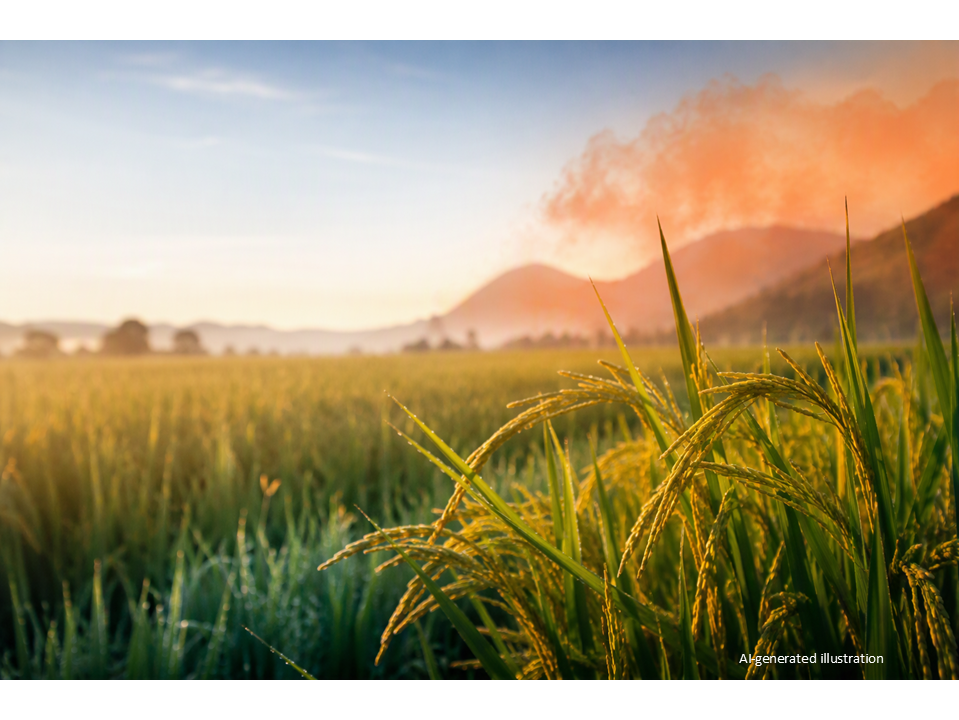
1570. Protecting Rice from Heat: Understanding Heat-Induced Sterility and Building Heat-Resilient Rice Production Systems
What Is Heat-Induced Sterility?
Japan’s annual mean temperature has risen over the long term, with hot years becoming increasingly frequent. According to the Japan Meteorological Agency, Japan’s annual mean temperature increased at a rate of 1.44°C per century between 1898 and 2025. Summer heat affects not only daily life but also agriculture. Rice is particularly vulnerable to high temperatures during flowering, when the florets open and pollination occurs. Exposure to extreme heat at flowering can disrupt pollen release and pollination, increasing the number of unfilled grains. This phenomenon is known as heat-induced sterility.
Its occurrence depends not only on air temperature but also on humidity, wind, solar radiation, and field conditions. Accurately assessing heat impacts and designing location-specific responses therefore require an understanding of the actual heat stress experienced by the rice plant.
Measuring the Effects of Heat
A research group involving NARO, JIRCAS, Gifu University, and Shimane University showed that the temperature of rice panicles during flowering—known as panicle temperature—is a key indicator for assessing heat-induced sterility. Using paddy-field micrometeorological observations from 11 countries and regions across Asia, Africa, and the Americas, the researchers analyzed the relationship between panicle temperature and heat-induced sterility. Their results showed that areas with high air temperatures do not necessarily coincide with areas where panicle temperatures rise enough to increase sterility risk. Under hot and humid conditions in particular, evaporative cooling is limited and panicle temperatures are estimated to rise more readily. These findings are expected to improve both present-day risk assessment and future yield projections, while also supporting the design of locally appropriate countermeasures.
Flowering Before the Day Heats Up
Alongside research to clarify the mechanisms and distribution of heat-induced sterility, breeders are developing varieties that can avoid the hottest part of the day. One promising trait is early-morning flowering, which causes rice florets to open earlier than usual.
Rice generally flowers between about 10:00 a.m. and noon, while temperatures are climbing toward the daily maximum. If flowering can occur earlier, when conditions are cooler, heat-induced sterility may be reduced.
In June 2026, an international research team led by NARO and JIRCAS announced the discovery of a new gene, Early Morning Flowering 3 (EMF3), which regulates flowering time in rice. Takasaki University of Health and Welfare, Kibi International University, IRRI, and the University of Tokyo also participated in the research.
The team showed that rice plants carrying a specific single-nucleotide substitution in the EMF3 gene on chromosome 3 flowered about two hours earlier than the usual 10:00 a.m.–noon period. In trials where temperatures rose through the morning and reached 38°C at noon, early-morning-flowering rice showed a smaller decline in seed set under heat stress than conventional rice.
The findings indicate that breeding for early-morning flowering could become a promising way to reduce heat-induced sterility. Practical application, however, will require further testing and breeding that take account of local climates, cropping systems, and varietal characteristics.
Combining Multiple Approaches
Early-morning flowering is one option for addressing heat-induced sterility. Reducing heat damage, however, requires more than a single technology: multiple measures must be combined according to local conditions. Along with breeding heat-tolerant varieties, these measures may include water management, adjustments to planting and cropping schedules, research on crop physiological responses, field-environment monitoring, remote sensing, and digital technologies.
It is also important to use climate projections and crop models to assess where, when, and to what extent heat risks may increase. Estimating future warming and its effects on rice production can help researchers and producers prepare suitable varieties, crop-management techniques, and observation and analytical systems well in advance.
Connecting Knowledge and People Internationally
Accelerating responses to heat stress requires linking expertise in breeding, agronomy, crop physiology, climate science, modeling, geospatial analysis, and digital technology. Because heat damage varies with local climate, cropping systems, and varieties, international research networks are essential for sharing, comparing, and applying data and experience from different regions. IRRI, headquartered in the Philippines, is one of the leading institutions in this network. Cooperation between Japan and IRRI began in 1960 and has supported researcher exchanges and joint studies in breeding, pathology, crop physiology, agronomy, the social sciences, and other fields. The value of international research collaboration goes beyond sharing results: it also enables partners to share research infrastructure, data, and analytical methods, while giving early-career researchers experience in an international environment that can feed into future collaboration and capacity development.
Turning Research into the Next Collaboration
Protecting rice from heat requires understanding the causes of heat-induced sterility, developing heat-tolerant varieties and crop-management practices, and integrating observation, forecasting, breeding, agronomy, and digital technologies with future climate risks in mind. It is equally important to connect knowledge and people across countries and disciplines and to build mechanisms for sustained research cooperation.
To advance discussion of these challenges, IRRI, JIRCAS, and NARO will jointly convene the International Strategic Forum and Technical Workshop on Heat-Resilient Rice Production Systems in Tokyo on October 13–14, 2026.
The International Strategic Forum on October 13 will discuss challenges facing rice production under climate change, priority research areas, and directions for international collaboration. At the Technical Workshop on October 14, researchers and technical experts from Japan and IRRI will share research findings, scientific resources, data, and analytical methods, and explore opportunities for joint research and researcher exchange.
For event details and registration, please visit the JIRCAS event page. Registration closes at 5:00 p.m. on Wednesday, October 7.
Date 2026-10-13(Tue) - 2026-10-14(Wed) (JST)
Japan–IRRI Strategic Forum and Technical Workshop on Heat-Resilient Rice Systems
Registration period: 2026-8-17(Mon) 14:00 - 2026-10-7(Wed) 17:00 (JST)
Place
2026-10-13: Hitotsubashi Hall (2F, National Center of Sciences Building, 2-1-2 Hitotsubashi,Chiyoda-ku,Tokyo 101-8439, Japan) 2026-10-14: IINO Conference Center (4F, IINO BUILDING, 2-1-1 Uchisaiwaicho, Chiyoda-ku, Tokyo 100-0011, Japan) *All sessions will be held in person
https://www.jircas.go.jp/ja/event/2026/e20261013
References
Japan Meteorological Agency. “Annual Mean Temperature in Japan.”
https://www.data.jma.go.jp/cpdinfo/temp/an_jpn.html
NARO, JIRCAS, Gifu University, and Shimane University (2022). “Humidity strongly affects increases in panicle temperature that cause heat-induced sterility in rice: An international observation network reveals the actual conditions of heat-induced sterility.”
https://www.naro.go.jp/publicity_report/press/laboratory/niaes/154560.h…
NARO et al. (2026). “Discovery of a gene controlling rice flowering time: Reducing heat-induced sterility under high temperatures and contributing to stable rice production.”
https://www.naro.go.jp/publicity_report/press/laboratory/carc/176068.ht…
Intergovernmental Panel on Climate Change (2023). Climate Change 2023: Synthesis Report.
https://www.ipcc.ch/report/ar6/syr/
Kato, Y. and Hayashi, K. (2021). “Japan and IRRI: Contributions to International Rice Research for Sustainable Development, Lessons Learned and Ways Forward.” JARQ, 55 (Special), 483–487.
https://www.jircas.go.jp/ja/publication/jarq/20ss13
Contributors: Keiichi Hayashi, Environment and Resources Program; Keisuke Omori, Information and Strategy Program; Miyuki Iiyama, Strategic Coordination Office