



Food and Nutrition
Development of technologies for stable food supply and improved nutrition
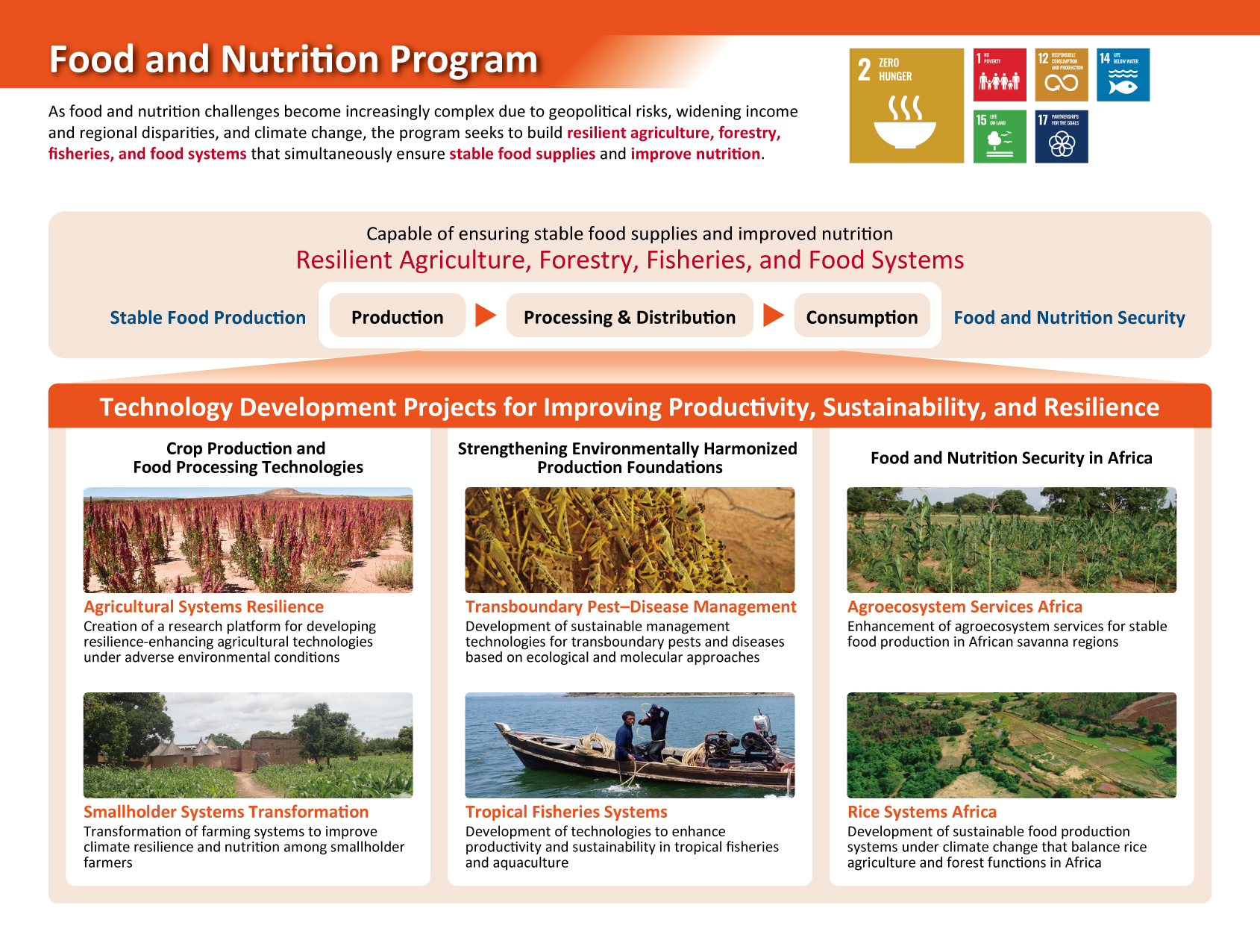
The global food security landscape is changing rapidly due to climate change, population growth, and increasing geopolitical risks. In developing regions, production systems are becoming more vulnerable because of drought, soil salinity, the spread of pests and diseases, and declining aquatic resources. At the same time, challenges such as undernutrition, micronutrient deficiencies, and food loss are becoming more severe. Building resilient food systems that can ensure both stable food supplies and improved nutrition is therefore an urgent priority.
The Food and Nutrition Program promotes research that contributes to enhanced productivity, sustainability, and resilience, building on excellence in scientific discovery. The program addresses diverse aspects of food systems, including the development of climate-resilient crops and cultivation technologies, breeding materials adapted to harsh environments, sustainable management of transboundary pests and diseases, innovations in livestock and fisheries production, and technologies that add value to food products while improving processing and preservation. In addition, the program places strong emphasis on fundamental research using genomics, molecular biology, omics technologies, and data science to discover new biological mechanisms and principles, and to generate innovative technologies and breeding materials. The program also focuses on agricultural ecosystem services that support crop production, including soil fertility, nutrient cycling, carbon sequestration, water use, and biodiversity, thereby contributing to the achievement of both environmental conservation and sustainable food production.
Research outcomes are translated into practical applications through international collaborative research and demonstration activities conducted in partnership with research institutions, international organizations, universities, and private-sector companies in developing regions. These outcomes also contribute to evidence-based policymaking and the dissemination of innovative technologies. Through research and development spanning from scientific discovery to societal implementation, the program aims to strengthen global food security and improve nutrition while advancing sustainable and resilient agriculture, forestry, fisheries, and food systems in the face of climate change.
Related JIRCAS Report

JIRCAS President Hasegawa Speaks at the CoolRice Project Kick-Off Meeting
On June 29, 2026, the “IRRI–MAFF CoolRice Project Kick-Off Meeting” was held at the headquarters of the International Rice Research Institute (IRRI) in Los Baños, Philippines. Dr. HASEGAWA Toshihiro, President of the Japan International Research Center for Agricultural Sciences (JIRCAS), gave a presentation.
Field
-
 Pick Up
1571. IRRI: Supporting Rice Research Worldwide—Working with Japan to Address Rice Production under Climate Change
Rice, an essential part of the Japanese diet, is not immune to the effects of climate change. Rice production worldwide must simultaneously address multiple challenges, including high temperatures, water scarcity, pests and diseases, and the need to reduce environmental impacts and greenhouse gas emissions. One institution that has long tackled these issues internationally is the International Rice Research Institute (IRRI), headquartered in the Philippines. Japan and IRRI have worked together for more than 60 years through rice research and exchanges among researchers.
In October 2026, IRRI, the Japan International Research Center for Agricultural Sciences (JIRCAS), and the National Agriculture and Food Research Organization (NARO) will jointly hold the International Strategy Forum and Technical Workshop on Heat-Resilient Rice Production Systems in Tokyo. This article introduces IRRI’s role and the history of its cooperation with Japan, while considering the research partnerships that will be important for rice production under a changing climate.
-
 Pick Up
1570. Protecting Rice from Heat: Understanding Heat-Induced Sterility and Building Heat-Resilient Rice Production Systems
Japan’s annual mean temperature has risen over the long term, and the Japan Meteorological Agency reports that unusually warm years have occurred frequently since the 1990s. How do rising temperatures and heat waves associated with climate change affect rice yield and quality? This article explains how heat-induced sterility occurs and why it is important to combine heat-tolerant varieties, crop management, climate-impact assessment, and future projections. On October 13 and 14, the International Rice Research Institute (IRRI), JIRCAS, and the National Agriculture and Food Research Organization (NARO) will jointly hold an international forum and technical workshop to discuss research priorities and directions for international collaboration toward heat-resilient rice production systems.