


Pick Up
1578. Preparing for Agricultural Risks in the Era of Multi-Hazards – Adaptation to Climate Change and On-the-Ground Implementation, Viewed through COP31 and the Latest Research –
Related Research Program
6th Medium to Long-Term Plan
Environment and Resources
Food and Nutrition
Information and Strategy
Information
1578. Preparing for Agricultural Risks in the Era of Multi-Hazards – Adaptation to Climate Change and On-the-Ground Implementation, Viewed through COP31 and the Latest Research –
The 31st session of the Conference of the Parties to the United Nations Framework Convention on Climate Change (COP31) is being held in Antalya, Türkiye, from November 9 to 20. The COP31 Presidency, Türkiye, has positioned food security as one of the priority areas of its Action Agenda. Within this area, it has made building “Climate-Resilient Agriculture,” which protects producers from drought, floods, and changing climate conditions, a priority, and says it will support the scaling up and wider dissemination of practices and technologies for adaptation.
Meanwhile, the International Centre for Integrated Mountain Development (ICIMOD) has drawn attention to events such as the large-scale flood involving a glacier collapse that occurred in Nepal in August this year, pointing to the threat that disasters in mountain regions pose to downstream water and food security. In addition, a report by the International Cryosphere Climate Initiative (ICCI) and the United Nations Environment Programme (UNEP), which the Centre has introduced, explains that the scale and duration of an “overshoot,” in which global temperature rise temporarily exceeds 1.5°C above pre-industrial levels, will determine how much damage becomes irreversible.
Given this situation, how should agriculture prepare for multiple hazards (phenomena that can cause damage)? This article introduces findings from the latest research and then considers the challenges of adaptation in the field.
Where Are Farmlands Threatened, and by What? – Insights from the Latest Research
A useful starting point for this question is a paper by Tabari and Hosseinzadehtalaei (Nature Communications 17:7706, 2026). The authors assessed the exposure of the world’s farmland and 10 major crops and crop groups to four types of hazards: heatwaves, droughts, floods, and compound hot and dry events. They combined this with country-level vulnerability indicators built from socioeconomic and institutional indicators to analyze future agricultural risk. Here, exposure refers to the degree to which farmland is subject to these phenomena, and the study evaluates it using the distribution of farmland and the probability of occurrence of each phenomenon.
The results indicate that exposure to multiple hazards may increase across wide areas of the world. Under the highest-emission scenario analyzed (SSP5-8.5), exposure is projected to increase by the end of the 21st century, compared with the end of the 20th century, on 85% of the world’s farmland for heatwaves, 91% for compound hot and dry events, 53% for droughts, and 72% for floods. These figures are the shares of farmland where exposure to each hazard increases; they do not indicate the share of farmland that will be damaged or the rate of yield decline.
The regions with particularly large increases in exposure include South Asia, sub-Saharan Africa, and the breadbasket regions of the United States and Europe. Among individual crops, maize and rice show large exposure. In contrast, under the low-emission scenario (SSP1-2.6), the share of farmland with increased exposure and the extent of the increase are kept smaller for all four types of hazards. The authors state that these differences between scenarios show the importance of reducing greenhouse gas emissions, that is, mitigation, in protecting food production.
Another important result is that a statistically significant relationship between farmland exposure and national vulnerability, which was not found in the past period analyzed, appears in many future scenario–hazard combinations. However, no significant relationship was found for drought and compound hot and dry events under SSP5-8.5. In addition, under the same scenario, the median farmland exposure in highly vulnerable countries is reported to be 1.1 to 3.3 times that in less vulnerable countries.
The authors argue that agricultural risk is determined not only by weather phenomena themselves but also by socioeconomic conditions, institutions, and human-resource capacity. As specific examples, they cite the roles of governance, education and extension, the maintenance of irrigation and drainage, and early warning systems. However, because the vulnerability indicators in this study are calculated at the national level, differences within countries are not fully reflected. The authors also state that assessments at finer scales, such as states, prefectures, or districts, are needed to capture local adaptive capacity.
Connecting International Discussions with Farm Fields – Considerations in This Article
Based on the Presidency’s Action Agenda and the research findings introduced so far, we believe that realizing “climate-resilient agriculture” requires not only understanding exposure to hazards but also paying attention to the social conditions that make people more susceptible to damage. This is also an important perspective for connecting international policy goals with responses in agricultural fields.
In this article, we regard the realization of resilient agriculture as creating a situation in which practices and technologies useful for adaptation not only exist but also reach farmers and are used according to local conditions. For example, what is needed are mechanisms in which climate information helps farmers make decisions and early warnings lead to advance preparation and action.
In a situation where multiple hazards occur simultaneously or in succession and their impacts cascade and amplify, there are challenges that responses focusing only on a single disaster or crop cannot capture. Would it not help reduce risks in the field to consider technologies suited to local conditions together with the people and institutions that use them?
Toward Discussions on Field Implementation at the International Symposium
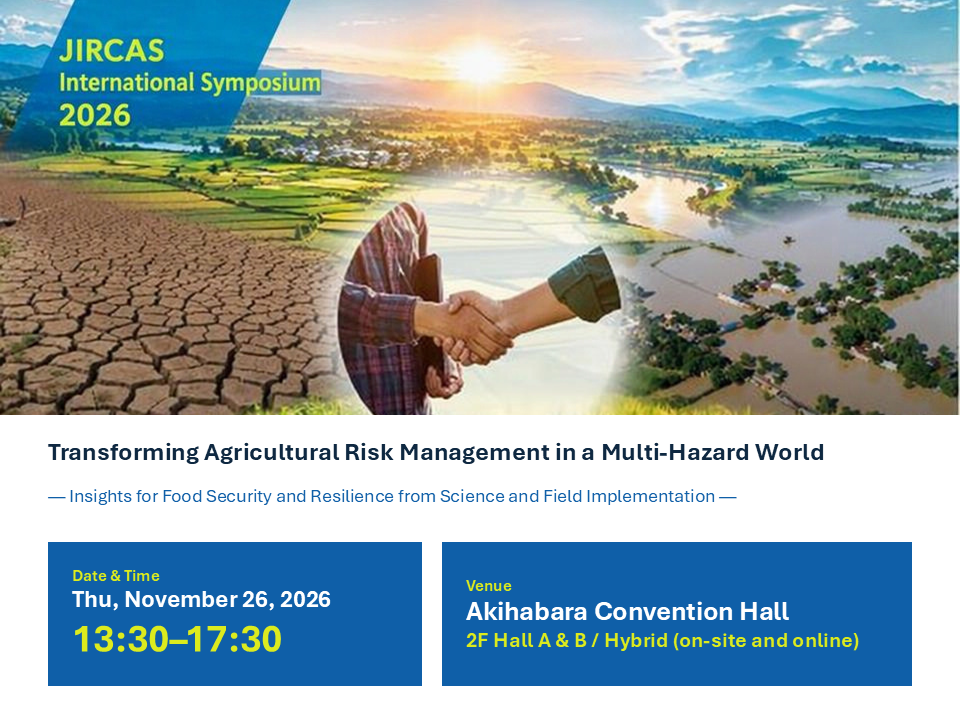
To discuss responses to these compound risks and the implementation of research outcomes in the field, JIRCAS will hold the JIRCAS International Symposium 2026, “Tackling Agricultural Risks in the Era of Multi-Hazards – Learning from Science, Technology and Innovation and On-the-Ground Implementation,” on Thursday, November 26. Taking place six days after the scheduled close of COP31, it is an opportunity to consider ways to connect science and technology with agricultural fields.
The keynote lectures will address climate services, early warning systems for multiple disasters, and compound risk management toward climate-resilient agriculture. The following sessions will introduce extreme weather in Japan, climate information and farmers’ decision-making in Nepal, and the development of yield-increasing technologies for smallholder rice farmers in sub-Saharan Africa. In the panel session, participants will discuss expanding field implementation and promoting international collaboration.
Alongside the discussions at COP31, why not consider ways to turn preparedness for agricultural risks into action in the field? We look forward to your participation.
JIRCAS International Symposium 2026
“Transforming Agricultural Risk Management in a Multi-Hazard World— Insights for Food Security and Resilience from Science and Field Implementation —”
Date and time: Thursday, 26 November 2026, 13:30–17:30
Venue: Halls A and B, 2nd floor, Akihabara Convention Hall (1-18-13 Sotokanda, Chiyoda-ku, Tokyo)
Format: Hybrid, combining in-person and online participation
Languages: Japanese and English (simultaneous interpretation provided)
Participation fee: Free (open to all)
Registration: Please register through the JIRCAS website.
URL: https://www.jircas.go.jp/ja/symposium/2026/e20261126_jircas
References
Tabari, H. & Hosseinzadehtalaei, P. “Multi-hazard exposure and vulnerability drive rising agricultural risk in global breadbasket regions.” Nature Communications 17, 7706 (2026). https://doi.org/10.1038/s41467-026-74617-5
UNFCCC. “UN Climate Change Conference - Antalya, November 2026.” https://unfccc.int/cop31
COP31 Türkiye. “Food Security.” COP31 Action Agenda. https://cop31.tr/action-plan/food-security
ICIMOD. “COP31 – Nepal and Bhutan sound the alarm on collapsing Himalayan glaciers.” 12 November 2026. https://www.icimod.org/press-release/cop31-nepal-and-bhutan-sound-the-a…