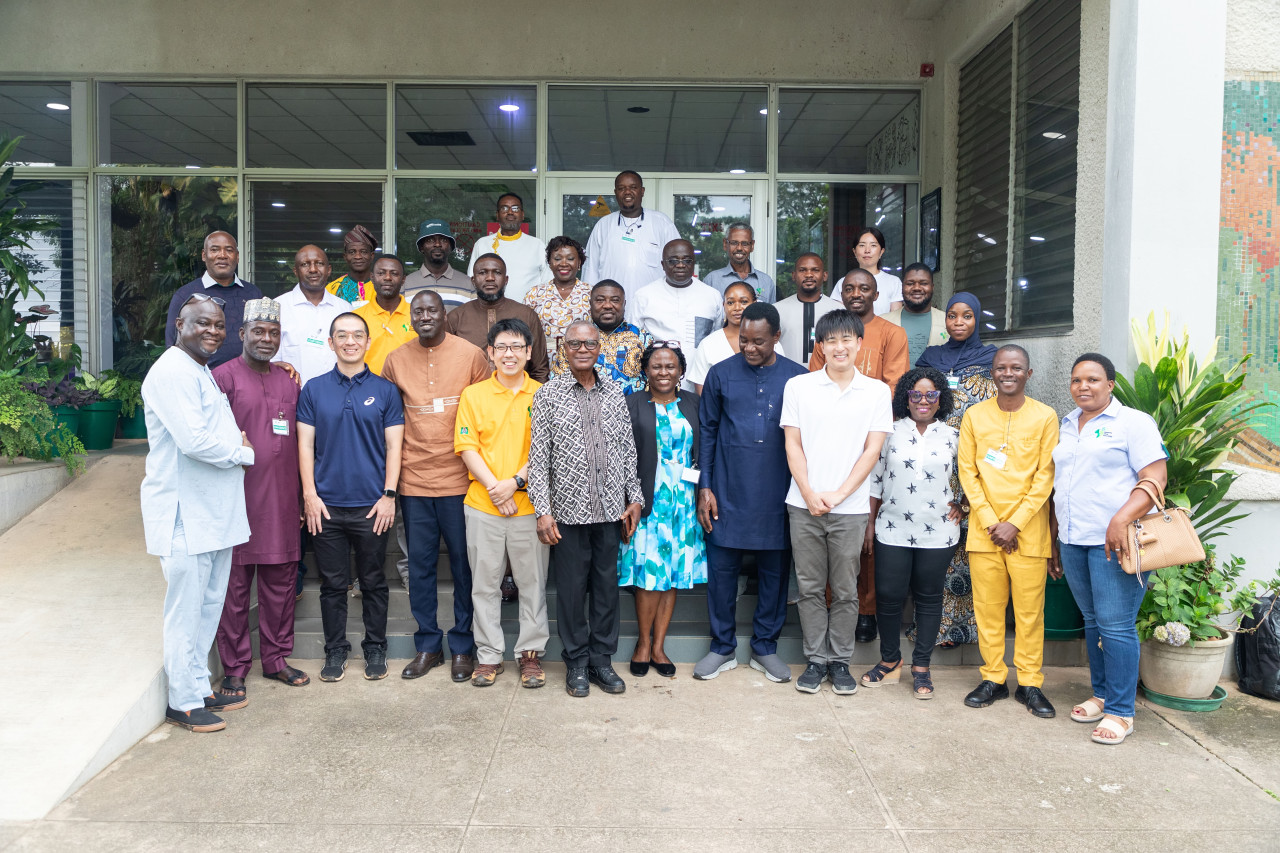




On August 27 and 28, 2026, the Japan International Research Center for Agricultural Sciences (JIRCAS) held a workshop for the TERRA Africa Project at the headquarters of the International Institute of Tropical Agriculture (IITA) in Ibadan, Nigeria. The workshop, themed “Strengthening Science-Based Regenerative Agriculture Packages for Sustainable Farming Systems in Africa,” was attended by approximately 35 researchers and stakeholders from Japan, Ghana, Nigeria, Mali, Uganda, and Ethiopia, including representatives from the Sasakawa Africa Association (SAA), universities, national research institutions, IITA, and the Forum for Agricultural Research in Africa (FARA). An additional 10 participants joined online.
Now in its fourth year, the TERRA Africa Project has so far focused on evaluating individual agricultural technologies. Building on these achievements, the workshop discussed the next phase of the project: advancing research toward the development and implementation of scientifically validated, economically feasible, and locally adapted regenerative agriculture (RA) packages. Over the two-day workshop, participating countries presented research findings and case studies. Discussions covered a wide range of RA technologies, including the Fallow Band System, conservation agriculture, green manure, nutrient management using compost and phosphate rock, biochar, spent mushroom substrate, irrigation management, and crop-livestock integration. JIRCAS presented the research framework of the TERRA Africa Project and research results obtained in Ghana, highlighting the importance of combining validated technologies according to local conditions and utilizing them as practical RA packages.
Through the discussions, participants agreed that RA packages should not be designed as a one-size-fits-all model, but rather adapted to the agroecological conditions, farming systems, and circumstances of farmers in each target region. They also confirmed that productivity, soil health, and profitability are key criteria for evaluating the performance and feasibility of RA packages. Participants further discussed the need to take into account practical factors affecting technology adoption by farmers, including labor availability, locally available resources, adoption and production costs, and economic viability.
Country teams from SAA in Mali, Uganda, Nigeria, and Ethiopia presented updates on their 2026 activities, technology adoption efforts, and collaboration with farmers. Common challenges identified across countries included climate-related risks, limited soil analysis capacity, securing materials required for compost production, maintaining demonstration plots, data collection, and economic assessment. The workshop also highlighted the importance of strengthening links between research institutions and on-farm demonstration activities, as well as improving data collection, monitoring, and dissemination of results through the use of digital technologies and capacity development.
Representatives of The Nippon Foundation expressed their appreciation for the efforts of researchers and SAA country teams working to develop RA approaches suited to African conditions. They also expressed their expectations that project activities would progress from technology development and testing toward the practical application and dissemination of regionally adapted RA packages.
The workshop further strengthened collaboration among TERRA Africa participating institutions and helped establish a shared understanding of the project's future direction. Based on the outcomes of the workshop, efforts will continue to refine RA packages for the 2027 cropping season while advancing research, field validation, evaluation, capacity building, and dissemination activities.