



Pick Up
1574. Intensifying El Niño and Risks to Food and Agriculture—Turning Climate Forecasts into Preparedness and Action

1574. Intensifying El Niño and Risks to Food and Agriculture—Turning Climate Forecasts into Preparedness and Action
The Copernicus Climate Change Service (C3S) reported that the global average temperature in September 2026 was 1.63°C above the estimated pre-industrial average for 1850–1900. In its ERA5 reanalysis dataset, this made September 2026 the second warmest September on record. The average sea surface temperature between 60°S and 60°N was 21.05°C, the highest ever recorded for September. The announcement also reported that El Niño was intensifying in the tropical Pacific.
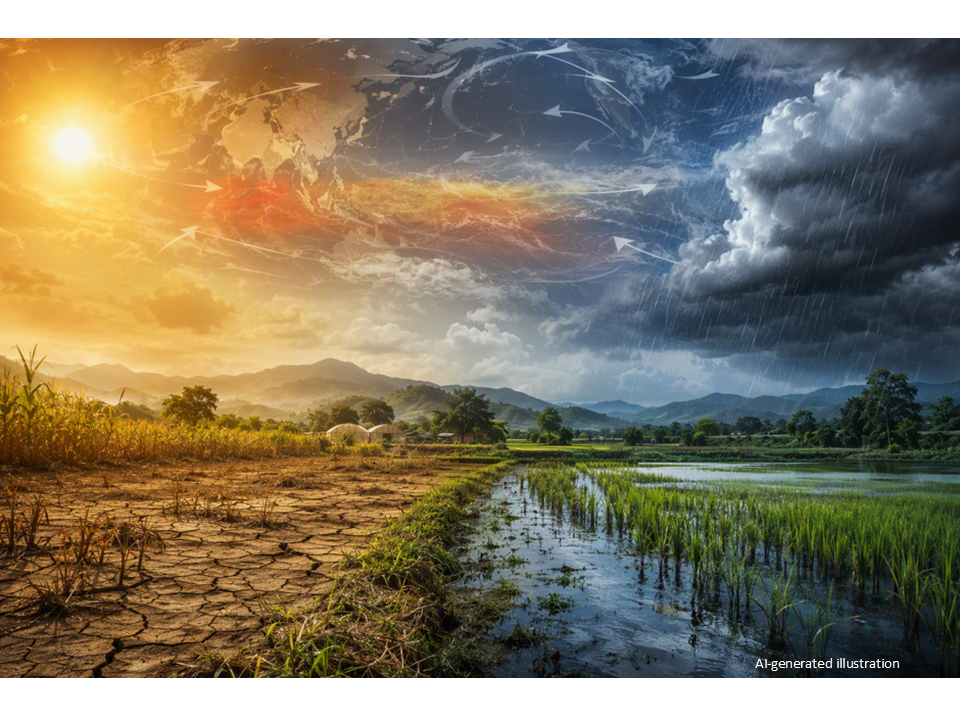
In an article published on 16 October 2026, World Food Day, the World Meteorological Organization (WMO) explained that the strengthening El Niño was altering rainfall patterns around the world and affecting agriculture, fisheries, and food production through drought and heavy rainfall. These impacts, however, are not uniform. WMO noted that they vary by region and season, as well as according to existing environmental conditions and other climate drivers.
According to the article, rainfall deficits from June to September 2026 caused low soil moisture and vegetation stress in the northern Greater Horn of Africa. By contrast, above-normal rainfall is forecast from October to December in equatorial and southern parts of the region. While increased rainfall can help secure water for crops and livestock, WMO warned that excessive rainfall raises the risks of flooding, landslides, and agricultural damage.
In South Asia, rainfall deficits were observed in several areas during the June–September monsoon season, while the rainfall outlook for October–December differs by location. For South America, WMO also described contrasting El Niño patterns: northern Brazil tends to become drier, whereas southern Brazil tends to receive more rainfall from September to January.
To respond to these regional and seasonal differences, WMO highlighted efforts to translate regional seasonal forecasts and national forecasts into information that supports specific decisions. Such practical use of climate science can help farmers determine planting dates, humanitarian agencies prepare emergency assistance, and governments plan water management.
In light of these reports, we believe it is essential not merely to communicate forecasts, but to connect them with preparedness and action tailored to local farming conditions and user needs. Responses to the effects of El Niño should also be viewed as an opportunity to consider broader agricultural risk management.
JIRCAS International Symposium 2026, Addressing Agricultural Risks in an Era of Multiple Hazards—Learning from Science, Technology and Innovation and Their Implementation in the Field, will address risks arising when multiple hazards occur simultaneously or in succession and their impacts cascade and intensify. The scope extends beyond extreme heat, drought, and floods to include pests and diseases and instability in the supply of agricultural inputs. The symposium will be held in a hybrid format at Akihabara Convention Hall and online on Thursday, 26 November 2026.
JIRCAS International Symposium 2026
“Addressing Agricultural Risks in an Era of Multiple Hazards—Learning from Science, Technology and Innovation and Their Implementation in the Field”
Date and time: Thursday, 26 November 2026, 13:30–17:30
Venue: Halls A and B, 2nd floor, Akihabara Convention Hall (1-18-13 Sotokanda, Chiyoda-ku, Tokyo)
Format: Hybrid, combining in-person and online participation
Languages: Japanese and English (simultaneous interpretation provided)
Participation fee: Free (open to all)
Registration: Please register through the JIRCAS website.
URL: https://www.jircas.go.jp/ja/symposium/2026/e20261126_jircas
References
World Meteorological Organization (WMO). “El Niño looms large on World Food Day.” 16 October 2026. https://wmo.int/media/news/el-nino-looms-large-world-food-day
Copernicus Climate Change Service (C3S). “Copernicus: Second warmest September as global temperatures stay above 1.5°C.” 12 October 2026. https://climate.copernicus.eu/copernicus-second-warmest-september-globa…