



Pick Up
1561. A Potentially Unprecedented El Niño and Global Weather Risks
Related Research Program
Information
1561. A Potentially Unprecedented El Niño and Global Weather Risks
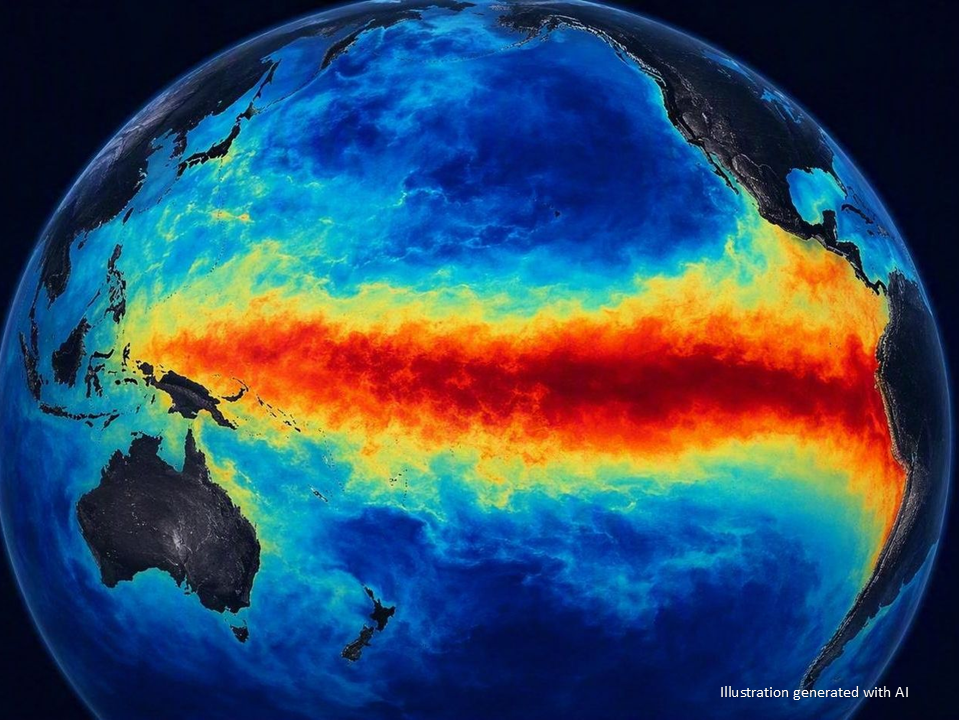
On 21 August 2026, the UK Met Office reported that the El Niño event currently developing could become an exceptional event, unprecedented in recent decades and possibly the largest since the 19th century. According to the Met Office forecast, sea-surface temperatures in the Nino3.4 region, one of the key indicators used to assess the strength of El Niño, may exceed 3°C above average in the coming months.
The Met Office explains that a typical El Niño raises equatorial Pacific sea-surface temperatures by around 1–2°C, and that even a 2°C rise would represent a very large event. If the current forecast is realized, the 2026 event could therefore far exceed the scale of El Niño events experienced in recent decades.
El Niño affects atmospheric circulation through warming of the tropical Pacific Ocean, leading to shifts in rainfall and temperature patterns around the world. In addition to the Indian summer monsoon, where rainfall has already been well below normal, the Met Office identifies Central America, west Pacific nations, and tropical South America as regions where the risk of low rainfall may increase. As El Niño strengthens toward winter, southern Africa and north-eastern Australia are also expected to face a heightened risk of drought.
At the same time, the article notes that El Niño tends to suppress Atlantic hurricanes by altering wind conditions in the tropical Atlantic. However, a lower number of hurricanes does not necessarily mean lower risk, as a single major hurricane can still cause severe damage. The Met Office also indicates that north-western Europe, including the UK, may see an increased likelihood of wetter and stormier conditions from autumn into early winter 2026.
Large El Niño events can also increase global average temperatures because heat stored in the ocean is released into the atmosphere. The Met Office notes that the global temperature impact is often most pronounced in the year following the winter peak of an El Niño event. It therefore suggests that 2027 is very likely to exceed 2024 as the warmest year on record, and that global mean temperature may temporarily rise above 1.5°C relative to pre-industrial levels.
This forecast highlights how natural climate variability, such as El Niño, can amplify weather risks when superimposed on the long-term warming trend driven by human-induced climate change. For regions concerned with agricultural production, water resources, disaster risk reduction, and food security, it will be important to continue monitoring global seasonal forecasts as well as warnings and advisories issued by national and regional meteorological agencies, and to prepare early for droughts, floods, heatwaves, and tropical cyclones.
Reference
Grahame Madge, “An ‘unprecedented’ El Niño and its implications for the weather forecast,” Met Office, 21 August 2026. https://www.metoffice.gov.uk/blog/2026/an-unprecedented-el-nio-and-its-…
Contributor: Miyuki Iiyama, Strategic Coordination Office