



Pick Up
1573. Considering the Impacts on Thai Agriculture amid Forecasts of a Major El Niño Event
Related Research Program
Information and Strategy
1573. Considering the Impacts on Thai Agriculture amid Forecasts of a Major El Niño Event
In the Pick Up article published on 24 August 2026, we introduced a UK Met Office forecast suggesting that the developing El Niño could become one of the strongest on record.
A Potentially Unprecedented El Niño and Global Weather Risks
https://www.jircas.go.jp/en/program/proc/blog/20260824
At the time, sea surface temperature anomalies in the Niño 3.4 region were projected to potentially exceed 3°C above normal over the following several months. As a typical El Niño event involves an increase of around 1–2°C, the forecast indicated the possibility of an exceptionally strong event.
Subsequently, the FAO Food Price Index released on 2 October 2026 reported that international food prices rose in September 2026 from the previous month. FAO cited weather factors, including dry and hot conditions in major producing regions, as contributing to higher prices for cereals, vegetable oils and sugar. In Southeast Asia, dry conditions also raised concerns about impacts on palm oil production.
This article reviews the potential impacts on Thai agriculture based on weather information from the Thai Meteorological Department and information reported as estimates by Krungthai COMPASS.
Impacts on Thai Agriculture
Much of Thailand’s agricultural production depends on rainfall and is therefore considered vulnerable to reduced precipitation associated with El Niño. According to the Thai Meteorological Department, Thailand’s nationwide average rainfall in August 2026 was 17% below normal. Meanwhile, the monsoon trough and tropical depressions and typhoons brought temporary heavy rainfall to the northern and northeastern regions, with flooding and landslide damage reported in some areas.
Thai media have also reported that Krungthai COMPASS, the economic and industry research unit of the state-owned Krung Thai Bank, estimates that total agricultural losses from El Niño could reach THB 62 billion, of which approximately THB 43 billion would be attributable to the rice sector.
1. Impact on Rice Production
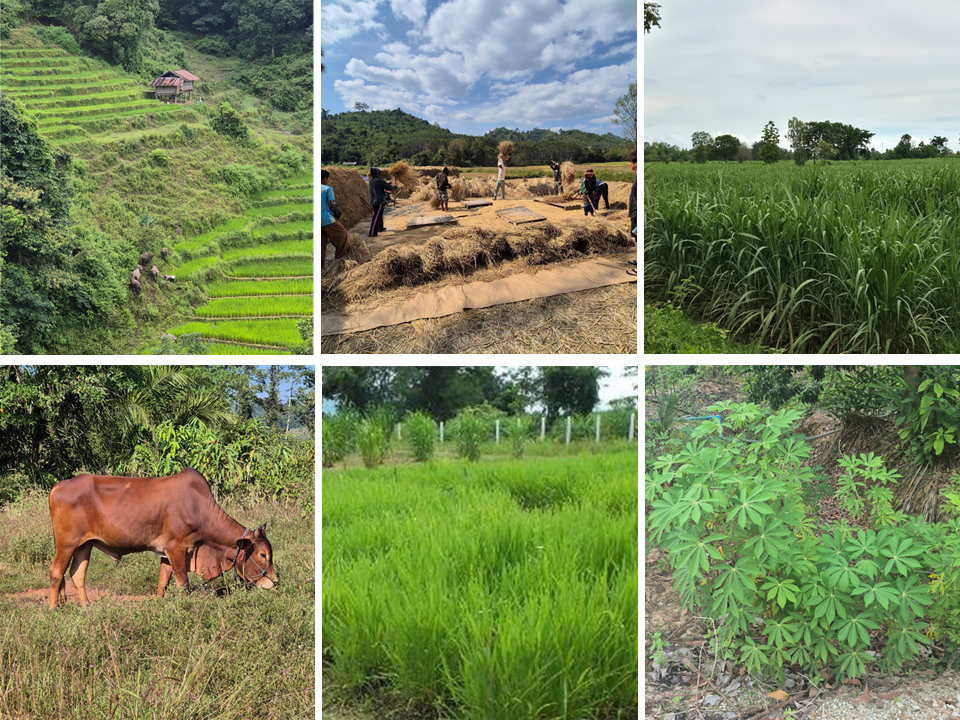
Thailand is one of the world’s leading rice exporters, and cultivation in many production areas depends on rainfall. Insufficient rainfall may delay planting, impair crop growth and reduce yields through water shortages. If reservoir levels continue to decline, securing irrigation water for dry-season cultivation may also become a challenge.
2. Impact on Cassava and Sugarcane Production
Northeastern Thailand (the Isan region) is a major production area for cassava and sugarcane. Because the region is highly dependent on rainfall, it is considered vulnerable to reduced precipitation associated with El Niño.
For cassava, attention is needed not only to drought but also to outbreaks of cassava mosaic disease. The combination of disease and water shortages could have a greater impact on production volumes and the supply of raw materials.
3. Impact on Livestock Production
In the livestock sector, reduced production of forage and feed crops is expected to become a major challenge. The Isaan region relies heavily on natural grasslands and rain-fed agricultural systems, making livestock production particularly vulnerable to prolonged dry seasons and reduced rainfall.
One possible adaptation measure for climate change and drought risk is the use of drought-tolerant forage grasses. JIRCAS, together with Thailand’s Department of Livestock Development (DLD), the National Agriculture and Food Research Organization, the University of Miyazaki and Okinawa Prefecture, developed the drought-tolerant tropical forage grass “Isan.”
Enhancing Livestock Productivity in Thailand: The Potential of the “Isan” Forage Grass
https://www.jircas.go.jp/en/program/proc/blog/20260731
If stable feed production can be maintained under dry conditions, this grass may help strengthen resilience to rainfall shortages caused by El Niño and similar events in the future.
Can Below-Normal Rainfall Coexist with Heavy Rain and Flooding?
The Thai Meteorological Department’s weather summary for August 2026 indicates that, although nationwide average rainfall was below normal, the monsoon trough and tropical depressions and typhoons brought heavy rainfall, particularly in northern and northeastern Thailand.
This suggests that below-normal average rainfall over a given period does not necessarily conflict with heavy rainfall occurring in particular places or at particular times. However, the causes of individual flood events need to be assessed separately, taking into account local rainfall, river and reservoir conditions, land use and other factors.
Reference
Krungthai COMPASS, Economic and Industry Research, Krung Thai Bank
https://krungthai.com/th/financial-partner/economy-resources/economic-r…
Thai Meteorological Department, Monthly Weather Summary, August 2026
https://tmd.go.th/en/climate/summarymonthly
Food and Agriculture Organization of the United Nations (FAO), El Niño
FAO Food Price Index, September 2026 (released 2 October 2026)
The Nation Thailand
NESDC cites potential THB62 billion El Niño damage to Thai agriculture
https://www.nationthailand.com/business/economy/40070184
(Contributor: Norihito Kanamori, Southeast Asia Liaison Office)