



Pick Up
1550. Enhancing Livestock Productivity in Thailand: The Potential of the “Isan” Forage Grass
Related Research Program
Information

1550. Enhancing Livestock Productivity in Thailand: The Potential of the “Isan” Forage Grass
In recent years, economic growth and changing dietary preferences have increased demand for milk and beef in Thailand. At the same time, livestock producers face rising feed costs and the need to adapt to the impacts of climate change.
The dairy sector maintains approximately 550,000 dairy cattle and produces around 1.2 million tons of raw milk annually (FAOSTAT). Thailand is the largest exporter of dairy products within ASEAN, and dairy exports reached approximately US$580 million in 2024, marking continued growth from the previous year (Ashu Research Inc.). Meanwhile, the beef cattle sector recorded a population of approximately 9.9 million head in 2024, with around 1.4 million farming households engaged in cattle production. Growing demand for beef has also contributed to an increase in live cattle exports (FAOSTAT; DTN, 2024).
Despite this growth, both the dairy and beef industries face a common challenge: feed supply and quality. Many farmers rely on rice straw, a by-product of rice cultivation, as their primary roughage source. However, rice straw has low nutritional value, limiting improvements in animal growth and milk production. Furthermore, dependence on imported concentrate feeds has increased production costs, making improvements in feed productivity an urgent priority. To address these issues, JIRCAS collaborated with Thailand’s Department of Livestock Development (DLD), the National Agriculture and Food Research Organization (NARO), the University of Miyazaki, and Okinawa Prefecture to develop “Isan,” a tropical forage grass variety adapted to the Asian monsoon region. The variety was officially registered in Japan in 2021 and in Thailand in 2024 (JIRCAS Press Release).
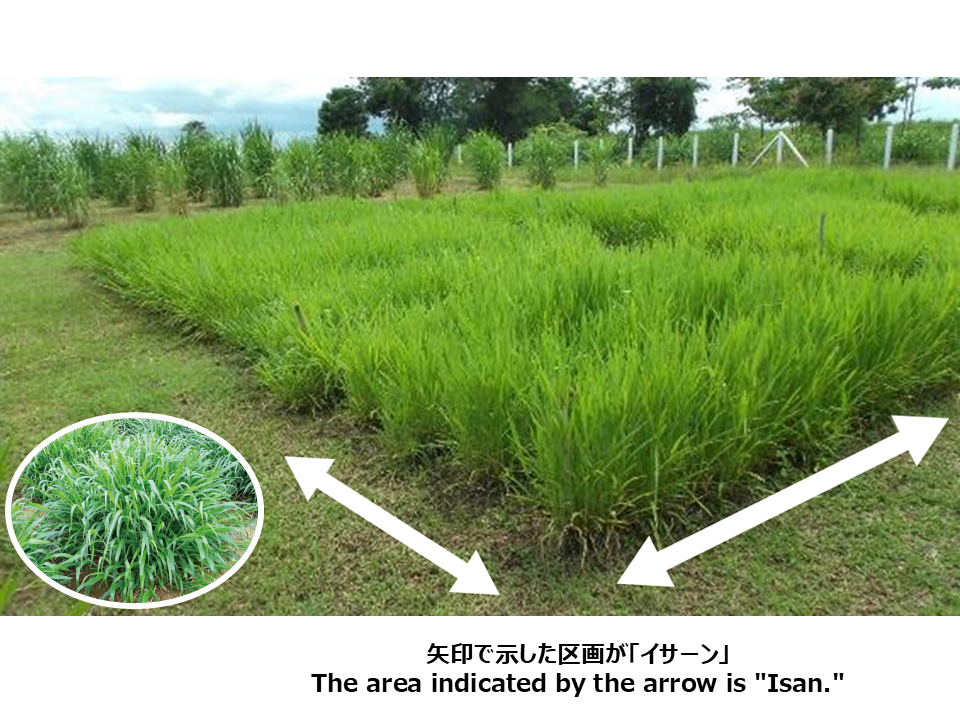
The key strengths of Isan are its high yield, high nutritional quality, and excellent drought tolerance. Dry matter production can reach approximately 20 tons per hectare per year, exceeding that of many existing forage varieties. The grass also contains relatively high levels of crude protein, enabling efficient provision of nutrients required by both dairy and beef cattle. In addition, its strong tolerance to dry conditions allows stable production even in northeastern Thailand, where long dry seasons are common (JIRCAS Press Release).
*The variety name “Isan” is derived from the Thai word for the country’s northeastern region.
As adoption of Isan expands, the availability of high-quality roughage is expected to improve substantially. This could enhance growth performance in beef cattle and increase milk yields in dairy herds. As a response to Thailand’s long-standing dependence on low-quality feed resources, Isan—developed through collaborative research between Japan and Thailand—holds promise as a technology that can contribute to higher productivity and sustainability in the livestock sector.
References:
JIRCAS Press Release: A tropical forage grass variety “Isan”, which belongs to the family Poaceae, has been registered in Thailand
https://www.jircas.go.jp/en/release/2024/press202415
Ashu Research Inc.: Thailand: Dairy Products
https://cms.scout.asia/wp-content/uploads/2025/10/20251021-THB-27-04.pdf
FAOSTAT
https://www.fao.org/faostat/en/#home
Department of Trade Negotiations (DTN), Ministry of Commerce, Thailand: News Release (12 December 2024)
https://www.dtn.go.th/th/content/page/index/id/13543
Contributor: Norihito Kanamori
Southeast Asia Liaison Office, JIRCAS