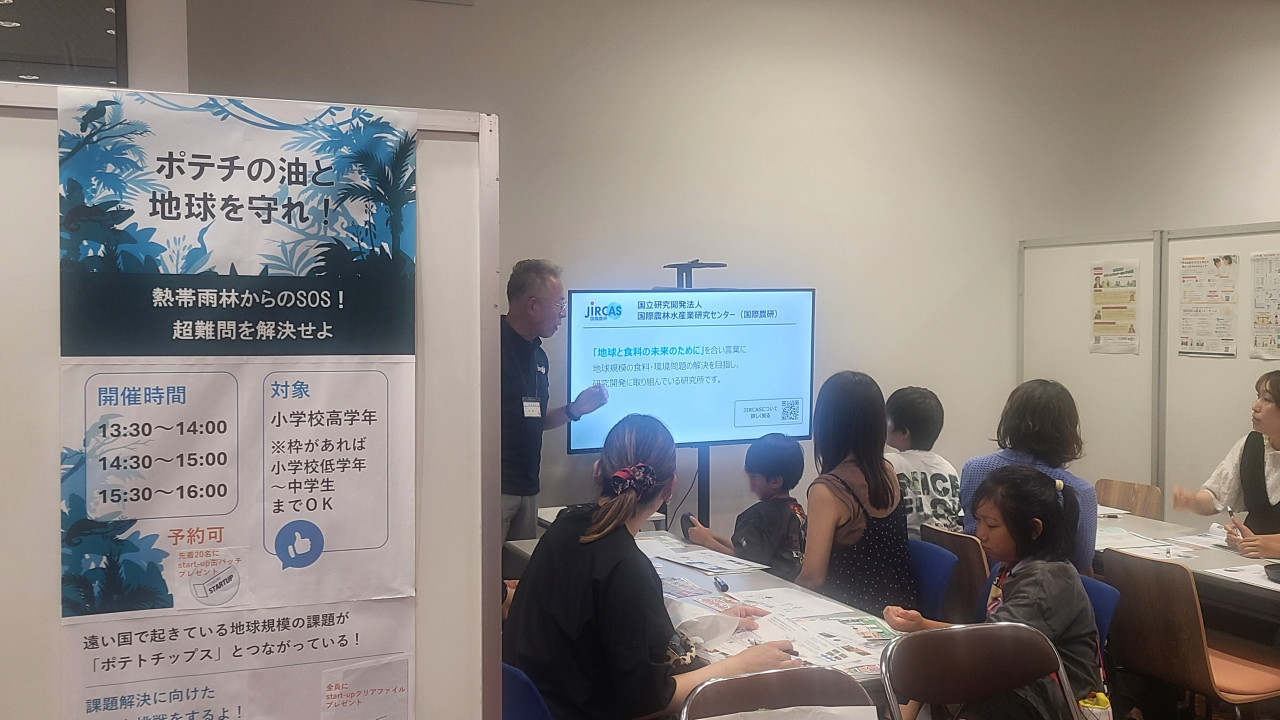



On July 29, 2026, the “Children’s Kasumigaseki Tour Day 2026,” hosted by the Ministry of Education, Culture, Sports, Science and Technology (MEXT), was held at the ministry’s headquarters in Chiyoda Ward, Tokyo. The event attracted numerous visitors, particularly families with children. The Japan International Research Center for Agricultural Sciences (JIRCAS) cooperated in the Tsukuba City exhibition booth titled “Save the Earth with Potato Chip Oil! An SOS from the Tropical Rainforest: Solving Tough Challenges with Cutting-Edge Technology and Innovative Ideas.” Dr. OMORI Keisuke, Director of the Information and Strategy Program at JIRCAS, served as lecturer.
The event was organized through cooperation among various government ministries and agencies with the aim of helping children deepen their understanding of society and public administration, while also promoting learning and interaction between parents and children during the summer vacation period. At the Tsukuba City booth, participants explored global environmental and social challenges, including tropical rainforest conservation and resource recycling, through the example of palm oil, a common ingredient in familiar food products such as potato chips.
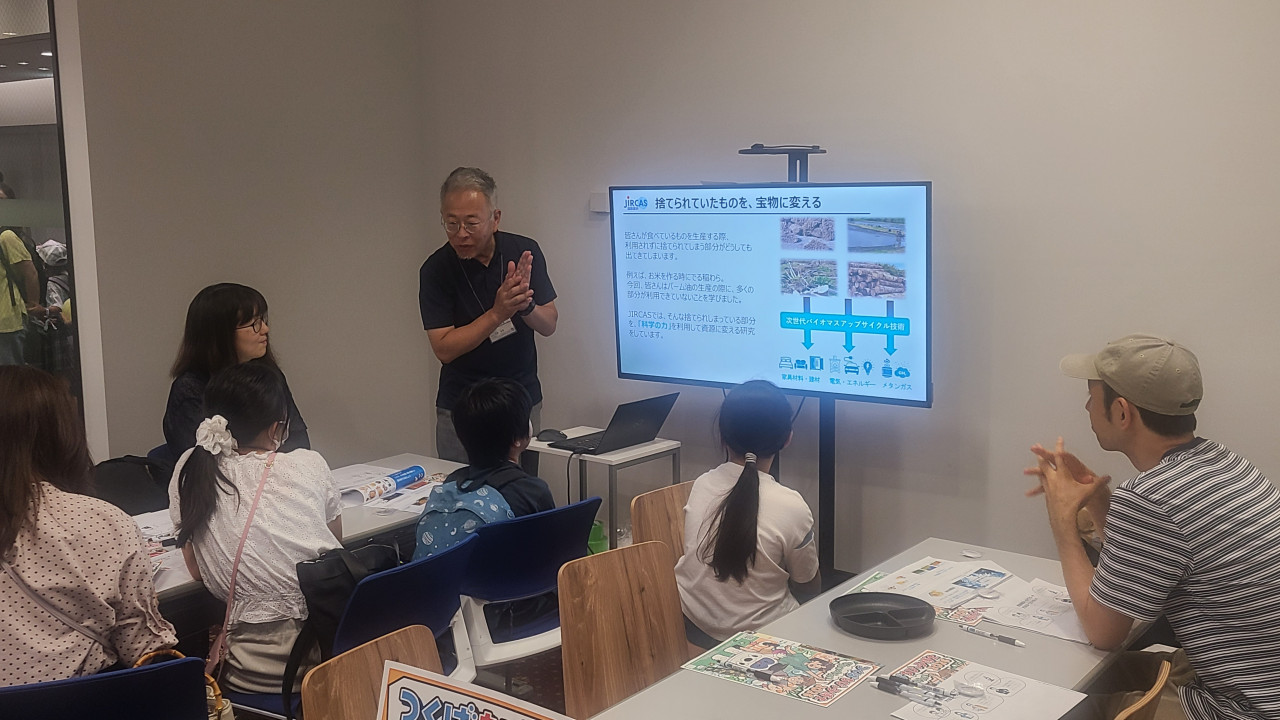
JIRCAS introduced research initiatives on sustainable palm oil production and biomass resource recycling, while also explaining the concept of upcycling, which seeks to create higher-value products from existing resources. The presentation clearly illustrated the relationship between everyday consumer behavior and environmental issues, encouraging participants to think about the actions needed to achieve a sustainable society.
Approximately 30 parents and children attended the session. Through videos and quizzes, participants gained a better understanding of the connections between daily life and environmental challenges. In response to the question, “How can we continue supplying vegetable oil while protecting biodiverse tropical rainforests?”, participants offered a variety of creative ideas, including “increasing production from the same area,” “designating areas where logging is permitted,” and “developing oil palms that are easy to harvest even when they grow tall. ”
Participants commented that the event provided a valuable opportunity to think about environmental issues through familiar, everyday products and that it allowed them to learn together as families in an enjoyable way. After the lecture, many children asked questions about the work of researchers and PhDs, demonstrating their strong interest in science and research.
Through dissemination of its research achievements, JIRCAS will continue to promote understanding of sustainable development and contribute to fostering scientific curiosity among the next generation.
Photos courtesy of Tsukuba Center, Inc. (TCI)