



Pick Up
1568. Thailand’s Unusual Black Egg, the “Chaiya Salted Duck Egg”
1568. Thailand’s Unusual Black Egg, the “Chaiya Salted Duck Egg”
In a previous Southeast Asia Liaison Office Newsletter, we introduced durian as a Thai agricultural product registered under the Geographical Indication (GI) system.
Geographical Indication (GI) Certification and Quality Improvement Technologies for Durian in Rayong Province, Thailand
https://www.jircas.go.jp/ja/program/proc/blog/20260619
This article examines the Chaiya Salted Duck Egg, an unusual regional specialty from southern Thailand, through the links among the local environment, duck production, salt-curing technology, and the Geographical Indication system.
One of the most famous local specialties of Chaiya District in Surat Thani Province is the Chaiya Salted Duck Egg (ไข่เค็มไชยา). This salted egg is a regional brand registered under Thailand’s Geographical Indication (GI) system and is a unique food product created through the combination of Chaiya’s natural environment and traditional processing techniques.
A GI system protects more than a product name: it specifies the links among production area, raw materials, processing methods, and quality attributes. Reviewing the registered specifications for Chaiya Salted Duck Eggs therefore provides a basis for assessing the product’s regional distinctiveness and quality claims.
Japan also has several GI-registered livestock products, including Kobe Beef, Matsusaka Beef, Kagoshima Kurobuta Pork, and Hinai-jidori Chicken. However, as of 2026, no egg products have been registered under Japan’s GI system. In this regard, the fact that eggs themselves have become a protected regional brand in Thailand is particularly noteworthy.
Characteristics of Chaiya Salted Duck Eggs
To assess the product’s importance as a regional industry, useful indicators would include the number of ducks raised, egg production volume, number of producers, sales value, and changes in distribution channels after GI registration. Statistics from government agencies and GI authorities could help connect this traditional food to agricultural production and regional value creation.
The product is made from duck eggs. In Chaiya, ducks are reported to forage in rice paddies and wetlands, where they may consume shrimp, shellfish, and small fish. Yolk color and flavor, however, can be influenced by several factors, including pigments and lipids in the feed, breed, and husbandry conditions. GI specifications, compositional analyses, and sensory evaluations are therefore needed to determine how the deep orange yolk and rich flavor are defined and assessed as product-quality attributes.
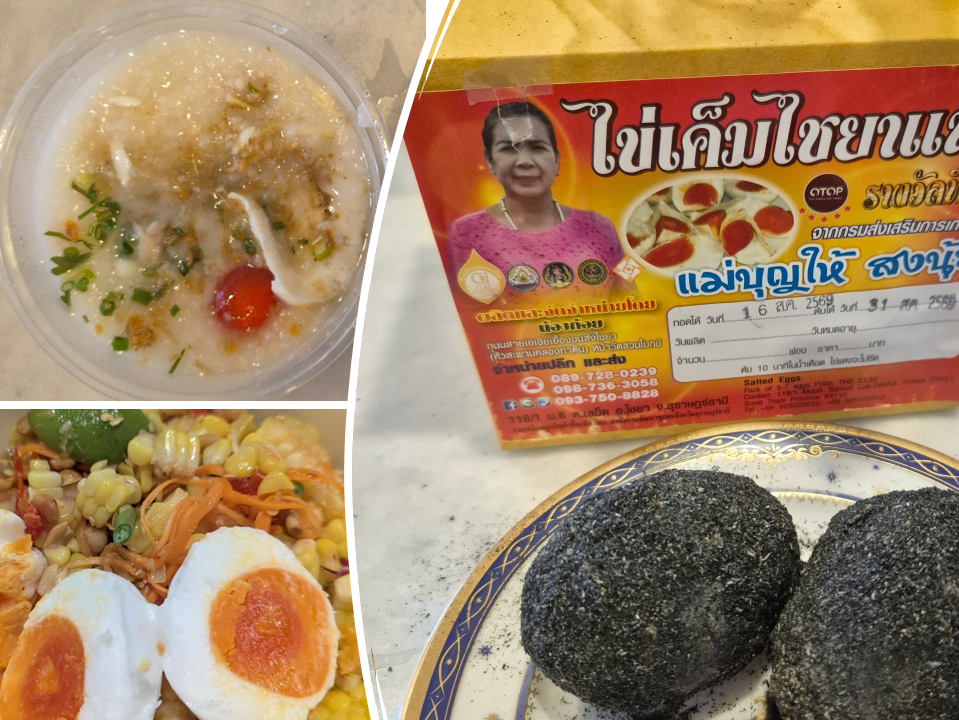
While brining is commonly used for salted eggs in Thailand, Chaiya Salted Duck Eggs are traditionally coated with a paste of soil, salt, and rice husk ash and cured for a specified period. The source of the soil, the proportions of the materials, and the curing period should be checked against GI registration documents and other primary sources, as descriptions may differ among producers and publications. The eggs may be sold with the black coating still in place.
The black material is the soil-salt-ash mixture used for curing. During maturation, concentration gradients drive salt through the eggshell, while water distribution and the physical states of proteins and lipids in the white and yolk also change. These processes may contribute to the saltiness and texture of the egg white and to the oily texture of the yolk. Measurements of salt content, water activity, and yolk lipid composition would allow the relationship between the traditional process and product quality to be assessed more objectively.
Food safety and quality control are also important when examining the traditional process scientifically. Hygiene of raw eggs, salt concentration, curing temperature and duration, heating conditions, and storage practices can affect microbial control and product consistency. Reviewing how these conditions are addressed in GI production specifications and Thai food-safety standards would clarify the connection between traditional knowledge and modern quality assurance.
How to Eat
Before consumption, the black coating is washed off with water, and the eggs are then boiled. Once opened, the eggs reveal a bright orange-red yolk.
In Thailand, Chaiya Salted Duck Eggs are commonly eaten with rice, but they are also widely used in dishes such as Som Tam Khao Pod Kai Khem (spicy Thai corn salad with salted egg) and jok (Thai rice porridge). The rich yolk is also popular as an ingredient in stir-fried dishes and savory sauces.
Chaiya Salted Duck Eggs illustrate how a local environment, duck production practices, traditional curing technology, and a GI framework can be combined to create a distinctive regional product. Further evidence on feed and egg quality, physicochemical changes during curing, food-safety controls, production volumes, and economic effects would help clarify how this tradition contributes to product quality and rural value creation.
Contributor: Norihito Kanamori, Southeast Asia Liaison Office, JIRCAS