



Pick Up
1549. Seventy-Six Percent of Carbon Emissions From Canada's 2023 Wildfires Originated From Soil and Peat: Concerns Over a Positive Climate Feedback
Related Research Program
Information

1549. Seventy-Six Percent of Carbon Emissions From Canada's 2023 Wildfires Originated From Soil and Peat: Concerns Over a Positive Climate Feedback
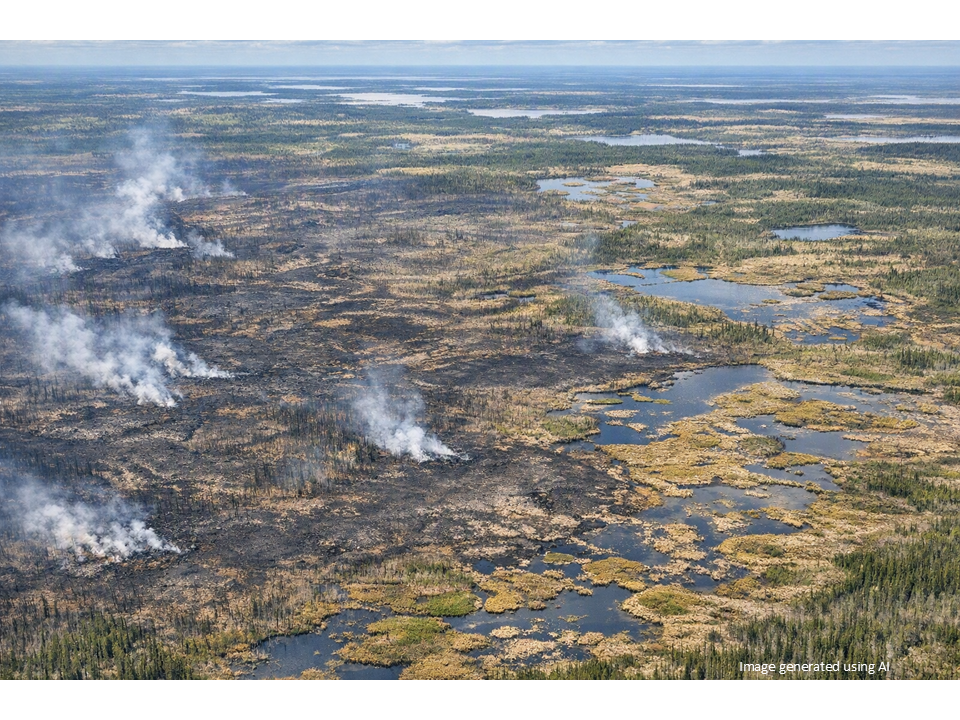
A study published in Geophysical Research Letters has revealed that most of the carbon emissions from Canada's record-breaking 2023 wildfires originated not from trees, but from the combustion of soils and peatlands. The fires burned approximately 15.1 million hectares, making them the largest wildfires ever recorded in Canada and about seven times the average annual area burned over the previous two decades.
Using a combination of ground observations, satellite data, and fire-weather information, the research team estimated that the 2023 wildfires released a total of 554 teragrams of carbon (Tg C). This amount represents approximately 23% of global wildfire carbon emissions in 2023.
A key finding of the study is that approximately 76% of total emissions (423 Tg C) came from the combustion of soil organic carbon, substantially exceeding emissions from aboveground forest biomass (131 Tg C, or 24%). In addition, about 5.1 million hectares of the burned area occurred in peatlands, which released an estimated 180 Tg C, accounting for roughly one-third of the total carbon emissions from the fires.
Canada is estimated to store about one-fifth of the world's soil organic carbon, making its boreal forests and peatlands globally important carbon reservoirs. The study notes that the unprecedented 2023 fire season was driven by unusually warm temperatures, early snowmelt, and an extended wildfire season, creating conditions conducive to large-scale burning.
The authors further estimate that the wildfire emissions were equivalent to approximately 2 billion tonnes of CO₂, nearly three times Canada's total anthropogenic greenhouse gas emissions in 2022. They warn that increasingly severe wildfires under a warming climate could trigger a positive climate feedback, whereby the release of long-stored carbon from soils and peatlands contributes to further warming, which in turn increases wildfire risk.
The findings highlight the importance of accounting not only for aboveground vegetation losses but also for carbon released from soils and peatlands when assessing the impacts of wildfires. In boreal regions in particular, increasing wildfire activity driven by climate change could have significant implications for the global carbon cycle and climate stability.
Reference
Zhong, Z., Ottah, C., Rogers, B. M., Veraverbeke, S., Potter, S., Kurz, W. A., Diaz, L. R., Christensen, S., & Gonsamo, A. (2026). Three-Fourths of Carbon Emissions From 2023 Record-Breaking Wildfires in Canada Traced to Soil and Peat Combustion. Geophysical Research Letters.
https://doi.org/10.1029/2026GL123393
Contributor: Miyuki Iiyama, Strategic Coordination Office