



Pick Up
1503. Global Rice Paddy Greenhouse Gas Emissions Have Doubled Over the Past Six Decades
Related Research Program
Information
1503. Global Rice Paddy Greenhouse Gas Emissions Have Doubled Over the Past Six Decades
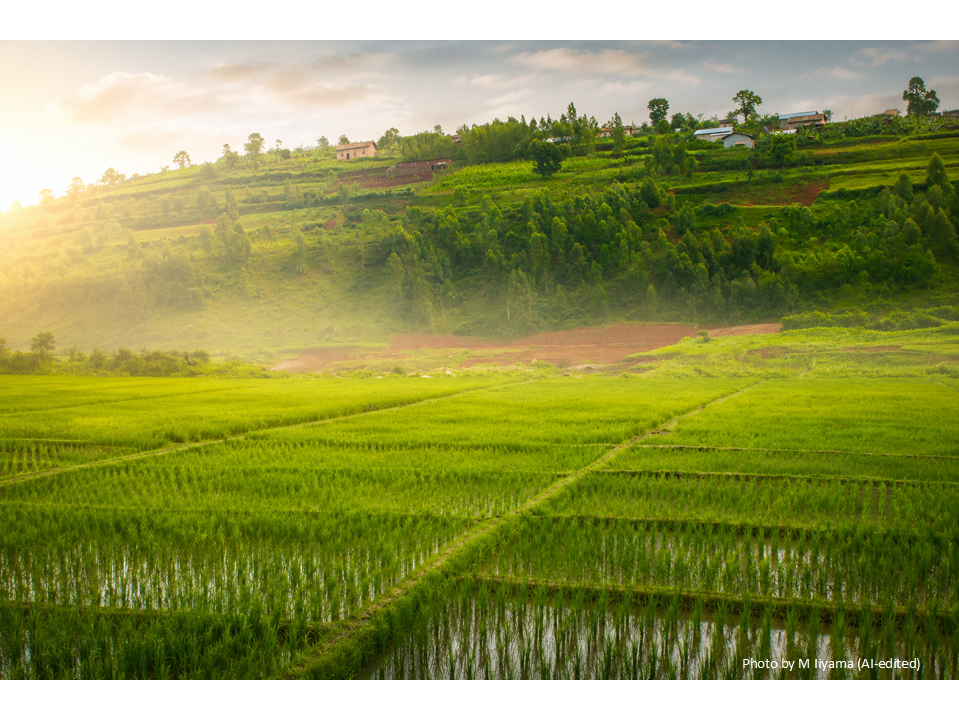
Rice paddies are essential for global food security, but they are also one of the major sources of greenhouse gas emissions in the agricultural sector. In particular, methane (CH4) emitted from rice paddies is a highly potent greenhouse gas and accounts for roughly one-fifth of global agricultural methane emissions. However, paddy soils can also function as carbon sinks through soil organic carbon (SOC) sequestration. Therefore, assessing the true climate impact of rice cultivation requires an integrated evaluation that includes not only CH4 and nitrous oxide (N2O) emissions, but also changes in soil carbon storage.
In this study, researchers combined a data-driven model, the process-based Dynamic Land Ecosystem Model for Agriculture (DLEM), and a meta-analysis covering 1,255 experimental sites and 21,334 site-years to analyze global rice paddy greenhouse gas balances from 1961 to 2020. The results showed that global rice paddies emitted an average of 1,090 ± 350 TgCO2e per year during 2011–2020, representing an increase of approximately 90% compared with the 1961–1980 average.
The largest driver of the increase was the expansion of rice cultivation area, which accounted for about 58% of the total increase in emissions. Expansion in Southeast Asia, South Asia, and Africa was found to have substantially increased methane emissions. In addition, intensified straw incorporation emerged as another important driver in recent decades, contributing an estimated 18% of the post-2000 increase in emissions. The study suggested that excessive straw incorporation may saturate soil carbon sequestration capacity while simultaneously stimulating methane production.
Regionally, Asia accounted for roughly 90% of global rice paddy emissions overall, while northeastern China and parts of Southeast Asia showed signs of weakening soil carbon sink capacity. Africa was also identified as an emerging methane hotspot due to the rapid expansion of rice paddies.
At the same time, the study found that practices such as alternate wetting and drying (AWD), reducing excessive residue incorporation, and optimizing fertilizer management could reduce future emissions by approximately 10% while maintaining crop yields. However, under future warming scenarios, completely eliminating rice paddy emissions is unlikely, and the study concluded that integrated, region-specific management strategies will be essential.
Overall, the study demonstrates that greenhouse gas emissions from rice agriculture are not simply a matter of methane emissions alone, but rather a complex interaction involving changes in soil carbon sequestration capacity. The findings also suggest that the adoption of regionally tailored “climate-smart agriculture” will become increasingly important in balancing food production with climate mitigation goals.
(Reference)
Zhang, J., Tian, H., Liang, X.-Z. et al. Global rice paddy greenhouse gas emissions have doubled over the past six decades driven by area expansion and intensified residue incorporation. Nat Food (2026).
DOI: 10.1038/s43016-026-01355-8
(Contributor: IIYAMA Miyuki, Strategic Coordination Office)