



Pick Up
1546. Land Degradation Widens Yield Gaps Across Global Croplands —A Nature Food Study Highlights an Often-Overlooked Threat to Food Security—
Related Research Program
Information
1546. Land Degradation Widens Yield Gaps Across Global Croplands
—A Nature Food Study Highlights an Often-Overlooked Threat to Food Security—
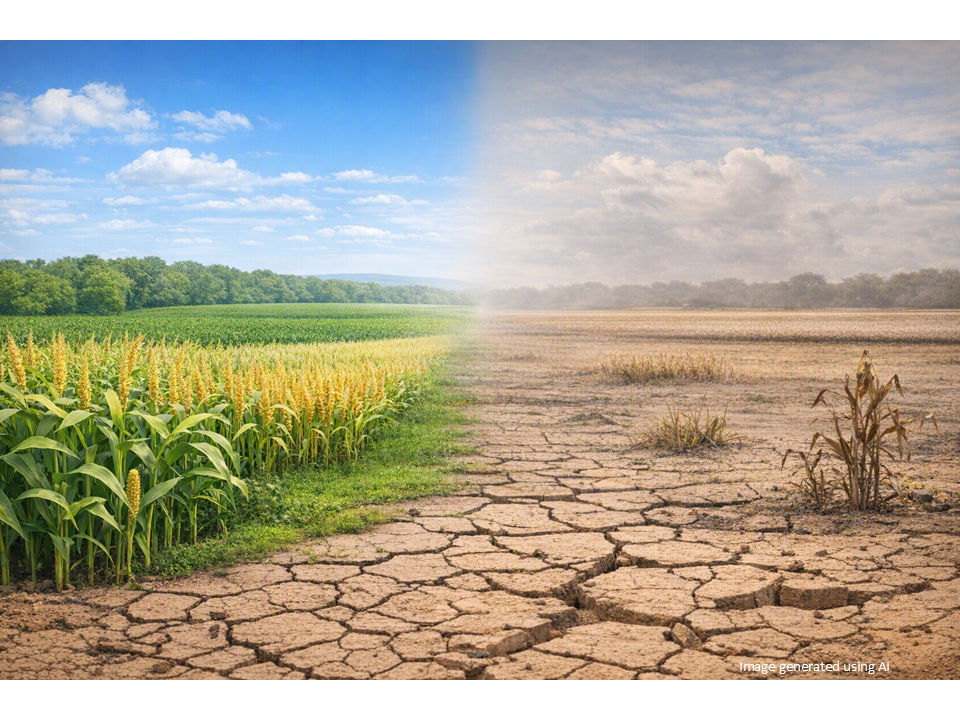
Alongside climate change and biodiversity loss, land degradation is a major challenge shaping the future of global food production. A recent study by Hadi et al., published in Nature Food, shows that greater land degradation is associated with larger crop yield gaps for major crops worldwide, with measurable implications for food security. This article introduces the study’s key findings and underscores the importance of sustainable land management.
Along with climate change and biodiversity loss, land degradation is one of the major environmental challenges facing the international community. Yet, until recently, there had been no clear consensus on the extent to which land degradation actually affects agricultural productivity.
Hadi et al.'s research provides the first systematic global quantification of the relationship between land degradation and crop yield gaps, using high-resolution global datasets. The study offers important insights for sustainable agricultural production and food security by demonstrating the impact of land degradation on food production at a global scale.
A yield gap refers to the difference between the yield actually achieved and the yield that could realistically be attained under local conditions. The study analyzed cropland data from approximately 400,000 locations, covering ten major global crops, including wheat, maize, rice and soybean. Land degradation was assessed by integrating multiple indicators, including soil erosion, soil compaction, declining soil organic carbon, reduced soil moisture and loss of tree cover.
The results showed that, on average, a 10% increase in land degradation was associated with an approximately 1.75%—or roughly 2%—increase in yield gaps. This means that as land degradation progresses, the gap between actual and attainable yields widens, indicating reduced agricultural productivity. The impacts were particularly pronounced in regions such as northern and southern India, northeastern China, the U.S. Midwest and northern Argentina, where a 10% increase in land degradation could widen yield gaps by more than 6%.
When extrapolated to croplands worldwide, the researchers estimated that land degradation is associated with annual production losses of around 20 million tonnes. This is equivalent to approximately 52 trillion kilocalories of food energy, or the annual food supply for about 71 million people, and corresponds to an estimated US$4 billion in lost agricultural revenue each year.
One notable finding is that the impact of land degradation is not limited to developing countries. In high-input, high-yield farming regions such as the United States and China, long-term intensive agriculture has led to accumulated land degradation, making yields particularly sensitive to even small changes in soil conditions. By contrast, in many sub-Saharan African countries, although yield gaps themselves are large, other constraints—such as limited access to fertilizer, irrigation and markets—play a larger role, making the relative impact of land degradation smaller.
These findings suggest that policy responses need to be tailored to regional contexts. In Africa, improving access to agricultural inputs and technologies remains essential, while in high-yield regions, maintaining the health of croplands through soil conservation and sustainable land management is increasingly important. The authors emphasize the need to promote sustainable intensification, incorporating practices such as conservation agriculture and integrated soil fertility management.
In recent years, climate change and biodiversity conservation have received growing attention, but land degradation remains comparatively overlooked despite being an equally important challenge. This study shows that land degradation is already having measurable impacts on global food production and provides evidence that investment in soil conservation and land restoration is vital not only for environmental protection but also for food security.
As the global population continues to grow and climate-related production risks increase, curbing land degradation and promoting sustainable cropland management will be key to securing future food supplies.
Reference
Hadi, H., Ray, D.K., Borrelli, P. et al. Land degradation is associated with larger crop yield gaps across global croplands. Nat Food 7, 678–687 (2026). https://doi.org/10.1038/s43016-026-01382-5
Contributor: Miyuki IIYAMA, Strategic Coordination Office