




On June 2–3, 2026, the “Second ASEAN Consultation Workshop and Capacity Building on Regenerative and Resilient Agriculture Systems,” co-organized by the ASEAN Secretariat, the Economic Research Institute for ASEAN and East Asia (ERIA), the Deutsche Gesellschaft für Internationale Zusammenarbeit (GIZ), and the European Union (EU), was held in Denpasar, Indonesia, with the Japan International Research Center for Agricultural Sciences (JIRCAS) participating at the invitation of the ASEAN Secretariat.
This workshop followed the first meeting and aimed to formulate an implementation plan for regenerative and resilient agriculture in order to address multiple challenges in the agriculture, forestry, fisheries, and food sectors, such as climate change, biodiversity loss, geopolitical tensions, and economic instability. Participants included representatives from ASEAN member states, the EU, and the Government of Japan, as well as UN agencies, international financial institutions, research organizations, and the private sector.
On the first day, discussions focused primarily on developing the implementation plan for ASEAN regenerative and resilient agriculture systems. On the second day, discussions were held on financing and investment opportunities to support the transition to such systems.
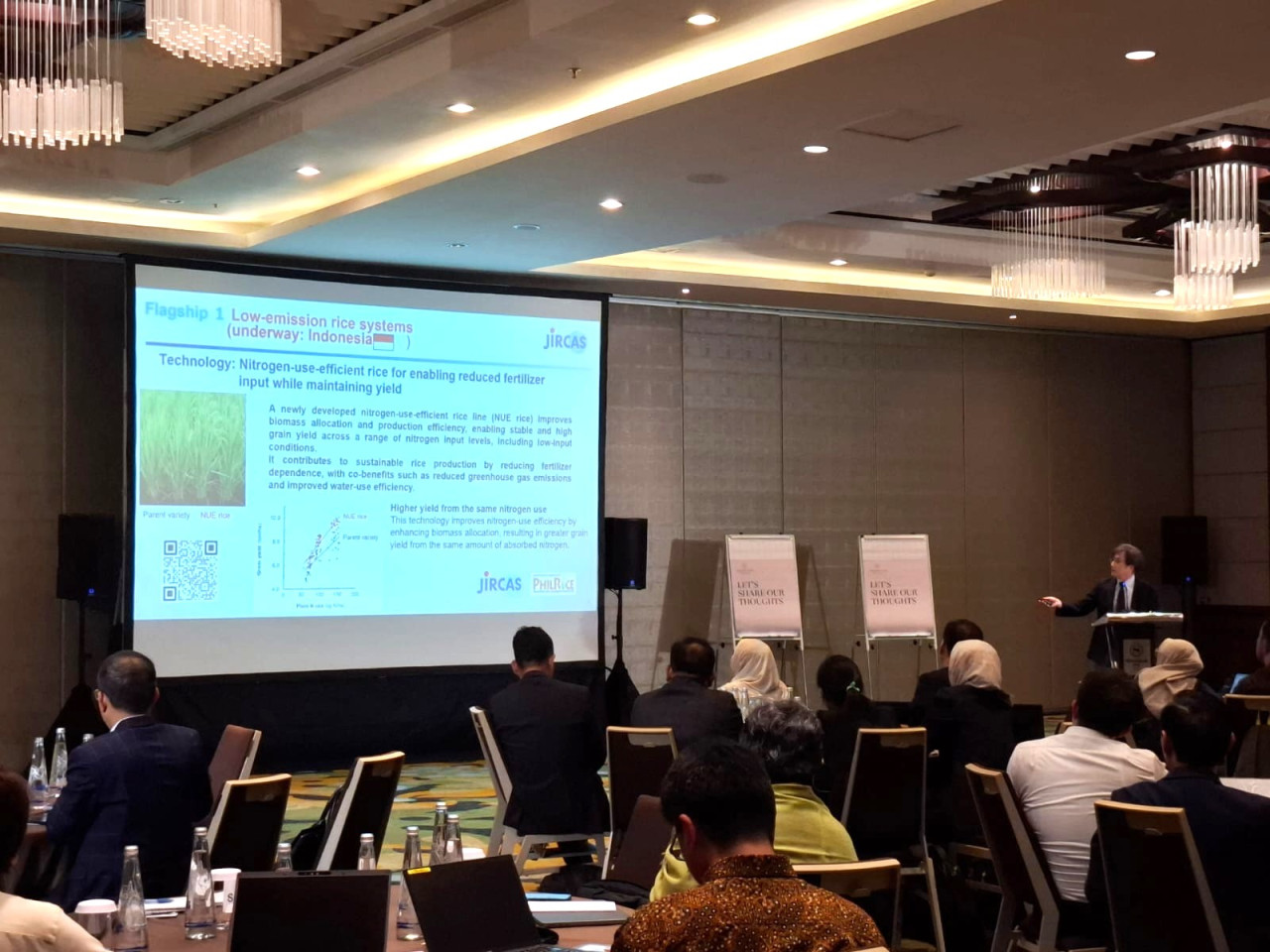
From JIRCAS, Dr. FUNAKI Yasuro, Green Asia Project Leader, participated and delivered a presentation on the first day. In his presentation, he introduced technologies that are expected to contribute to the implementation of the ASEAN regenerative and resilient agriculture system plan and are currently being demonstrated within the ASEAN region. Specifically, the following technologies listed in the Technology Catalog Contributing to Production Potential and Sustainability in the Asia-Monsoon Region (Ver. 4.0) were introduced (Note: institutions responsible for technology development are indicated in parentheses):
- Life cycle assessment method for estimating greenhouse gas emissions across the entire process from fertilizer production to rice harvesting (JIRCAS)
- Next-generation biomass technology (JIRCAS)
- Simplified measurement technology for carbon sequestration in biochar (Ritsumeikan University & Akita Prefectural University)
- Deep planting technology for sugarcane (JIRCAS)
In addition, from the Green Asia Report Series:
- Rice with high fertilizer efficiency (JIRCAS)
To contribute to the transformation of food systems in the Asian monsoon region with innovations originating from Japan, it is essential not only for JIRCAS but also for Japan as a whole to bring together diverse technological capabilities in the agriculture, forestry, and fisheries sectors and promote them as an “All-Japan” effort. To this end, JIRCAS has compiled internationally applicable technologies from its own research as well as from organizations such as the National Agriculture and Food Research Organization (NARO), the Forestry and Forest Products Research Institute, the Fisheries Research and Education Agency, the National Institute of Advanced Industrial Science and Technology (AIST), and universities. These are consolidated as a “Technology Catalog,” systematically organized and disseminated both domestically and internationally.
Moving forward, JIRCAS will continue to actively utilize opportunities such as this workshop, selecting and presenting technologies from the catalog that best match the agenda and challenges of each meeting, thereby contributing to the creation of tangible results through Japanese innovations.