



Pick Up
1572. Development and Global Impact of International “Measuring Tools” for Pathogenicity
1572. Development and Global Impact of International “Measuring Tools” for Pathogenicity
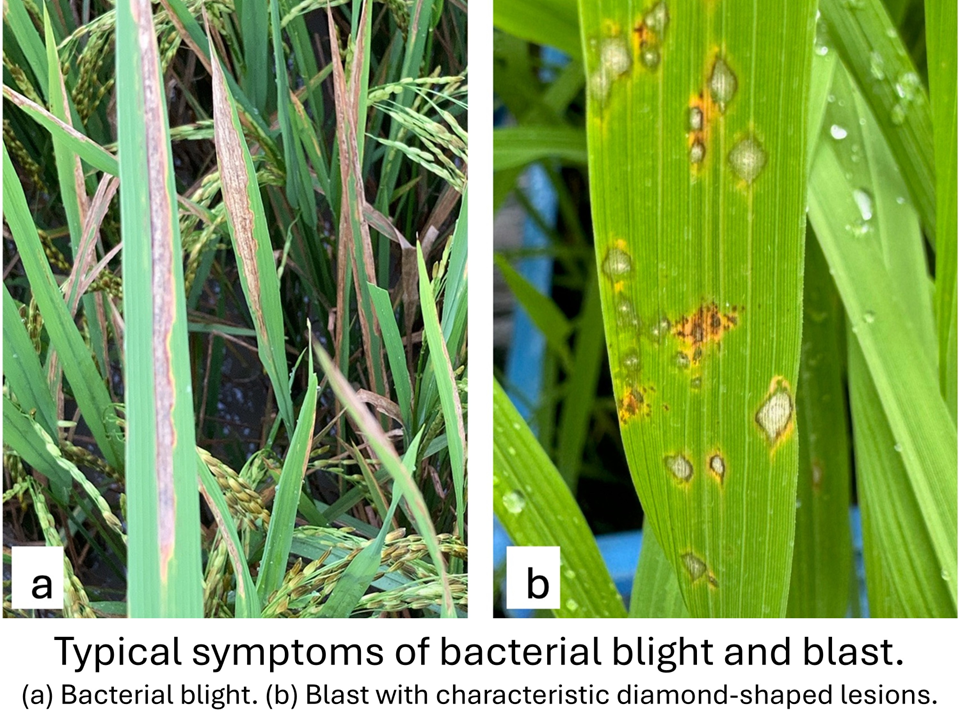
A review article has been published in The Plant Genome describing the development history, global dissemination, and use of internationally shared “measuring tools” for evaluating the pathogenicity of the bacterial blight and rice blast pathogens. These tools have been developed and used over many years by JIRCAS and the International Rice Research Institute (IRRI), building on the knowledge of Japanese researchers and international collaborative research. The article comprehensively reviews the roles of the “measuring tools” and international research networks, developed and strengthened through international collaboration, in monitoring pathogen populations, analyzing resistance genes, and breeding rice varieties with durable disease resistance.
The “measuring tools” are two sets of resistance lines: the IRRI bacterial blight near-isogenic lines (IRBB) and the IRRI-bred blast-resistant lines (IRBL). Near-isogenic lines (NILs) are lines in which a specific resistance locus has been introgressed into a recurrent parent through backcrossing; consequently, they share a common genetic background while differing primarily at the target disease-resistance locus. Artificial inoculation tests using these lines make it possible to distinguish resistance genes that remain effective from those for which resistance has been overcome by pathogens, enabling pathogenicity to be assessed using internationally shared criteria.
The global adoption of these standardized “measuring tools” has enabled researchers and breeders to compare pathogen characteristics across national borders and to select effective resistance genes. Surveillance of changes in pathogen populations and continuing to deploy appropriate resistance genes provide an essential foundation for breeding resistant varieties and sustaining stable rice production.
From Japanese Knowledge to a Global Foundation
Japan has accumulated a long history of research on rice blast resistance, pathogen race identification, and the utilization of resistance genes. JIRCAS has built upon these research achievements through collaborative research with IRRI, contributing to the development of internationally applicable differential systems for rice blast, as well as to the standardization of their evaluation methods. The differential system and evaluation methods established through collaboration between Japan and IRRI have become a common foundation for comparing the pathogenicity of rice blast isolates across countries and regions. This achievement has been passed on to research and breeding institutions worldwide, supporting pathogen surveillance and the breeding of resistant varieties suited to local disease risks.
A Common Foundation for Global Rice Production
IRBB and IRBL have been developed through international collaborative research since the 1980s and distributed to research and breeding institutions worldwide, including those in Asia and Africa. The international rice blast research network led by JIRCAS played a particularly important role in disseminating IRBLs for rice blast research. The network has brought together research institutions in Japan, the Philippines, China, Korea, Vietnam, Thailand, Bangladesh, Indonesia, Lao PDR, Cambodia, and Kenya, among other countries. Using the differential variety set and standardized evaluation protocols, participating institutions have analyzed pathogen diversity. The development of an internationally standardized differential system has established a foundation for comparing changes in pathogen populations across countries and regions, and for advancing the breeding of resistant varieties suited to local disease risks.
Breeding Disease-Resistant Varieties
Relying on a single resistance gene can allow pathogens to evolve and overcome resistance. Therefore, current breeding approaches emphasize the pyramiding of multiple resistance genes and pathotype-based breeding, in which resistance genes are selected and deployed based on virulence of local pathogen populations.
IRBB and IRBL have also been used as donor materials for resistance breeding. For example, in India, Bangladesh, Indonesia, and elsewhere, varieties and promising breeding lines carrying multiple resistance genes effective against local populations of bacterial blight and rice blast pathogens have been developed using pathogenicity information obtained with these lines. The adoption of resistant varieties is expected to reduce yield losses and contribute to lower pesticide use.
Changes in temperature, rainfall, humidity, and cropping systems associated with climate change may affect disease dynamics and pathogen populations. Continuous pathogen surveillance and the appropriate deployment of resistance genes will therefore become increasingly important.
Future perspectives
New resistance genes discovered in wild rice and through recent genomic research need to be incorporated into further improvement of the “measuring tools.” Similar standardized evaluation systems are also expected to be developed for other major rice diseases, including sheath blight and rice tungro disease, in addition to bacterial blight and rice blast, thereby advancing more sustainable breeding for disease resistance.
The development and international deployment of IRBB and IRBL by JIRCAS and IRRI have connected genetic resources, plant pathology, breeding, and international collaboration, thereby supporting rice production and food security in many regions. This review documents the historical significance of these efforts and demonstrates that developing globally adopted “measuring tools” is not the endpoint. Rather, these tools provide a foundation for the next generation of disease-resistance breeding to address climate change and pathogen evolution, underscoring the continuing importance of international collaboration for stable food production in the future.
Publication Information
• Title: History of near-isogenic lines carrying genes for resistance to bacterial blight and blast in rice (Oryza sativa L.)
• Authors: Van Schepler-Luu, Mary Jeanie Telebanco-Yanoria, Hiroki Saito, and Casiana M. Vera Cruz
• Journal: The Plant Genome
• DOI: 10.1002/tpg2.70300
• Article URL: https://acsess.onlinelibrary.wiley.com/doi/10.1002/tpg2.70300
Contributor: Hiroki Saito, Tropical Agriculture Research Front