



Pick Up
1491. Thai Koji "Luk Pang"
Related Research Program
Information
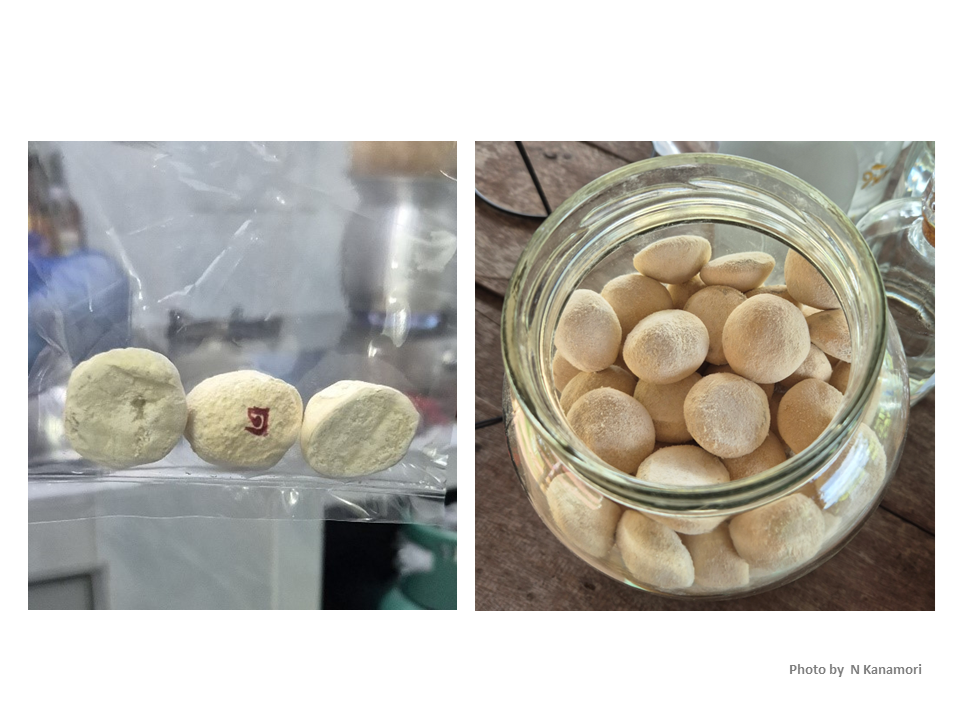
1491. Thai Koji "Luk Pang"
Koji (also written as kōji) is used not only in Japan but widely across East Asia, such as China and Korea, as well as Southeast Asia. In China, it is called 'Qu', in Korea 'Nuruk', in Thailand 'Luk Pang', in the Philippines 'Bubod', and in Indonesia 'Ragi'. It is also found in mountainous regions such as Nepal, Bhutan, and Tibet. In all cases, the term refers to grain-based starters cultivated with microorganisms.
The World of Koji
| Country / Region | Name | Main Type of Koji |
| Japan | Koji (糀) | Loose Koji |
| China | Qu (Chi) | Loose Koji / Cake Koji |
| Korea | Nuruk | Cake Koji |
| Thailand | Luk Pang | Cake Koji |
| Phillippines | Bubod | Cake Koji |
| Indonesia | Ragi | Cake Koji |
| Vietnam | Men | Cake Koji |
| Tibet | Murcha / Marcha | Cake Koji |
The Role of Koji
The most important role of koji is its enzymatic function in food production. Amylase breaks down starch into sugars, producing sweetness, while protease breaks down proteins into amino acids, creating umami.
In Japan, koji is used in many traditional fermented foods such as sake, miso, soy sauce, mirin, vinegar, and shochu. Because koji mold is indispensable to Japanese food culture, it was designated the 'National Fungus' by the Brewing Society of Japan in 2006.
In Japan, pure starter cultures are propagated on rice, barley, or soybeans to produce loose koji, in which mold grows on each individual grain. Outside Japan, cake koji is more common. It is made by forming grain flour into cakes and allowing naturally occurring microorganisms to grow.
Cake koji contains a mixture of molds, yeasts, lactic acid bacteria, and acetic acid bacteria, resulting in complex flavors but also a higher risk of fermentation failure.
Thai Cake Koji “Luk Pang”
Thai koji is called Luk Pang (ลูกแป้ง) and is made by kneading rice flour into a dough and shaping it into round cakes.
Luk Pang is mainly used for making Khao Mak (sweet fermented rice) and Sato (rice wine). For Khao Mak, minimal ingredients are added to maintain a white color, while Sato uses Luk Pang mixed with dozens of medicinal herbs, resulting in a brownish color.
Sato is produced uniquely in many regions of Thailand, each with its own original Luk Pang recipe. Alcohol has historically been used in Thai rituals, suggesting cultural significance behind the use of medicinal herbs.
Contributor: KANAMORI Norihito, Southeast Asia Liaison Office