



Enhanced dephosphorylation of phytate to inositol in brown-rice koji-amazake saccharified with rice-koji made with Aspergillus oryzae and Aspergillus luchuensis
Related Research Project
Indigenous crops and foods design
Country
Japan
Description
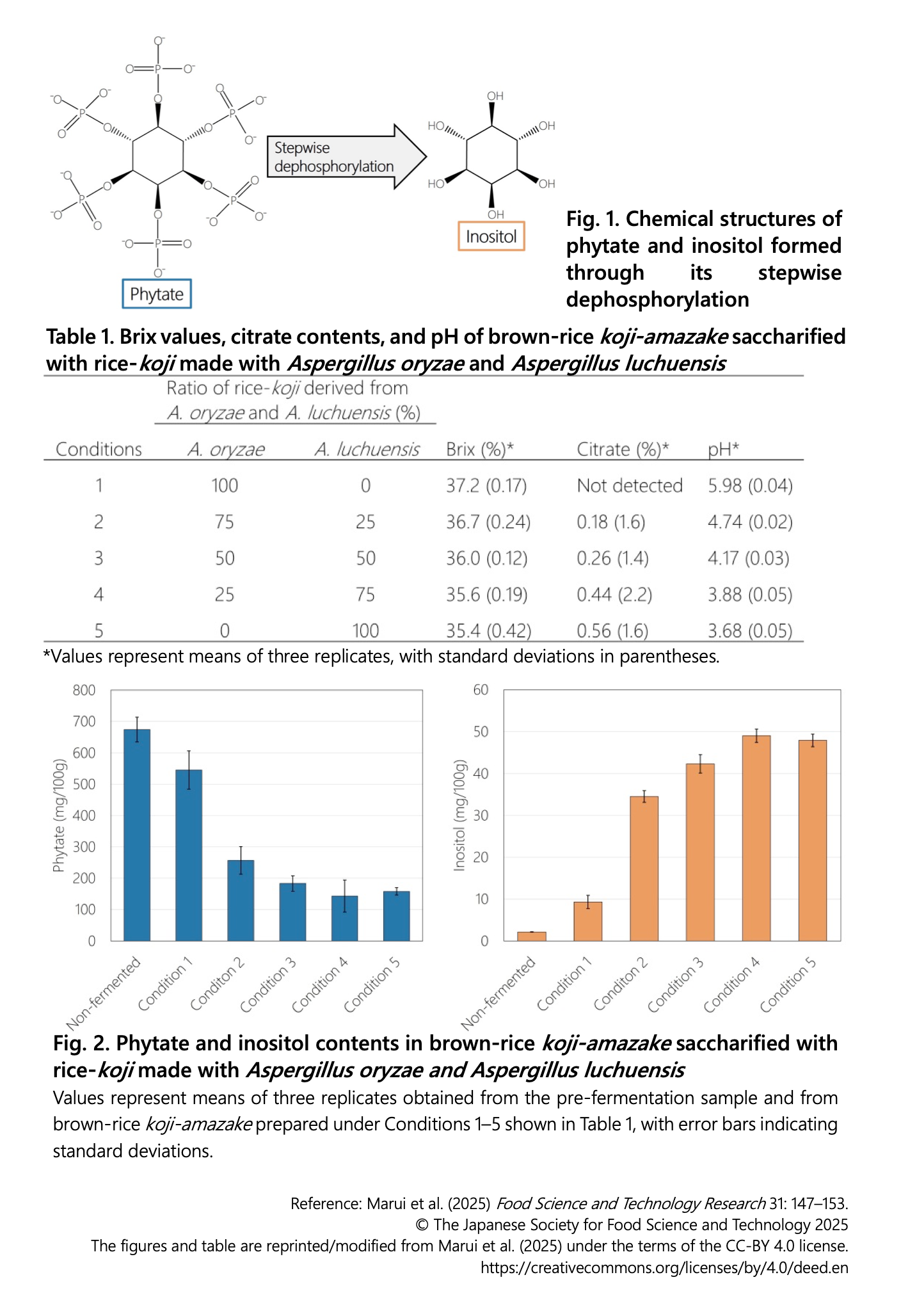
Brown rice provides B vitamins, minerals, and dietary fiber, but its bran layer contains phytate (inositol hexakisphosphate), which binds minerals and can reduce their bioavailability depending on processing and intake conditions. Therefore, brown rice products require processing approaches that enhance nutritional quality. Koji‑amazake is a sweet, fermented rice drink produced through enzymatic saccharification by rice-koji and contains glucose, amino acids, and B vitamins. While Aspergillus oryzae is typically used for rice-koji production, Aspergillus luchuensis, which produces citrate, is also utilized. Phytase and acid phosphatase from both fungi contribute to phytate dephosphorylation. Complete phytate dephosphorylation yields nutritionally important inositol (Fig. 1). This study evaluated acidification resulting from citrate produced by A. luchuensis‑derived rice‑koji and quantified phytate dephosphorylation and inositol formation in brown‑rice koji‑amazake saccharified with rice‑koji derived from A. oryzae or A. luchuensis, applied either individually or as a mixture.
When brown‑rice koji‑amazake was prepared using 5 g of brown rice (Himenomochi), 10 mL of water, and 3 g of dried rice‑koji and incubated at 55°C for 8 h, the product made solely with A. oryzae‑derived rice‑koji (Condition 1) showed a Brix value of 37.2%, a pH of 5.98, and no detectable citrate (Table 1). Increasing the ratio of A. luchuensis‑derived rice‑koji (Conditions 2–5) lowered Brix values and increased citrate content, leading to a decrease in pH (Table 1). In non-fermented mixtures with heat‑inactivated A. oryzae-derived rice-koji, phytate and inositol contents were 652 mg and 2.15 mg per 100 g, respectively, whereas Condition 1 yielded 516 mg of phytate and 9.26 mg of inositol (Fig. 2). Mixed‑rice-koji Conditions 2–4 significantly enhanced phytate degradation and inositol production compared with Condition 1 (Fig. 2). Condition 5, using only A. luchuensis-derived rice-koji, produced phytate (158 mg/100 g) and inositol (47.9 mg/100 g) levels similar to those of Condition 4 (Fig. 2).
The incorporation of A. luchuensis–derived rice‑koji effectively promotes phytate dephosphorylation in brown rice‑koji‑amazake, supporting product designs aimed at improving nutritional value. Citrate from A. luchuensis acidifies the product, which may enhance microbial stability and broaden flavor options, although consumer preference for sourness should be considered when adjusting formulations. Because this study used commercially available dried rice‑koji and enzyme activities vary among fungal strains, the practical application of these findings requires evaluating strain‑specific enzymatic properties of the rice‑koji used.
Figure, table
- Research project
- Program name
- Term of research
-
FY2021-2025
- Responsible researcher
-
Marui Junichiro ( Biological Resources and Post-harvest Division )
Shiraishi Yohei ( Bio'c Co., Ltd. )
Takeura Mio ( Bio'c Co., Ltd. )
Shompoosang Sirinan ( Institute of Food Research and Product Development, Kasetsart University, Thailand )
Varichanan Patthinan ( Institute of Food Research and Product Development, Kasetsart University, Thailand )
Boulom Sayviene ( National University of Laos )
- ほか
- Publication, etc.
-
Marui et al. (2025) Food Science and Technology Research 31 (2): 147−153https://doi.org/10.3136/fstr.FSTR-D-24-00170
- Japanese PDF
-
2025_B03_ja.pdf531.99 KB
- English PDF
-
2025_B03_en.pdf310.38 KB
* Affiliation at the time of implementation of the study.