



Pick Up
1490. Global Commodity Market Developments
Related Research Program
Information
1490. Global Commodity Market Developments
The Commodity Markets Outlook released by the World Bank Group in late April 2026 highlights that the war in the Middle East has delivered an unprecedented supply shock to global commodity markets. Attacks on energy infrastructure and the severe disruption of maritime shipping through the Strait of Hormuz have constrained supplies across a wide range of commodities, including crude oil, natural gas, fertilizers, and metals.
Prior to the conflict, the Strait of Hormuz served as a critical trade route, handling around 35 percent of global seaborne crude oil trade and about 20 percent of liquefied natural gas (LNG) shipments. In March 2026, global oil supply is estimated to have declined by approximately 10 million barrels per day—the largest supply disruption on record. Brent crude oil prices surged temporarily to nearly USD 120 per barrel and have since remained well above levels observed at the beginning of the year. Reduced LNG supplies have also driven sharp increases in natural gas prices across Asia and Europe.
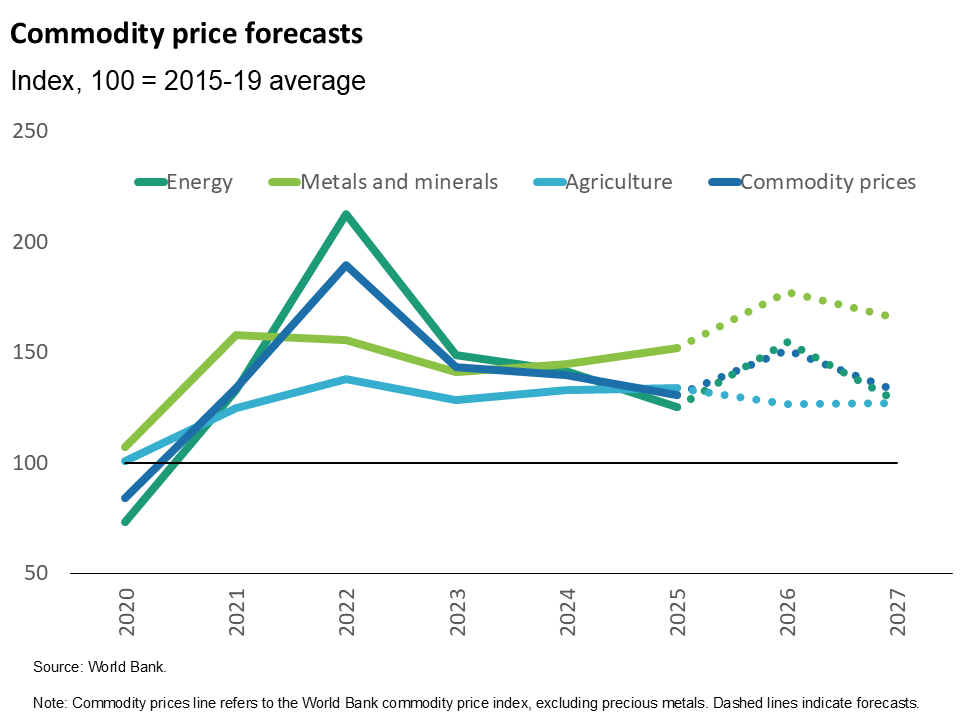
Against this backdrop, the World Bank forecasts that global commodity prices will rise by 16 percent year on year in 2026. Energy prices are projected to increase by 24 percent, with Brent crude oil averaging USD 86 per barrel. Fertilizer markets are also expected to be significantly affected: prices are forecast to rise by 31 percent, led by urea, for which the Gulf region is a major supplier. While overall food price inflation is expected to remain relatively moderate, the sharp increase in fertilizer prices is set to place the heaviest burden on farmers since 2022.
In metals markets, supply constraints combined with robust demand are expected to push prices for base metals such as aluminum to record highs. Precious metals are also experiencing elevated prices and heightened volatility, reflecting persistent geopolitical uncertainty.
Rising commodity prices are likely to reignite inflationary pressures in developing economies and weigh on economic growth. The World Bank warns that, if the conflict persists, as many as 45 million additional people could fall into acute food insecurity. The report emphasizes that governments should avoid broad, untargeted support measures and instead prioritize rapid, temporary assistance focused on the most vulnerable populations.
Reference
World Bank. 2026. Commodity Markets Outlook, April 2026.
https://openknowledge.worldbank.org/bitstreams/497b52a8-8294-4d4d-8c5f-…
Contributor: IIYAMA Miyuki, Strategic Coordination Office