



Pick Up
1443. Reflecting on the Impact of the Ukraine Invasion on Food Security
Related Research Program
Information
1443. Reflecting on the Impact of the Ukraine Invasion on Food Security
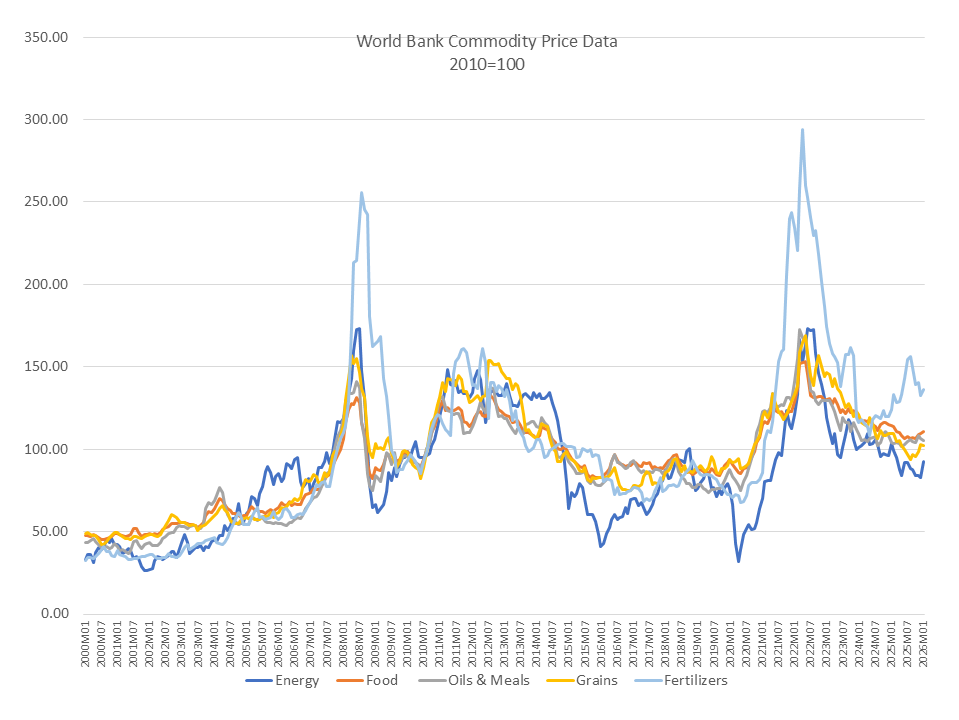
Four years ago, on February 24, 2022, Russia's invasion of Ukraine inflicted a new geopolitical shock on a world already facing supply chain disruptions due to the COVID-19 pandemic, dramatically increasing uncertainty surrounding food security. While food prices have now stabilized compared to their peak in March 2022, we must remain constantly vigilant regarding potential shock factors. Today, we'll look back at our February 24th blog posts from the past three years and examine the impact of the shock of the invasion of Ukraine on food security.
724. One Year Since Russia's Invasion of Ukraine (February 24, 2023)
Russia and Ukraine are among the world's leading producers and exporters of wheat, an important staple crop. They are also major producers and exporters of feed and oil crops such as maize and sunflower, and Russia is also a major exporter of fertilizer. Russia's invasion of Ukraine raised concerns about supply chain disruptions, leading to soaring food, fuel, and fertilizer prices. While international food prices have since stabilized, persistently high input prices, such as feed, oil crops, and fertilizer, have put pressure on producers and prompted many food companies to raise prices on processed products, resulting in ongoing cost-push food inflation around the world.
When we think of a food crisis, we often imagine a situation in which staple crops such as wheat, rice, and corn become scarce or inaccessible. However, today, crops produced around the world are not only consumed directly as food by humans, but also used for livestock feed, processing, and industrial purposes. Disruptions to these supply chains can lead to food crises.
Regionally, North and South America, Australia, and Europe specialize in processing and feed production. In contrast, in Africa and emerging Asian countries with rapid population and economic growth, food demand is growing significantly. However, productivity in many of these regions remains sluggish, and they are struggling to provide enough food to their growing populations.
Global food security requires international cooperation to avoid geopolitical disruptions to supply chains. At the same time, given the relative performance of food crop production in terms of increasing cultivated area and yields worldwide, technical assistance to sustainably improve productivity is extremely important in developing countries where food crop productivity is stagnating.
963. Food System Risks Following Russia's Invasion of Ukraine (February 22, 2024)
Two years have passed since Russia's invasion of Ukraine on February 24, 2022. The record-breaking rise in world food prices in 2022 reminded the international community that food production relies on global supplies of fuel and fertilizer, and that disruptions to supply chains due to geopolitical conflicts directly pose food security risks.
While global food prices have stabilized since the Black Sea Grain Agreement brokered by the United Nations and Turkey in July 2022, this is being reflected in food price inflation around the world with a time lag, increasing the vulnerability of food security in food-importing countries, particularly those experiencing currency depreciation. Russia also withdrew from the Black Sea Grain Agreement in July 2023, and since October of last year, instability in the Red Sea region, sparked by conflicts in the Middle East, has become a new source of supply chain disruption.
Meanwhile, risks posed by the limits of the global system are also affecting food price trends. In July 2023, the UN Secretary-General described this as the arrival of an era of global boiling. Not only do extreme weather events caused by climate change have a direct impact on food production, but the food system, which relies on fuel and fertilizer, itself is also a cause of climate change and biodiversity loss.
International cooperation is needed to eliminate uncertainty surrounding food security, and comprehensive measures are needed that incorporate scientific and technological innovation and behavioral change to build resilient and sustainable food systems.
1202. Global Food Crises of the Past Three Years (February 24, 2025)
Three years ago, on February 24, 2022, Russia's invasion of Ukraine triggered geopolitical risks involving major food exporting countries, threatening global food security.
The Russian invasion of Ukraine dramatically reduced exports from Ukraine, a major grain exporter. While the impact of the war on Ukraine's grain exports was mitigated by pre-war sowing and large inventories accumulated in 2022, there are concerns that future exports will be severely affected due to loss or damage to production facilities and unplanted areas.
Contributor: Miyuki IIYAMA, Information Program