



Pick Up
1565. Record-High Sea Surface Temperatures and the Compound Risks of Marine Heatwaves and Ocean Acidification
Related Research Program
Information

1565. Record-High Sea Surface Temperatures and the Compound Risks of Marine Heatwaves and Ocean Acidification
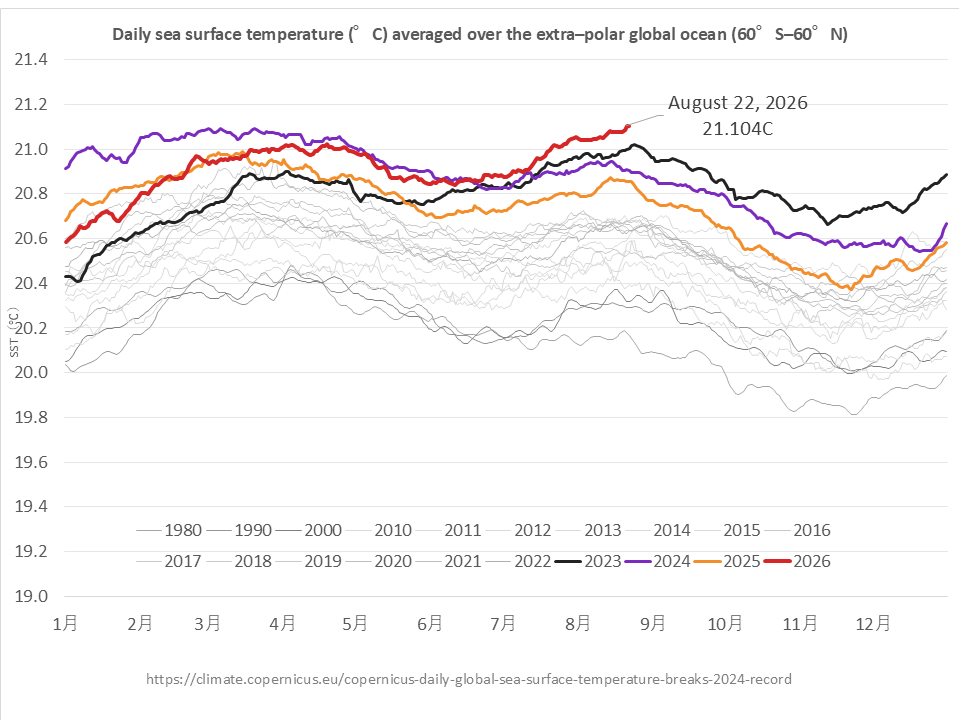
The Copernicus Climate Change Service (C3S) announced that the global average sea surface temperature reached a new record high on 22 August 2026. In addition, a study published in AGU Advances showed that “compound extremes,” in which marine heatwaves and ocean acidification extremes occur simultaneously, are occurring more frequently than expected, particularly in low- to mid-latitude ocean regions.
According to C3S, the global average sea surface temperature reached 21.1°C on 22 August 2026, exceeding the previous record of 21.09°C set in March 2024. This value is based on ERA5 reanalysis data for the ocean area between 60°S and 60°N. The ERA5 sea surface temperature data used in Climate Pulse cover the period from 1979 onward, when satellite observations are available, and are therefore considered more reliable.
Global sea surface temperatures usually peak in March or April, following the Southern Hemisphere summer. For this reason, the fact that the daily average record was broken in August is noteworthy. C3S explained that this record is consistent with the long-term warming of the ocean as well as the influence of a developing El Niño event in the tropical Pacific. C3S also noted that ocean warming may lead to sea level rise through thermal expansion, increase the likelihood and intensity of marine heatwaves, and intensify extreme precipitation and some storms. It also pointed out that higher seawater temperatures may reduce the ocean’s efficiency in absorbing carbon dioxide from the atmosphere.
Meanwhile, the study by Gregor and Gruber published in AGU Advances analyzed “compound extremes,” in which marine heatwaves (MHWs) and ocean acidification extremes (OAXs) occur simultaneously, using observation-based surface ocean data from 1982 to 2024. The analysis found that compound extremes occurred in low- to mid-latitude ocean regions, especially in persistently stratified areas, at a frequency approximately four times higher than would be expected if the two types of events occurred independently. According to the study, many compound extremes were relatively small in scale and short in duration, but some large and long-lasting cases were also identified, including the 2015 “Blob” in the Northeast Pacific, the 2023–2024 North Atlantic marine heatwave, and the 2011 event off Western Australia. In the case of the “Blob” in particular, impacts such as fisheries closures, effects on seabirds and marine mammals, and shifts in species distributions were reported.
The study also indicates that, in the process by which compound extremes occur, warming associated with marine heatwaves increases the concentration of hydrogen ions ([H+]) in seawater, thereby promoting ocean acidification extremes. At the same time, decreases in dissolved inorganic carbon (DIC) may act to weaken the rise in hydrogen ion concentration. The researchers explain that marine heatwaves and ocean acidification extremes are more likely to occur simultaneously under conditions in which the increase in [H+] associated with warming outweighs the moderating effect caused by decreases in DIC.
When marine heatwaves and ocean acidification extremes coincide, marine organisms may be exposed simultaneously to multiple stressors, namely high temperatures and acidification. The researchers state that understanding the past distribution, seasonality, and conditions under which such compound extremes occur will help improve understanding of marine ecosystems that may be particularly vulnerable to future risks.
The recent record-high sea surface temperature and the study discussed here are based on different sources of information and analyses. Taken together, however, they suggest the growing importance of viewing ocean warming not only as a standalone phenomenon, but also in terms of the potential for multiple stressors, including acidification, to occur simultaneously, and of assessing their impacts on marine ecosystems and coastal communities in an integrated manner.
References
Copernicus Climate Change Service. Daily global sea surface temperature breaks 2024 record. 24 August 2026. https://climate.copernicus.eu/copernicus-daily-global-sea-surface-tempe…
Gregor, L. and Gruber, N. Recent History of Surface Ocean Acidification Extremes That Compound Marine Heatwaves. AGU Advances. First published 8 August 2026. https://doi.org/10.1029/2025AV002112
Contributor: Miyuki IIYAMA, Strategic Coordination Office