



Pick Up
1495. April 2026 Ranked as the Third Warmest on Record, with Sea Surface Temperatures the Second Highest
Related Research Program
Information
1495. April 2026 Ranked as the Third Warmest on Record, with Sea Surface Temperatures the Second Highest
The Copernicus Climate Change Service (C3S), Europe’s climate monitoring agency, has released its latest analysis of global temperature, ocean conditions, and polar regions for April 2026.
According to the report, the global average temperature for April 2026 was the third highest on record, at 1.43°C above the pre-industrial level.
This confirms that the strong warming trend observed in recent years is continuing, underscoring the persistence of global climate change.
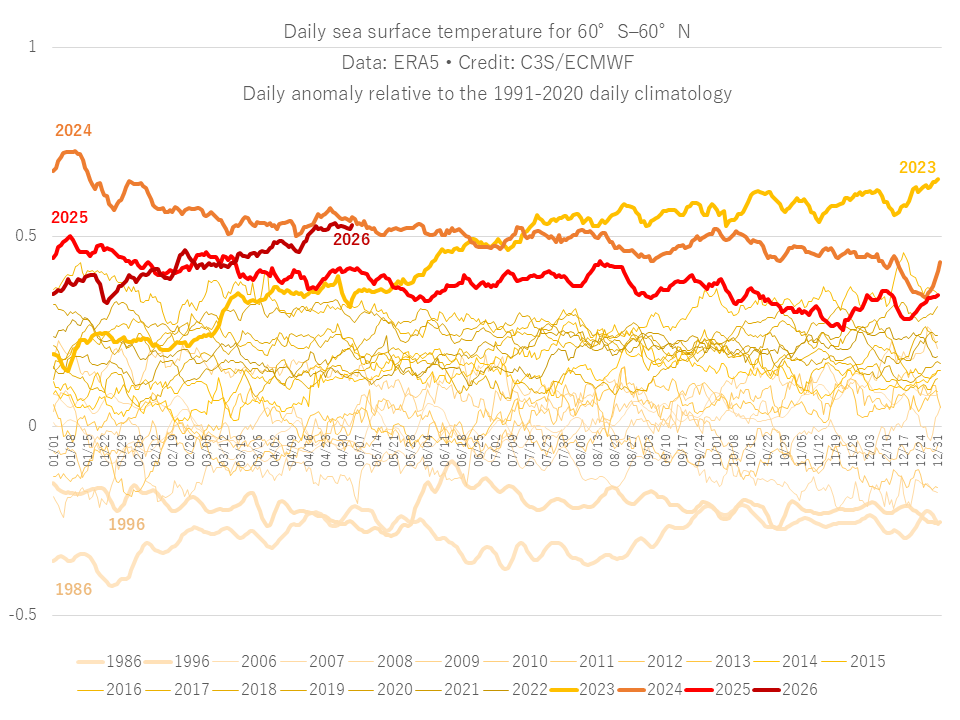
One of the most notable aspects of the report is the condition of the oceans. Sea surface temperatures ranked as the second highest ever observed for April, approaching the record levels seen in 2024. Exceptionally high temperatures were recorded across a vast area spanning the equatorial Pacific to the west coast of North America, where strong marine heatwaves have developed. With a transition toward El Niño conditions anticipated in the coming months, there are concerns that global temperatures may rise further.
In Europe, April 2026 was the tenth warmest on record overall, but this figure masks striking regional contrasts. Southwestern regions, including Spain, experienced record-breaking warmth, while Eastern Europe saw below-average temperatures. This coexistence of unusually warm and cool conditions is becoming a characteristic feature of recent climate patterns.
In the Arctic, sea ice extent ranked as the second lowest on record for April and has remained at persistently low levels since the beginning of the year. Despite this being a period when ice coverage would typically still be relatively extensive, it has stayed near record lows, highlighting the rapid pace of change in polar regions.
Precipitation patterns also showed significant regional variation. Much of western and central Europe experienced dry conditions due to persistent high-pressure systems, while Eastern Europe, the United Kingdom, and parts of the Mediterranean saw above-average rainfall.
Globally, severe flooding occurred in the Middle East and South-Central Asia, with flash floods reported across the Arabian Peninsula. At the same time, southern Africa faced worsening drought conditions, illustrating the simultaneous intensification of both wet and dry extremes.
In addition, tropical cyclones developed in the Pacific, contributing to a series of weather-related disasters worldwide. The concurrent occurrence of floods, droughts, and storms highlights increasing instability in the climate system.
The report emphasizes that not only rising temperatures but also simultaneous anomalies in oceans, sea ice, and precipitation are becoming more evident. This represents a crucial signal that climate change is evolving beyond gradual warming into a phase marked by increasing extremes.
While 2026 has already shown a pronounced warming trend, the expected development of El Niño could further amplify these conditions. The findings from this report provide important insights into the growing risks associated with future climate change.
Contributor: IIYAMA Miyuki, Strategic Coordination Office