



Pick Up
1398. 2025 Expected to be Second- or Third-Warmest Year on Record
Related Research Program
Information

1398. 2025 Expected to be Second- or Third-Warmest Year on Record
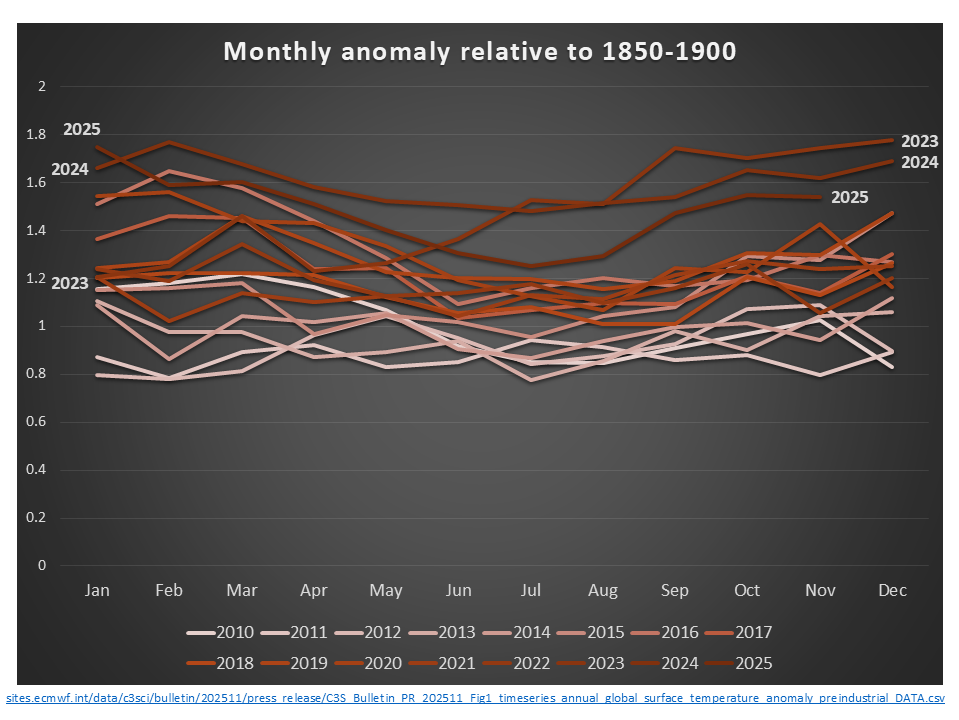
According to the latest data from the Copernicus Climate Change Service (C3S), 2025 is currently on track to be tied with 2023 as the second warmest year on record. The monthly climate update also revealed that November 2025 was the third warmest November globally, with significantly above-average temperatures in northern Canada and the Arctic Ocean. This November was marked by numerous extreme weather events, including a tropical cyclone in Southeast Asia that caused widespread, devastating flooding and loss of life.
November 2025 was the third warmest November globally, with an average surface temperature of 14.02°C, 0.65°C higher than the November average from 1991 to 2020. While November 2025 was 0.20°C cooler than the hottest November on record in 2023, it was 1.54°C warmer than the estimated 1850-1900 average used to define pre-industrial levels, making it the second month since April 2025 to exceed 1.50°C, after October 2025.
The global mean temperature anomaly from January to November 2025 was 0.60°C higher than the 1991-2020 average and 1.48°C higher than the pre-industrial baseline of 1850-1900, consistent with the full year of 2023, which is currently the second-warmest year on record. 2025 is virtually certain to be either the second or third warmest year on record.
While 2025 may not see a rise of more than 1.5°C above pre-industrial levels, the global average temperature from 2023 to 2025 is likely to exceed 1.5°C, marking the first time that a three-year period has exceeded 1.5°C during the observation period.
The global average temperature in autumn 2025 (September to November) was 0.67°C higher than the 1991-2020 average, making it the third warmest on record and lower than the autumns of 2023 and 2024. Temperatures were generally above average globally, particularly in northern Canada, over the Arctic Ocean, and across Antarctica. Temperature variations were observed in South Asia, and a significant cold anomaly was observed in northeastern Russia.
The average sea surface temperature (SST) between 60°S and 60°N in November 2025 was 20.42°C, the fourth-highest on record for the month and 0.29°C lower than the November 2023 record. Much of the North Pacific continued to experience well-above-normal SSTs, with the western part experiencing record-high temperatures. Meanwhile, in the central and eastern equatorial Pacific, SSTs were near or below the 1991-2020 average, reflecting a transition from ENSO-neutral conditions to a weak La Niña event.
Contributor: IIYAMA Miyuki, Information Program