



Pick Up
1418. 2025 Was the Third Warmest Year on Record
Related Research Program
Information

1418. 2025 Was the Third Warmest Year on Record
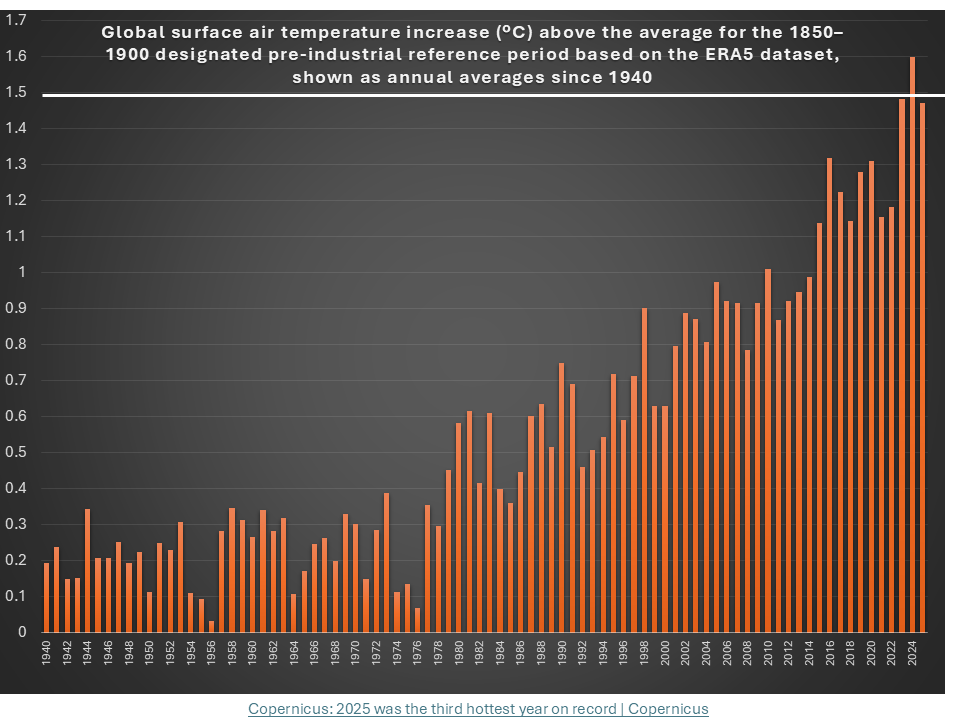
Data from the Copernicus Climate Change Service (C3S) indicate that 2025 was the third warmest year on record, slightly (0.01°C) cooler than 2023 and 0.13°C cooler than 2024, the warmest year on record. The past 11 years have been the warmest on record, and for the first time, the global average temperature for the past three years (2023-2025) exceeded the 1.5°C limit above pre-industrial levels (1850-1900). Global land temperatures were the second hottest on record, Antarctica recorded its highest annual temperature on record, and the Arctic recorded its second-hottest year ever recorded.
In 2025, global surface temperatures rose 1.47°C above pre-industrial levels. Multi-methodological estimates suggest that current long-term global warming levels are projected to be approximately 1.4°C above pre-industrial levels. Based on current warming rates, the long-term global warming limit of 1.5°C set by the Paris Agreement could be reached by the end of this century. This is more than a decade earlier than predicted based on the warming rates at the time the agreement was signed.
The three-year period from 2023 to 2025 was exceptionally warm for two main reasons. First, atmospheric greenhouse gas accumulation due to continued emissions and a decline in carbon dioxide absorption by natural sinks. Second, climate change amplified El Niño and other oceanic variability, resulting in anomalously warm sea surface temperatures across the oceans. Other contributing factors include changes in aerosol levels, low cloud cover, and atmospheric circulation.
In 2025, air and sea surface temperatures in the tropics were cooler than in 2023 and 2024, but many regions outside the tropics still experienced significantly higher-than-normal temperatures. The cooler tropical temperatures compared to 2023-2024 were partly due to a near-normal ("ENSO-neutral") or weak La Niña event in the equatorial Pacific Ocean that persisted throughout 2025. El Niño phenomena, combined with long-term anthropogenic global warming, tend to increase global temperatures, while La Niña phenomena tend to have the opposite effect.
Warmer temperatures in the polar regions partially offset the temperature decreases observed in tropical regions in 2025. Annual mean temperatures reached a record high in Antarctica and the second-highest on record in the Arctic. Record annual temperature increases were also observed in several other regions, including the northwestern and southwestern Pacific Oceans, the northeastern Atlantic, far eastern and northwestern Europe, and central Asia.
In 2025, half of the world's land area experienced above-average days of at least severe heat stress (defined as a perceived temperature of 32°C or higher). High temperatures also contributed to the spread and intensification of unusual wildfires in dry, windy regions. These wildfires released toxic air pollutants such as carbon dioxide, particulate matter, and ozone, which can have adverse effects on human health, particularly in parts of Europe (where total annual wildfire emissions were at an all-time high) and North America. These emissions significantly worsened air quality and had harmful effects on human health at both local and large-scale levels.
Contributor: IIYAMA Miyuki, Information Program