



Pick Up
1558. Expanding Forest Fires: Latest Data Highlights Growing Forest Risks in a Warming World
Related Research Program
Information
1558. Expanding Forest Fires: Latest Data Highlights Growing Forest Risks in a Warming World
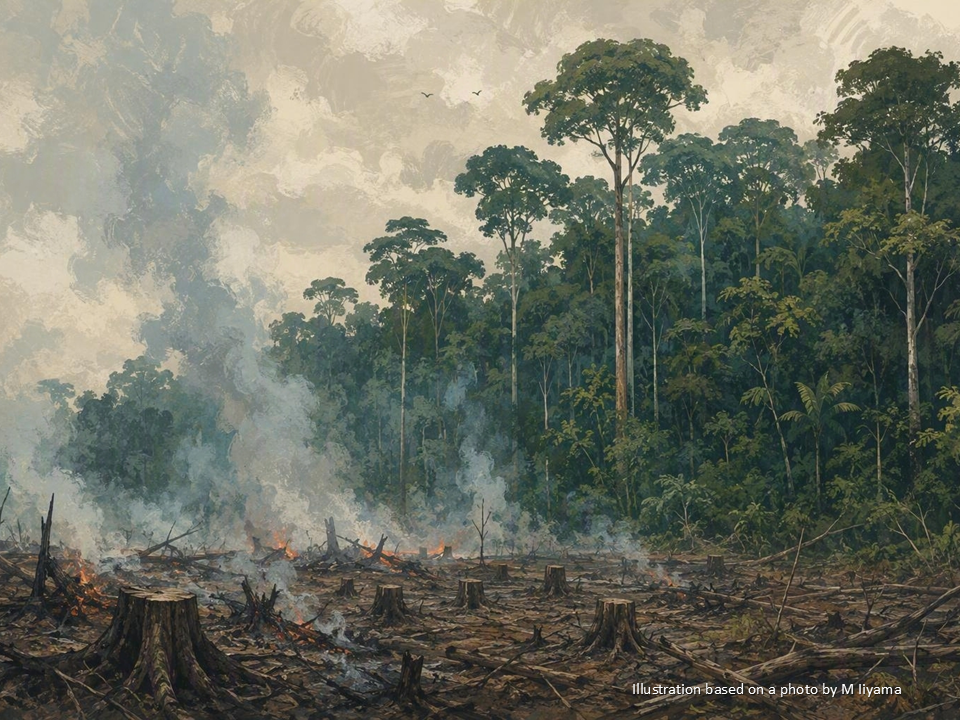
The World Resources Institute (WRI), drawing on the latest data from researchers at the University of Maryland, reports that forest fires have become more widespread and destructive over the past two decades, while their share of global tree cover loss has also increased.
According to data for 2001–2025, forest fires now burn more than twice as much tree cover each year as they did 20 years ago, and more than three times as much in the tropics.
In recent years, record-setting fires have become increasingly common. Globally, fires accounted for roughly 43% of annual tree cover loss between 2023 and 2025, a sharp increase from the average of about 27% during 2001–2022. Alongside persistent drivers such as agricultural expansion and logging, forest fires are becoming a major factor keeping global forest loss stubbornly high.
Climate change is one of the key forces behind this trend. Rising temperatures make extreme heat waves and droughts more likely, drying out forests and surrounding landscapes and creating conditions for larger and more frequent fires. When forests burn, carbon stored in trees and soils is released into the atmosphere, potentially accelerating climate change. This creates a worrying fire–climate feedback loop in which warming contributes to more fire, and fire in turn contributes to further warming.
Boreal forests have been particularly affected. More than 60% of all fire-related tree cover loss between 2001 and 2025 occurred in boreal regions. Although fire is a natural part of boreal forest ecosystems, warming at high northern latitudes is lengthening fire seasons, increasing drought frequency and driving larger and more severe fires. In Canada, around 7.8 million hectares of forest burned in 2023, and fire activity remained high in both 2024 and 2025.
Fire risk is also rising in tropical forests. Tropical rainforests are usually protected from fire by heavy rainfall and are not adapted to withstand it. However, land clearing for agriculture and pasture, forest degradation and drier conditions are contributing to larger fires in places such as the Amazon and Congo basins. In 2024, fire-related tree cover loss in the tropics exceeded 4 million hectares, and fire surpassed agriculture as the leading driver of tropical primary forest loss. El Niño events, which bring high temperatures and lower rainfall to some regions, can further intensify this risk.
In temperate and subtropical regions, forest fires often pose more direct risks to people, infrastructure and economies because forests are located near densely populated areas and managed landscapes. Heat waves and drought have fueled major fires across Europe, including in Spain, France and Portugal, while South Korea experienced record-breaking wildfires in 2025. In the United States, the expansion of wildland–urban interfaces is increasing both ignition risks and the scale of damage when fires occur.
Reducing forest fires requires action on multiple fronts. In addition to addressing climate change, countries need to curb deforestation and forest degradation, manage burning near forests, strengthen preventive measures such as fuel reduction and controlled burning, incorporate Indigenous Peoples’ and local communities’ knowledge into fire management, and use satellite data and early-warning systems for faster response. Forests store carbon, regulate water cycles, protect biodiversity, support food systems and safeguard communities. The growing threat of fire underscores the need to integrate forest management and climate action.
(Reference)
World Resources Institute, The Latest Data Confirms: Forest Fires Are Getting Worse https://www.wri.org/insights/global-trends-forest-fires
Contributor: Miyuki IIYAMA, Strategic Coordination Office