



Pick Up
1537. June 2026 Becomes the Hottest June on Record for Western Europe – Consecutive Heatwaves and Strengthening El Niño Increase Climate Risks
Related Research Program
Information

1537. June 2026 Becomes the Hottest June on Record for Western Europe – Consecutive Heatwaves and Strengthening El Niño Increase Climate Risks
The Copernicus Climate Change Service (C3S), Europe’s climate monitoring agency, has released its latest assessment of global temperature, oceanic, polar, and hydrological conditions for June 2026. According to the report, June 2026 was the second-warmest June ever recorded globally and the warmest June on record in Western Europe. In addition, sea surface temperatures reached a new June record, highlighting the continued accumulation of heat throughout the Earth's climate system.
The global average surface air temperature in June 2026 reached 16.54°C, which was 0.56°C above the 1991–2020 average for the month. Compared with the estimated pre-industrial average (1850–1900), the temperature was 1.39°C higher, making it the second-warmest June on record, behind only June 2024.
Ocean temperatures also remained exceptionally high. The average sea surface temperature (SST) across the extra-polar oceans (60°S–60°N) reached 20.86°C, the highest June value ever recorded. This exceeded the previous June record, set in 2024, by a narrow margin of 0.01°C. Particularly warm conditions were observed across the tropical Pacific, where El Niño conditions have emerged and are expected to strengthen in the coming months. If El Niño continues to develop, it could contribute to further global warming and an increased likelihood of extreme weather events worldwide.
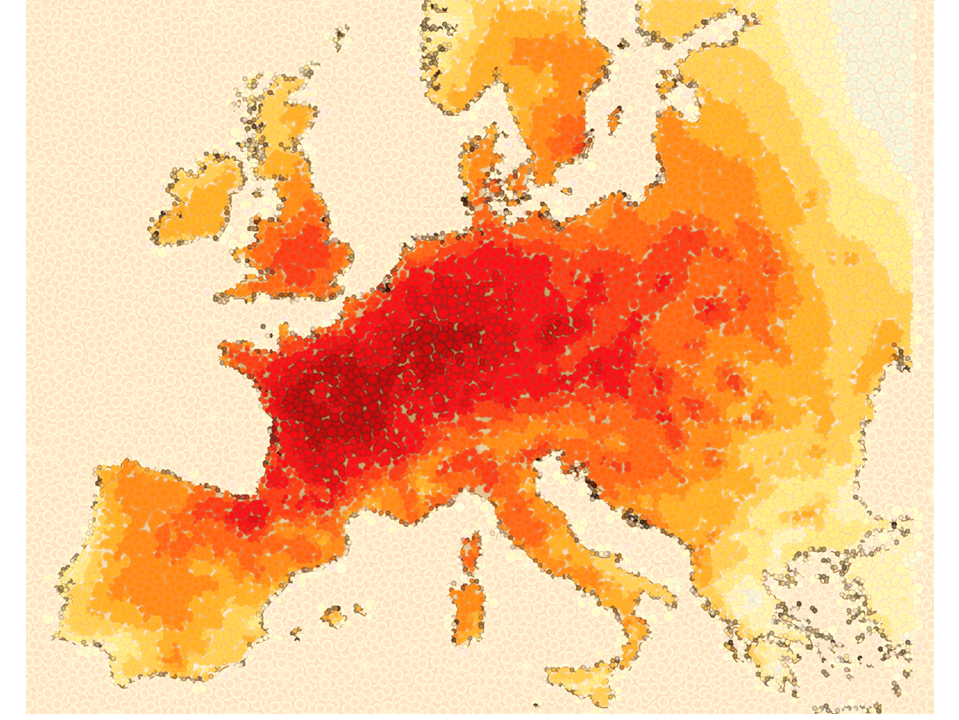
Europe experienced an exceptionally intense heatwave during the second half of June. Following a major heatwave in May, another heatwave emerged in early July, resulting in a succession of extreme heat events within a short period. Several countries in Western Europe broke both June temperature records and all-time national temperature records. Severe health impacts, including heat-related deaths, were also reported.
Western Europe recorded an average temperature of 20.74°C, which was 3.06°C above the 1991–2020 average and surpassed the previous June record set in 2025, making it the warmest June ever observed in the region. Across Europe as a whole, the average temperature reached 19.14°C, ranking as the second-highest June temperature on record.
Regarding precipitation, much of Europe experienced increasingly dry conditions. Italy, large parts of Western, Central, and Eastern Europe, as well as southern parts of the United Kingdom, received below-average rainfall. Persistent high-pressure systems combined with extreme heat increased drought risks throughout many regions. In particular, the combination of hot and dry conditions contributed to heightened wildfire activity across the Iberian Peninsula and southern France.
River flows also declined across extensive areas. Below-average river discharge was observed in France, Central Europe, Eastern Europe, and parts of northeastern Europe, indicating growing pressure on water resources. In contrast, Ireland, northern parts of the United Kingdom, the Baltic States, Scandinavia, Türkiye, and parts of Greece experienced wetter-than-average conditions, with some areas affected by localized flooding.
Globally, wetter-than-average conditions were reported in parts of North America, southern East Asia, southern Africa, and Australia. Meanwhile, dry conditions prevailed across portions of the United States and Canada, parts of Central and South America, the Middle East, Central Asia, and Russia.
In the polar regions, Arctic sea ice extent was approximately 5% below average, making it the sixth-lowest June extent on record. The most pronounced reductions were observed around Svalbard, Franz Josef Land, and the northern Barents Sea. Antarctic sea ice extent was also approximately 8% below average, ranking as the sixth-lowest June extent in the observational record.
The latest C3S findings indicate that climate change is not only reflected in rising average temperatures but also in simultaneous changes across multiple components of the climate system, including heatwaves, ocean warming, drought, wildfire risk, and sea-ice decline. The occurrence of successive heatwaves in May, June, and July suggests that both the frequency and intensity of extreme weather events may be increasing.
Furthermore, if El Niño continues to strengthen, the probability of extreme climatic events—including heatwaves, droughts, and heavy rainfall—may increase across many regions of the world. These changes represent not only a long-term rise in average temperatures but also growing extremity in terms of frequency, timing, and intensity. As a result, the impacts on society and economic activity are likely to become increasingly complex and severe. Continued monitoring, along with strengthened climate adaptation and risk management strategies, will be essential in the years ahead.
Contributor: Miyuki Iiyama, Strategic Coordination Office