



Pick Up
1533. Global Food Price Trends – June 2026
Related Research Program
Information
1533. Global Food Price Trends – June 2026
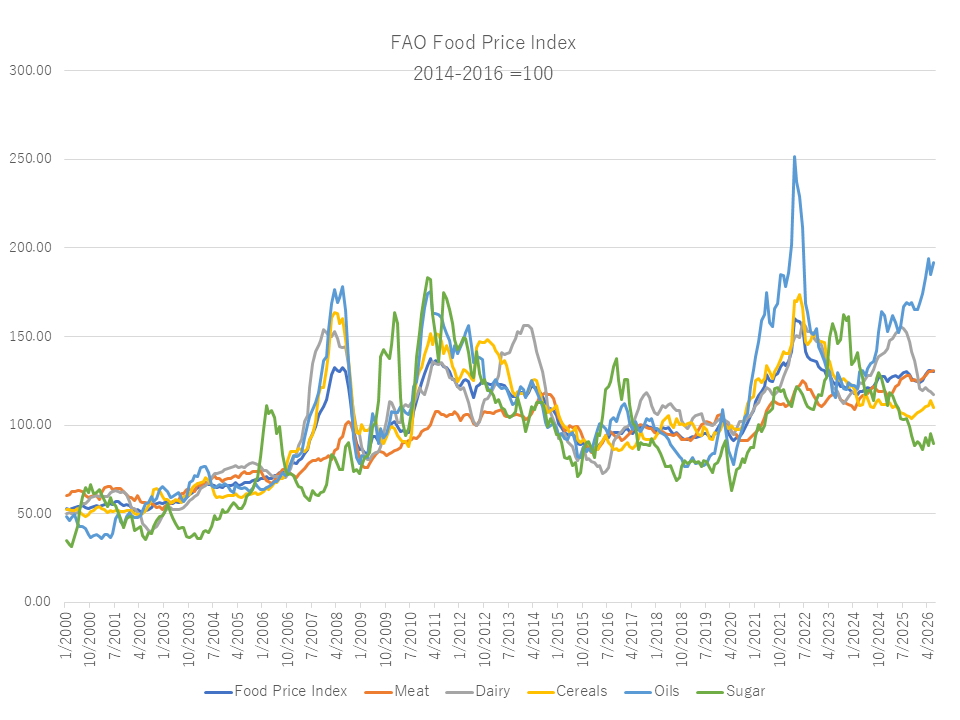
The FAO Food Price Index (FFPI) averaged 130.3 points in June 2026, down 0.3 percent month-on-month. Higher vegetable oil and meat prices were more than offset by declines in sugar, cereals and dairy prices. Compared with historical levels, the index was 1.7 percent above its value a year earlier, but still 18.7 percent below the all-time high recorded in March 2022.
The FAO Cereal Price Index averaged 110.2 points in June, declining 3.5 percent from May, while remaining 2.7 percent higher than a year earlier. Wheat prices fell 4.4 percent, reflecting smooth harvest progress and favorable supply prospects in the Black Sea region, which outweighed concerns over crop conditions in the United States and Australia. Although rainfall eased drought risks in some Australian growing areas, El Niño-related dryness and rising input costs continued to weigh on production prospects. A stronger U.S. dollar and lower crude oil prices also contributed to the decline. Maize prices fell 6.2 percent, supported by abundant export supply prospects from South America and weaker biofuel demand linked to lower energy prices. Barley and sorghum prices declined by 3.4 percent and 7.7 percent, respectively. In contrast, the FAO All Rice Price Index increased 3.2 percent, supported by stronger demand for Indica rice in Asia, weather-related concerns, and rising production and transportation costs.
The FAO Vegetable Oil Price Index averaged 192.0 points in June, increasing 3.8 percent from May and standing 23.3 percent above its level a year earlier. International palm oil prices rebounded due to stronger biodiesel demand in Indonesia and concerns over reduced export availability resulting from lower yields. Rapeseed oil prices also continued to rise, supported by adverse weather conditions in Australia and Canada, as well as robust biofuel demand. Sunflower oil prices remained broadly stable, as tighter supplies in the current season were largely offset by expectations of increased availability in the next marketing season. Soybean oil prices, however, edged lower amid seasonal supply increases in South America and declining crude oil prices.
The FAO Meat Price Index averaged 131.0 points in June, up 0.4 percent month-on-month and 4.0 percent above its year-earlier level, reaching a new record high. Poultry prices increased due to strong global import demand and temporary supply tightening associated with production adjustments in Brazil. Sheep meat prices also rose, reflecting firm international demand and limited exportable supplies. By contrast, pig meat prices continued to decline amid ample supplies in the European Union and subdued demand from Asian markets. Beef prices eased slightly, as expectations of higher exports from Australia and slower growth in Chinese import demand weighed on market sentiment.
The FAO Dairy Price Index averaged 117.4 points in June, declining 1.5 percent from May and remaining 24.5 percent below its level a year earlier. Skim milk powder prices fell as improved supply conditions in the European Union and the United States coincided with softer demand, ending a five-month period of continuous increases. Nevertheless, prices remained above year-earlier levels. Whole milk powder prices also declined, as weaker import demand from China outweighed purchases from Southeast Asia and the Middle East. Butter and cheese prices fell on improved milk availability and higher production in both the European Union and the United States. Notably, cheese prices recorded their eleventh consecutive monthly decline.
The FAO Sugar Price Index averaged 89.7 points in June, down 5.7 percent from May and 13.3 percent lower than a year earlier. The decline was largely driven by developments in Brazil, where ethanol prices fell for a third consecutive month through June. As a result, more sugarcane was diverted to sugar production rather than ethanol, increasing export availability and exerting downward pressure on international sugar prices. Depreciation of the Brazilian real further encouraged exports. Nevertheless, concerns persist that El Niño conditions could adversely affect sugar production in major producing countries such as India and Thailand during the 2026/27 season, limiting the extent of the price decline.
Overall, global food prices remained broadly stable in June 2026, although substantial differences emerged across commodity groups. Improved supply conditions pushed cereal and sugar prices lower, while vegetable oil and meat prices moved higher. Looking ahead, market attention will remain focused on the potential impact of El Niño on major cereal and sugar crops, as well as developments in energy markets and biofuel demand, both of which are expected to remain key drivers of international food price movements in the months ahead.
Contributor: Miyuki IIYAMA, Strategic Coordination Office