



Pick Up
1530. “Hydrologic Whiplash”: Accelerating Swings Between Wet and Dry Under Climate Change
Related Research Program
Information
1530. “Hydrologic Whiplash”: Accelerating Swings Between Wet and Dry Under Climate Change
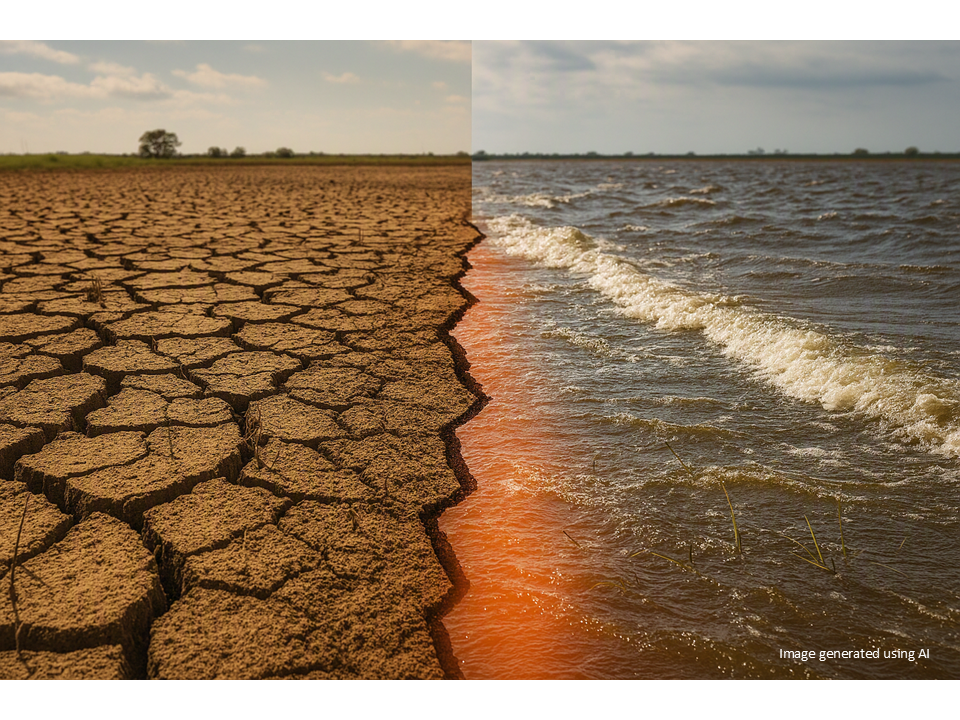
With the progression of climate change, extreme events in which droughts and floods rapidly alternate over short periods are increasingly being reported worldwide. These abrupt swings between dry and wet conditions are referred to as hydrologic whiplash and are gaining attention as a framework that integrates water-related hazards that have traditionally been analyzed separately. A perspective article published in Proceedings of the National Academy of Sciences (PNAS) introduces this concept and discusses its recent trends.
The article highlights, for example, the case of California in late 2022, where severe drought conditions were followed within a short time by intense flooding caused by successive atmospheric rivers. Such rapid transitions between extreme dryness and extreme wetness are thought to be increasing in both frequency and intensity as climate change progresses.
One key driver of this phenomenon is the increase in atmospheric water-holding capacity as temperatures rise. A warmer atmosphere can retain more water vapor, leading to intensified precipitation during wet periods, while also enhancing evapotranspiration during dry periods, thereby exacerbating drought conditions. As a result, the variability of precipitation and hydrological conditions increases, making extreme swings between dry and wet states more likely.
Recent research further suggests that these rapid transitions have become more frequent over the past several decades, particularly on relatively short timescales ranging from weeks to months. These findings indicate a growing instability in hydrological conditions.
This trend presents new challenges for water resource management. For instance, reservoir levels may fluctuate dramatically within short periods, making conventional operation strategies less effective. In addition, existing forecasting models—largely based on historical climate conditions—may not adequately capture these rapid transitions, limiting their ability to provide reliable predictions.
Moreover, the impacts of hydrologic whiplash extend beyond water resources. The sequential occurrence of droughts and floods within the same region can amplify economic and social burdens, including increased damage to infrastructure, instability in agricultural production, and disruptions to ecosystems.
Importantly, the article emphasizes the need to focus not only on individual extreme events but also on the transitions between them. This perspective suggests that future efforts should prioritize improved prediction methods that account for rapid shifts, as well as more flexible and adaptive approaches to water management.
Finally, it is important to recognize that the impacts of climate change are not limited to gradual shifts in average conditions. Rather, they increasingly manifest as greater variability and intensified extremes. The concept of hydrologic whiplash provides a useful framework for understanding this emerging risk structure and offers valuable insights for the development of future climate adaptation strategies.
Reference:
Amy McDermott, Driven by climate change, sudden swings between wet and dry create “hydrologic whiplash”, Proceedings of the National Academy of Sciences (2026).
https://www.pnas.org/doi/10.1073/pnas.2617960123
Contributor: IIYAMA Miyuki, Strategic Coordination Office