





From February 17 to 18, 2026, the “TERRA Africa Project FY2025 Activity Report Meeting” was held at the University for Development Studies (UDS) in Tamale, Northern Ghana. A total of 54 participants attended, including researchers from JIRCAS, UDS, and the Savannah Agricultural Research Institute (SARI), as well as representatives from the Sasakawa Africa Association (SAA) and The Nippon Foundation.
The TERRA Africa Project was launched in FY2023 with the aim of promoting regenerative agriculture in sub-Saharan Africa, and will enter its third year of implementation at the end of March 2026. In FY2025, field trials and farmer surveys were conducted in Ghana and in SAA’s focus countries—Nigeria, Mali, Ethiopia, and Uganda—based on technologies developed by JIRCAS and implemented in collaboration with SAA. As a result, highly reliable data were obtained on the effectiveness and adaptability of regenerative agriculture technologies under diverse local environmental conditions.
In his opening remarks, Prof. Mohammed Iddrisu, Principal at UDS, emphasized the importance of regenerative agriculture in restoring soil health, improving productivity, and strengthening the profitability and resilience of smallholder farmers. He highly praised the project’s contributions and called for scaling up its results and creating a lasting impact.
In the research results session, reports were presented on increases in soil organic carbon and improvements in biological properties through green manures, as well as enhanced soil water retention through minimum tillage. In particular, it was shown that combining these practices with organic amendments such as compost enriched with phosphate rock is highly effective. In application trials on maize and soybean, stable growth responses were obtained by combining organic amendments with chemical fertilizers, indicating high potential for application to smallholder farmers.
In his address, Mr. SEKO Masato, Director of the Social Innovation Program at The Nippon Foundation, highly appreciated both the scientific robustness and policy relevance of the project’s results, and stressed the importance of continuing and expanding outreach activities through collaboration with SAA. SAA President SUZUKI Shuichi also noted that the project has brought tangible improvements to smallholder livelihoods, and highlighted the need for further collaboration and expansion.
Through this report meeting, the FY2025 achievements were shared among stakeholders, fostering a common understanding aimed at scaling up proven technologies, maximizing their impact, and strengthening partnerships among participating organizations. The participants reaffirmed their commitment to continue promoting site-specific research and extension activities in an integrated manner, thereby contributing to the realization of sustainable agriculture in sub-Saharan Africa.
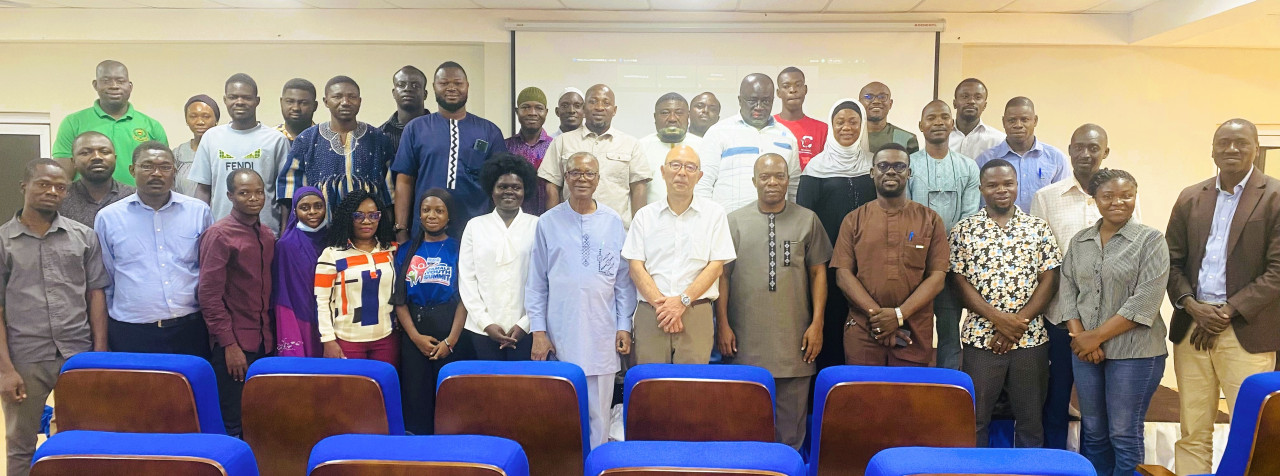
Commemorative photo with meeting participants