



Pick Up
1556. July 2026 Sets a New July Record for Global Ocean Surface Temperatures as Heat and Drought Drive Wildfires in Western Europe
Related Research Program
Information
1556. July 2026 Sets a New July Record for Global Ocean Surface Temperatures as Heat and Drought Drive Wildfires in Western Europe
The Copernicus Climate Change Service (C3S) reported that July 2026 was the joint-second warmest July globally, with an average surface air temperature of 16.90°C, 0.67°C above the 1991–2020 average and 1.47°C above the estimated pre-industrial baseline. The month also set a new July record for sea surface temperatures (SSTs) across the extra-polar oceans.
The average SST across the extra-polar oceans (60°S–60°N) reached 20.96°C, exceeding the previous July record of 20.89°C set in 2023. Exceptionally warm waters persisted across much of the tropical Pacific as El Niño conditions developed, while record July SSTs around Europe were associated with strong or severe marine heatwaves along the Atlantic coast and in the western Mediterranean.
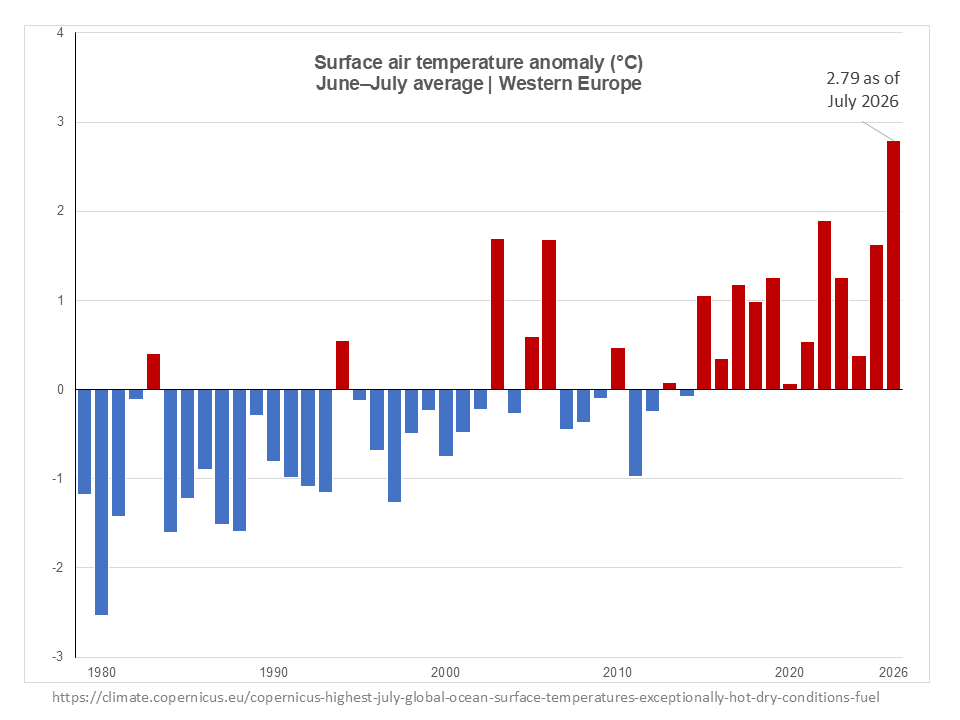
Western Europe recorded its hottest June–July period on record, with an average temperature of 21.62°C, or 2.79°C above average. July brought the region’s third and fourth heatwaves since May, underscoring the persistence of extreme heat since early summer.
Dry conditions also intensified across much of Western and Central Europe. France, Spain, parts of Germany, and the United Kingdom reported exceptional or record deficits in precipitation and/or soil moisture, and Western Europe’s surface soil moisture in July 2026 was significantly lower than during July 2022. These hot and dry conditions contributed to exceptional wildfire activity in terms of burnt area and emissions.
River flows were much lower than average across many dry regions, with the Seine, Rhine, and Danube particularly affected, increasing pressure on water supply, irrigation, ecosystems, river transport, and energy production. In contrast, parts of northeastern, southeastern, and eastern Europe were wetter than average, with localized flooding reported.
Arctic sea ice extent ranked as the sixth lowest for July, while Antarctic sea ice extent ranked as the fifth lowest for July, with below-average sea ice cover in most Antarctic ocean sectors except the Amundsen Sea.
The latest C3S findings show how rising temperatures, ocean warming, drought, wildfire risk, reduced river flows, and sea-ice decline are increasingly interconnected. Continued monitoring, climate adaptation, and strengthened risk management will be essential as compound climate extremes become more frequent and severe.
Contributor: Miyuki Iiyama, Strategic Coordination Office