


Pick Up
1527. Cutting-Edge Research Connecting the World from a Subtropical Island: Initiatives of the JIRCAS Tropical Agriculture Research Front (Ishigaki)
Related Research Program
Information
1527. Cutting-Edge Research Connecting the World from a Subtropical Island: Initiatives of the JIRCAS Tropical Agriculture Research Front (Ishigaki)
June 29 is the “International Day of the Tropics,” established by the United Nations.
A search for the locations of JIRCAS reveals two sites in Japan: the headquarters in Tsukuba City, Ibaraki Prefecture, and the JIRCAS Tropical Agriculture Research Front (TARF) in Ishigaki City, Okinawa Prefecture. TARF was established on Ishigaki Island in 1970 as the Okinawa Subtropical Station of the Tropical Agriculture Research Center, the predecessor of JIRCAS. The name “Nekken” became widely used as a familiar nickname among local residents from the time of its establishment.
The reason TARF is located in Ishigaki Island far from the headquarters is that the island’s natural conditions are similar to those of tropical and subtropical regions—the primary focus of JIRCAS research. This location allows researchers to conduct experiments under conditions comparable to those in overseas target regions.
Ishigaki Island lies between 24°21′ and 24°35′ north latitude and 124°05′ and 124°20′ east longitude. It is approximately 2,000 km from Tokyo, 1,200 km from Kagoshima, 410 km from Naha, and about 280 km from Taipei, Taiwan. Situated at the center of the Yaeyama Islands at the southern end of the Ryukyu Archipelago, the island maintains diverse ecosystems ranging from coral reef seas to Mount Omoto (526 m), the highest peak in Okinawa Prefecture.
The average annual temperature is about 24°C, and annual precipitation averages around 2,100 mm. However, during the summer, periods of high temperature combined with low rainfall can cause drought. Additionally, typhoons that approach or make landfall several times a year bring beneficial rain but can also cause significant damage to agriculture and local communities.
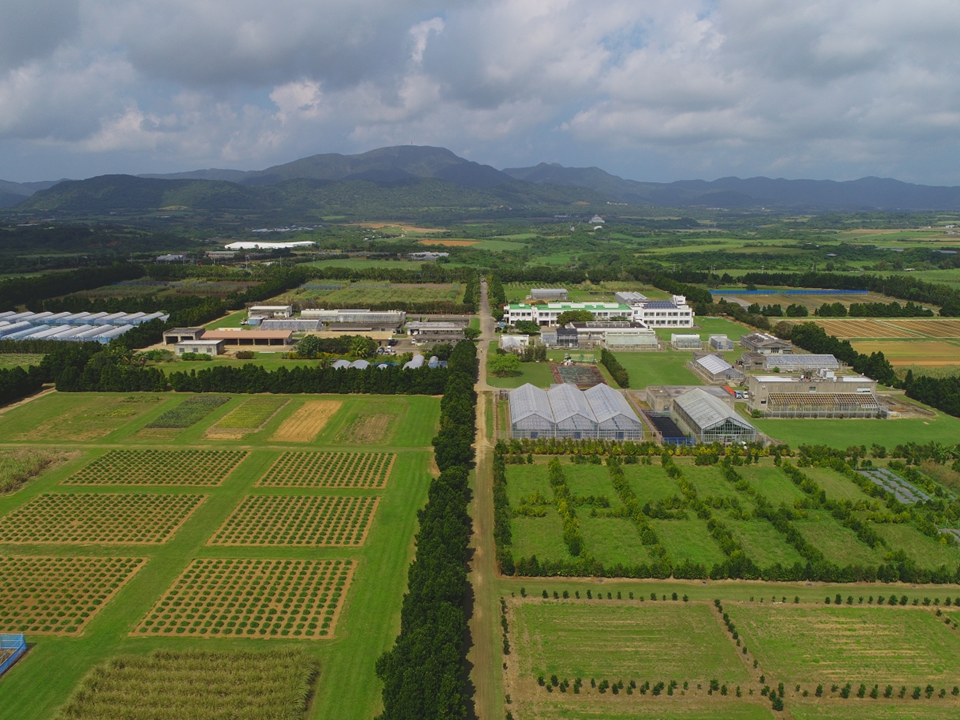
Under these subtropical conditions, TARF is equipped with approximately 21 hectares of experimental fields and various greenhouses. Using these facilities, the center conducts fundamental and basic research aimed at developing agricultural production technologies primarily for developing regions and island areas in the Asia-Pacific. It also carries out field demonstration trials to apply and verify research outcomes in target regions.
In recent years, the impacts of climate change—such as rising temperatures, more frequent typhoons and heavy rainfall, and sea-level rise—have been reported both in Japan and worldwide. In agriculture, challenges include reduced yields and quality due to drought, as well as heat stress damage. The need to reduce greenhouse gas emissions has also been emphasized.
Meanwhile, global economic and social changes have caused fluctuations in energy prices and logistics costs, affecting food prices worldwide. These international trends and market fluctuations also impact agricultural management in Japan, particularly through rising fuel and fertilizer costs, posing challenges to maintaining long-term production systems.
In response to these circumstances, JIRCAS is strengthening the functions of TARF and advancing research that leverages Ishigaki Island’s climatic and geographical advantages as a frontline base for addressing global food and environmental issues. In addition to providing technical contributions to developing regions, TARF supports domestic agriculture through activities such as breeding rice and sugarcane varieties, conserving and managing genetic resources of tropical crops, and developing varieties of legumes, vegetables, tropical fruit trees, and forage crops suited to the southwestern islands.
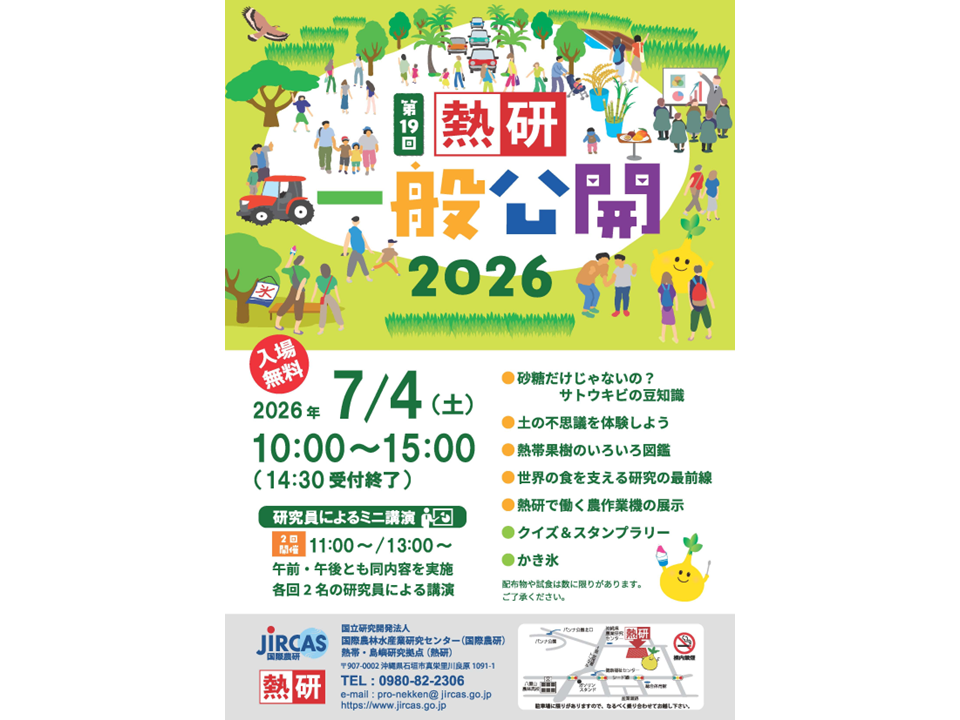
An open house is scheduled at TARF on Saturday, July 4, 2026. For details, please check the official JIRCAS website. Those nearby are encouraged to attend.
(Contributor: YAMANAKA Shinsuke, JIRCAS Tropical Agriculture Research Front)