



Pick Up
1516. May 2026 Was the Second Warmest on Record, Marked by an Early Heatwave and Signs of Transition to El Niño
Related Research Program
Information
1516. May 2026 Was the Second Warmest on Record, Marked by an Early Heatwave and Signs of Transition to El Niño
The Copernicus Climate Change Service (C3S), the European Union’s climate monitoring agency, has released its latest analysis of global temperature, ocean, and polar conditions for May 2026. According to the report, the global average surface air temperature for May 2026 was the second highest on record, reaching 1.42°C above the estimated pre-industrial (1850–1900) level. This places it just behind May 2024 and highlights the exceptionally high global temperatures since the beginning of 2026.
Ocean conditions also remained anomalously warm. The global average sea surface temperature (SST) for May 2026 ranked as the second highest on record for the month. Particularly elevated SSTs were observed across large parts of the tropical Pacific, where conditions indicate an ongoing transition toward an El Niño event. If El Niño develops in the coming months, it could further amplify global temperatures and increase the likelihood of extreme weather events.
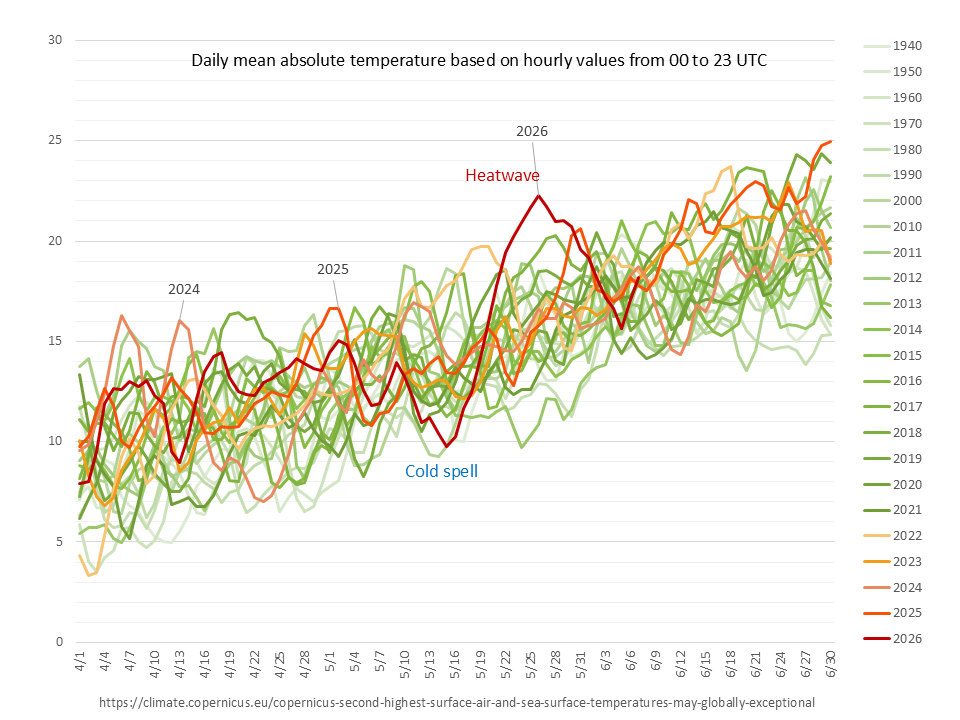
Europe experienced pronounced temperature contrasts during the month. While conditions remained cooler than average until mid-May, a rapid and significant warming followed. Western Europe experienced an exceptionally early and intense heatwave, with May temperature records broken in countries including France, the United Kingdom, Ireland, and Portugal. “Feels-like” temperatures reached between 35°C and 40°C in some areas. This abrupt shift likely intensified impacts by limiting the time available for populations, agriculture, and ecosystems to adapt to the sudden heat.
Precipitation patterns also showed strong regional contrasts. Western, central, and southern Europe—including parts of Spain and Italy—experienced notably drier-than-average conditions. In contrast, above-average rainfall led to flooding in Turkey, the Black Sea region, and parts of northern Europe. This simultaneous occurrence of drought and heavy rainfall reflects a typical pattern of intensification in the hydrological cycle associated with climate change.
Hydrological conditions further underscored these disparities. River flows declined across central and eastern Europe due to persistent rainfall deficits, while parts of Turkey and the Iberian Peninsula saw increased river flows due to earlier precipitation and heavy rainfall events. Globally, wetter-than-average conditions were observed in parts of North America, Asia, southern Africa, and Australia, whereas widespread drying affected regions such as Central Asia and large parts of South America.
In the polar regions, Arctic sea ice extent ranked as the fourth lowest on record for May, remaining below average across most sectors. The most pronounced reductions were observed in the northern Barents Sea and around Svalbard. Antarctic sea ice extent was also approximately 9% below average, continuing the trend of persistently low levels observed in recent years.
Overall, the analysis shows that not only are temperatures rising, but multiple components of the climate system—including the ocean, precipitation, and sea ice—are changing simultaneously, with increasing variability. The occurrence of an unusually early and intense heatwave during this period highlights a trend toward earlier onset and greater intensity of extreme events, suggesting a growing climate risk.
Furthermore, as the transition toward El Niño progresses, global temperatures and the uneven distribution of extreme weather events may intensify over the coming months to a year. However, uncertainties remain regarding the strength and duration of this potential event, underscoring the need for continued monitoring.
The latest C3S report demonstrates that climate change is no longer limited to gradual increases in average temperature but is increasingly characterized by extremes across three dimensions: timing, intensity, and regional variability. These changes are adding complexity to societal and economic impacts, making long-term adaptation and risk management ever more critical.
Contributor: IIYAMA Miyuki, Strategic Coordination Office