



Pick Up
1500. From JIRCAS Southeast Asia Liaison Office: The Royal Ploughing Ceremony
Related Research Program
Information
1500. From JIRCAS Southeast Asia Liaison Office: The Royal Ploughing Ceremony
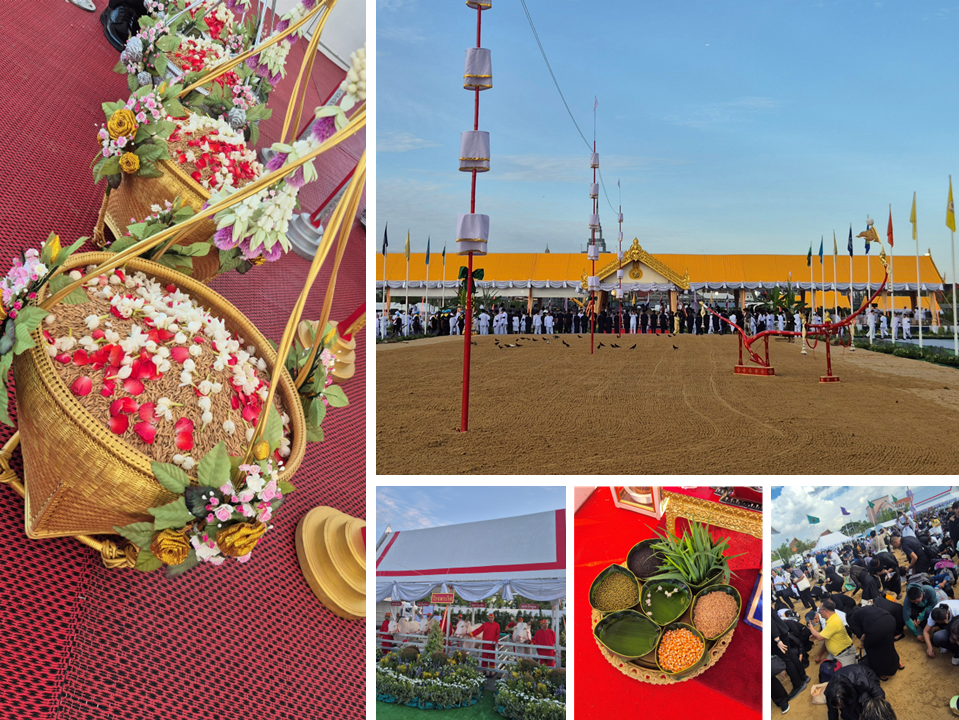
The Royal Ploughing Ceremony in 2026 was held on May 13, and I attended the event upon invitation from the Department of Agriculture (DOA) under the Ministry of Agriculture and Cooperatives of Thailand. The venue was attended by many officials and agricultural practitioners, reflecting the high level of national interest in the ceremony.
In Thailand, the traditional royal ceremony known as the Royal Ploughing Ceremony is held every May at Sanam Luang, the ceremonial ground in front of the Grand Palace in Bangkok. This ritual marks the beginning of the agricultural season while also serving as an important national event to forecast weather conditions and crop yields for the year. Its history dates back to the Sukhothai period. The ceremony follows a unique format that blends elements of Buddhism and Brahmanism, symbolizing the deep connection between the state and agriculture.
In 2026, the ceremony was held on May 13 and was conducted with great solemnity in the presence of His Majesty King Rama X (Maha Vajiralongkorn). As this event is closely associated with Thailand’s Ministry of Agriculture and Cooperatives, I had the opportunity to attend the ceremony upon invitation from the Department of Agriculture (DOA). The venue was filled with numerous officials and agricultural practitioners, reflecting the high level of national interest in the event.
During the ceremony, after the sacred oxen plough the field, a divination ritual is conducted in which the oxen choose from several offerings placed before them. In 2026, the oxen selected beans, water, grass, and alcohol, which were interpreted as signs of abundant food production, stable water resources, and growth in trade and the economy. These interpretations are notable in that they are linked not only to agricultural prospects but also to the broader national economic outlook.
On the other hand, the cloth-length divination performed during the ceremony suggested that rainfall would be somewhat limited, indicating that certain regions may need to exercise caution regarding water resources. In this way, the Royal Ploughing Ceremony plays a role not only as a traditional ritual but also as an influence on agricultural policy and public awareness.
Even in modern Thailand, this ceremony serves as an opportunity to show respect for farmers and to reaffirm the importance of agriculture, continuing to attract nationwide attention. Through my participation, I was able to once again appreciate the cultural characteristic of Thailand, where agriculture, the monarchy, and society are closely interconnected.
Contributor: KANAMORI Norihito, Southeast Asia Liaison Office