



Pick Up
1466. Green Asia Report Series No. 4: Local Biochar Use for Sustainable Agriculture in Asia (Second Edition)
Related Research Program
Information



1466. Green Asia Report Series No. 4: Local Biochar Use for Sustainable Agriculture in Asia (Second Edition)
The revised edition of the Green Asia Report Series No. 4, "Local Biochar Use for Sustainable Agriculture in Asia," has been published. This series aims to introduce scalable technologies that can be shared in the Asia-Monsoon region and contribute to food systems transformation in the region by serving as a reference for various stakeholders, including government officials, researchers, extension officers, producers, and the private sector. The fourth issue focuses on the growing interest in biochar, explaining recent research findings and providing technical information useful for practical applications. In the second edition, the method for simple yet accurately estimation of carbon sequestration by biochar has been updated to reflect the expanding range of applicable biomass. Additionally, the latest international trends regarding biochar certification and carbon credits have been added. The overview of the report is as follows.
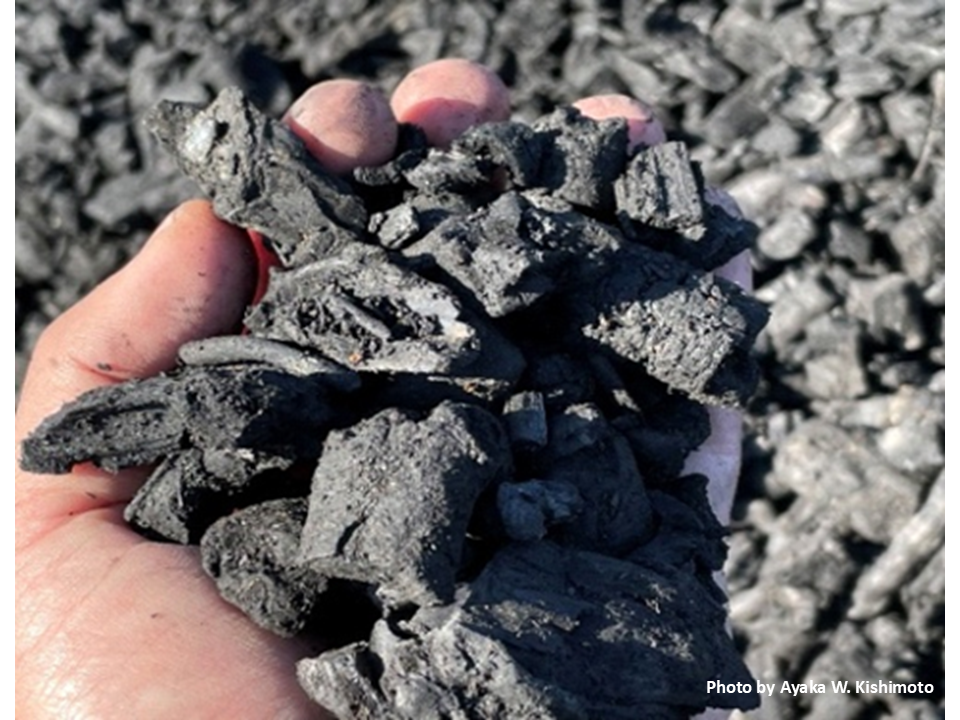
Biochar is derived from biomass through thermochemical conversion at temperatures exceeding 350°C under oxygen-free or limited-oxygen conditions. When applied to mineral soils, biochar can improve the soil environment and moderately increase soil pH in acidic soils. Furthermore, because it sequesters carbon in the soil, it is recognized as one of the carbon dioxide removal (CDR) technologies. The improvement of the soil environment is attributed to the structure of biochar. Its porous structure serves as a habitat for soil microorganisms, retains nutrients, and plays an important role in nutrient cycling and the maintenance of soil ecosystems. The properties of biochar depend on the feedstock and pyrolysis methods. Wood-based biochar generally has a higher carbon content, whereas manure-based biochar tends to provide more plant-available nutrients. To maximize the benefits of biochar, it is important to identify locally available biomass, select an appropriate pyrolysis system, and utilize the resulting biochar according to its specific properties.
Because biochar has public benefits, such as mitigating climate change by removing atmospheric carbon dioxide, it is sometimes difficult to expect individuals to cover the costs of its implementation. Therefore, to promote its implementation, it is effective to provide policy frameworks and incentives that benefit all stakeholders contributing to the public interest. In Japan, there are many initiatives in this field, with examples including subsidies, carbon credits, and the eco-branding of vegetables grown in biochar-applied farmland. To provide such incentives fairly and rationally, it is necessary to estimate the amount of carbon sequestration by biochar. Conventional estimation using elemental analysis requires significant time and cost, but recently, a proximate analysis method compliant with Japanese Industrial Standards has been developed, making it possible to estimate in a shorter time and at a lower cost. This method is included in “Technology Catalog Contributing to Production Potential and Sustainability in the Asia-Monsoon Region” as “a simple and accurate method for estimating soil carbon sequestration using biochar based on proximate analysis.”
Further research is needed on the long-term effects of using biochar on farmland. However, a comprehensive meta-analysis of existing research clearly shows positive effects on agriculture. The use of biochar is expected to contribute to sustainable agriculture and climate change mitigation.
Report Series https://www.jircas.go.jp/en/greenasia/report
International Center for Strategy "MIDORI" https://www.jircas.go.jp/en/greenasia
Contributor: KOBAYASHI Shintaro, Social Sciences Division