



Pick Up
1456. Risks to Energy, Fertilizer, and Fragile Economies Posed by Maritime Disruptions in the Strait of Hormuz
Related Research Program
Information


1456. Risks to Energy, Fertilizer, and Fragile Economies Posed by Maritime Disruptions in the Strait of Hormuz
Rising military tensions in the Strait of Hormuz are disrupting maritime shipping flows and raising concerns about potential spillover effects on global markets. The United Nations Conference on Trade and Development (UNCTAD) has released a preliminary report on the impacts of disruption in the Strait of Hormuz, one of the world's most important trade corridors, on global trade and development.
The Strait of Hormuz accounts for approximately one-quarter of global seaborne oil trade, as well as significant volumes of liquefied natural gas (LNG) and fertilizer. Rising military tensions in the region have disrupted shipping through this narrow strait. The resulting ripple effects extend far beyond the region, affecting energy markets, maritime shipping, and global supply chains. These developments raise concerns about the outlook for global trade and development.
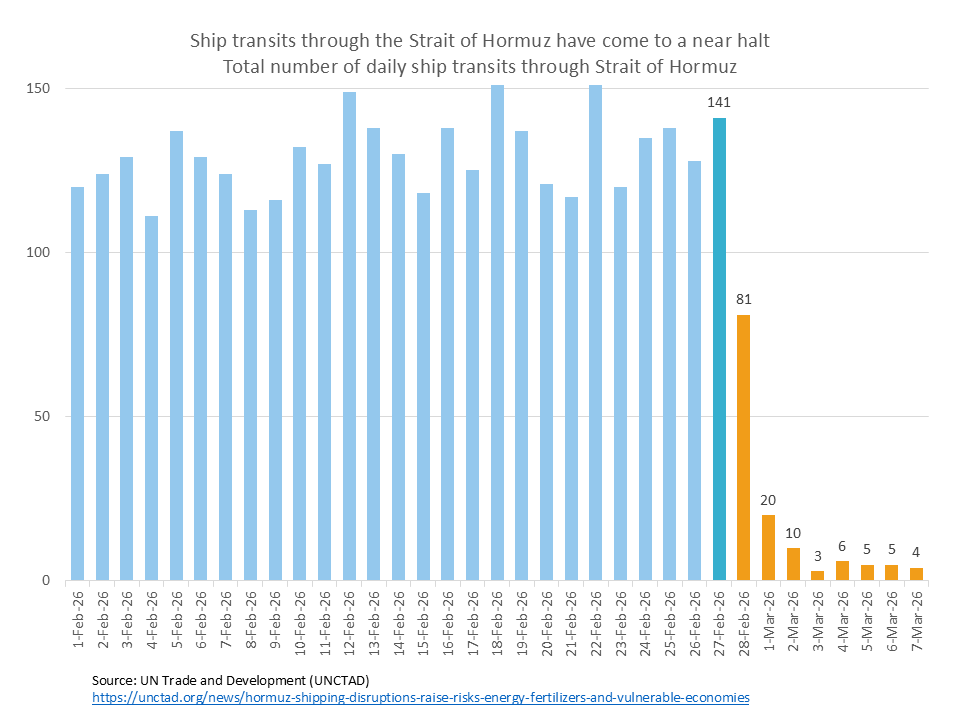
Since the rise in military tensions, shipping through the Strait of Hormuz has nearly come to a halt, with the total number of ships passing through the strait per day falling by 97%.
Disruptions in the strait particularly threaten energy supplies to Asia. Of the goods traffic that passed through the Strait of Hormuz in 2024, 84% of crude oil and 83% of liquefied natural gas (LNG) were bound for Asia. Additionally, one-third of seaborne global fertilizer trade passed through the strait, of which 67% was urea.
The oil market reacted swiftly, with crude oil prices increasing 27% and LNG prices increasing 74% between February 27 and March 9. Rising energy, fertilizer, and transport costs (including freight, fuel, and insurance) could lead to higher food prices and increased pressure on the cost of living, especially for the most vulnerable. Notably, Sudan, Sri Lanka, Tanzania, and Somalia had a regional dependence on fertilizer imports of over 30% in 2024.
Similar impacts have been seen during recent global shocks, such as the COVID-19 pandemic and the outbreak of conflict in Ukraine, which demonstrated that disruptions to energy, transport, and agricultural inputs can spill over into food markets.
This shock comes at a time when many developing countries are struggling to repay their debts and are facing tight fiscal space and limited capacity to absorb new price shocks. While the impact on the global economy as a whole will depend on the duration and scale of the disruption, this situation highlights the importance of continued monitoring of the impact, particularly on vulnerable economies.
(Reference)
UNCTAD (2026) Strait of Hormuz Disruptions: Implications for Global Trade and Development (UNCTAD/OSG/TT/INF/2026/1) 10 Mar 2026
Contributor: IIYAMA Miyuki, Information Program