



On Thursday, October 23, 2025, 20 first-year students from Gunma Prefectural Kiryu High School visited the International Research Center for Agricultural Sciences (JIRCAS) for the 14th session of the Future Science Talent Academy. At this school, initiatives are conducted to increase students’ interest in science and nurture awareness for future career choices by exposing them to cutting-edge science and technology through practical training. This visit was part of that effort.
The session began with an introduction to JIRCAS’s research activities and international collaborative projects, explaining specifically how research in agriculture, forestry, and fisheries, conducted in partnership with institutions worldwide, contributes to Japan’s food supply and daily life. Students were encouraged to think about domestic challenges in food production and the state of international food distribution, as well as the significance of research activities conducted in developing countries.
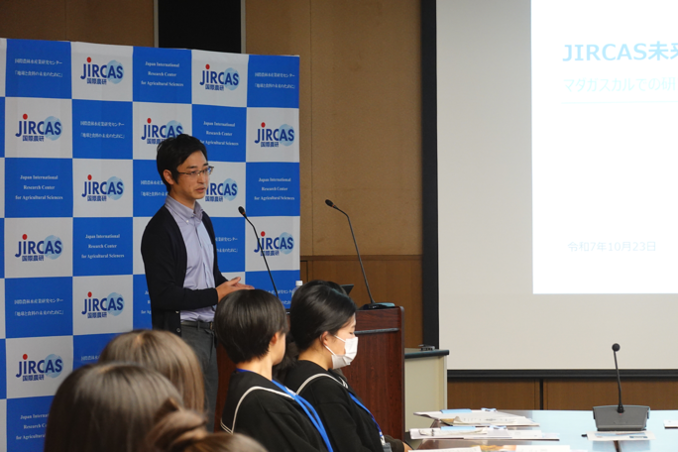
Next, Dr. OZAKI Ryosuke (Researcher, Social Sciences Division) gave a lecture. He explained the current situation of poverty in Africa and the potential of agricultural approaches as solutions. Using data and comparisons with Asia, he illustrated that in Asia, increased crop yields per unit area drive food production growth, whereas in Africa, expanding cultivated land is the main factor.
Dr. Ozaki also explained initiatives that consider farmers’ economic situations and cultivation environments to promote the adoption of agricultural technologies and behavioral changes. He emphasized that simply introducing technology is not enough; it is crucial to engage in dialogue with farmers to identify the support that is truly needed.
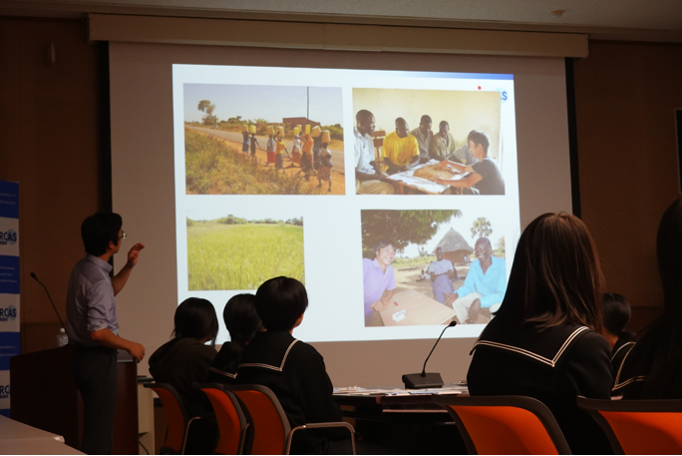
In addition, he shared his own career journey, including studying in the United States after graduating from a Japanese university, participating in the Japan Overseas Cooperation Volunteers in Uganda, working in the private sector, and returning to Africa-inspired research through graduate studies before joining JIRCAS. He included photos of life in Africa and stories of interactions with local farmers to illustrate his experiences.
At the end of the lecture, he stated, “Being a researcher is a rare profession where you are allowed to not know something—and can pursue that curiosity.” He conveyed the excitement and appeal of scientific exploration, and the students listened attentively with serious expressions.
Through this visit, students gained a deeper understanding of the potential of science, the societal significance of research, and the importance of international cooperation. Moving forward, the Academy will continue providing opportunities for students to engage directly with research environments to further stimulate interest and engagement in science and technology.