On Tuesday, October 28, 2025, nine students from Gunma Prefectural Maebashi High School visited the Japan International Research Center for Agricultural Sciences (JIRCAS) for the 15th session of the Future Science Talent Academy.
At this school, science training is conducted to increase students’ interest in science and raise awareness of future career paths by providing exposure to cutting-edge science and technology. This visit was part of that initiative.
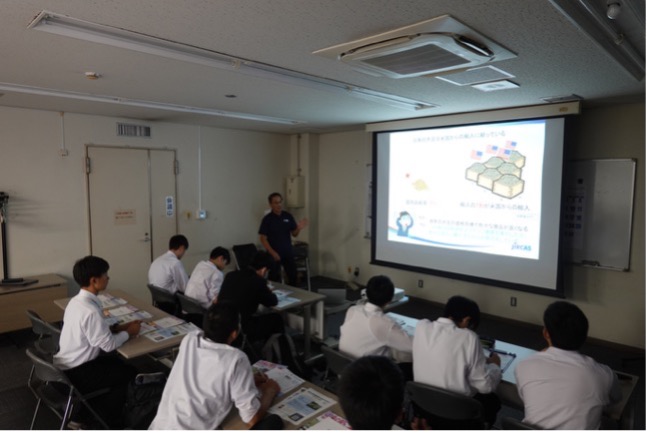
The session began with an introduction to JIRCAS’s research activities and international collaborations, explaining how research in agriculture, forestry, and fisheries, conducted in partnership with institutions worldwide, contributes to food and daily life in Japan. The role of research in achieving the United Nations Sustainable Development Goals (SDGs) was also discussed, giving students an opportunity to consider the significance of Japan’s collaboration in research and technology development in developing countries.
Next, Senior Researcher YAMANAKA Naoki from the Biological Resources and Post-harvest Division gave a lecture. He explained the current state of global soybean production and focused on soybean rust disease, a major challenge in South America, which produces the largest volumes. He described research aimed at developing soybean varieties with enhanced resistance by combining multiple rust-resistant genes. These varieties are then crossbred with high-quality, high-yield varieties used locally to create practically useful cultivars. He illustrated that, through collaboration with partners in various South American countries, four rust-resistant varieties have now been officially registered locally.
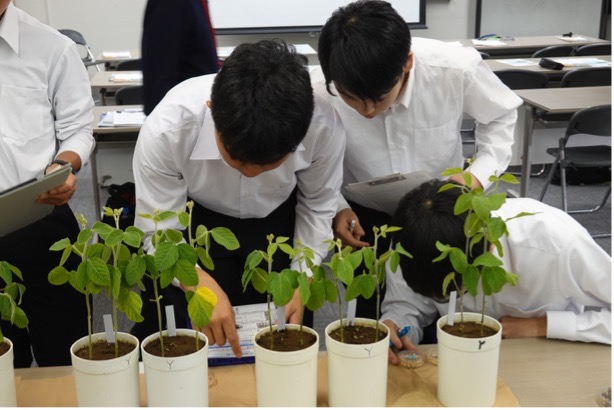
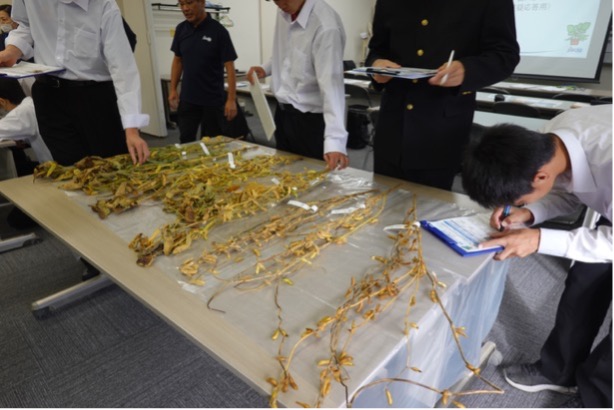
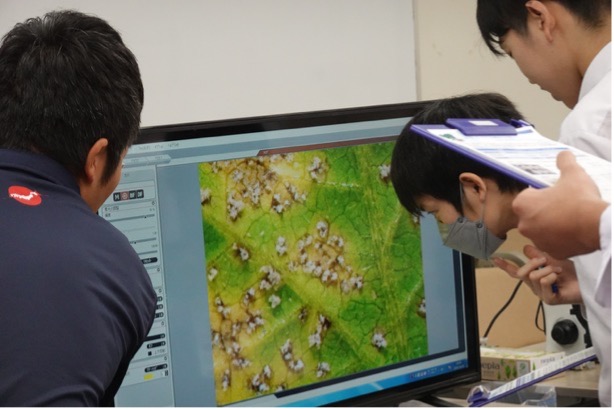
Following the lecture, students participated in a hands-on exercise called “Comparison of Soybean Varieties.” They examined seeds, plant bodies, and rust resistance, touching and comparing actual plants, and observed infected leaves and rust spores under a microscope. Students actively asked questions and engaged with the research team members working alongside Dr. Yamanaka.
Students were astonished to see that, although the newly developed varieties looked almost identical to the previous ones, no rust spores were formed on the improved plants. Many students also noted that while they had seen soybean seeds before, they had never closely observed the whole plant, commenting, “This is the first time I really got to know soybeans,” as they carefully examined the specimens.
Through this visit, students gained a deeper understanding of the potential of science, the societal significance of research, and the importance of international collaboration, while also reflecting on their own career paths and future goals. The Future Science Talent Academy will continue to provide direct exposure to research environments to further stimulate interest and engagement in science and technology.