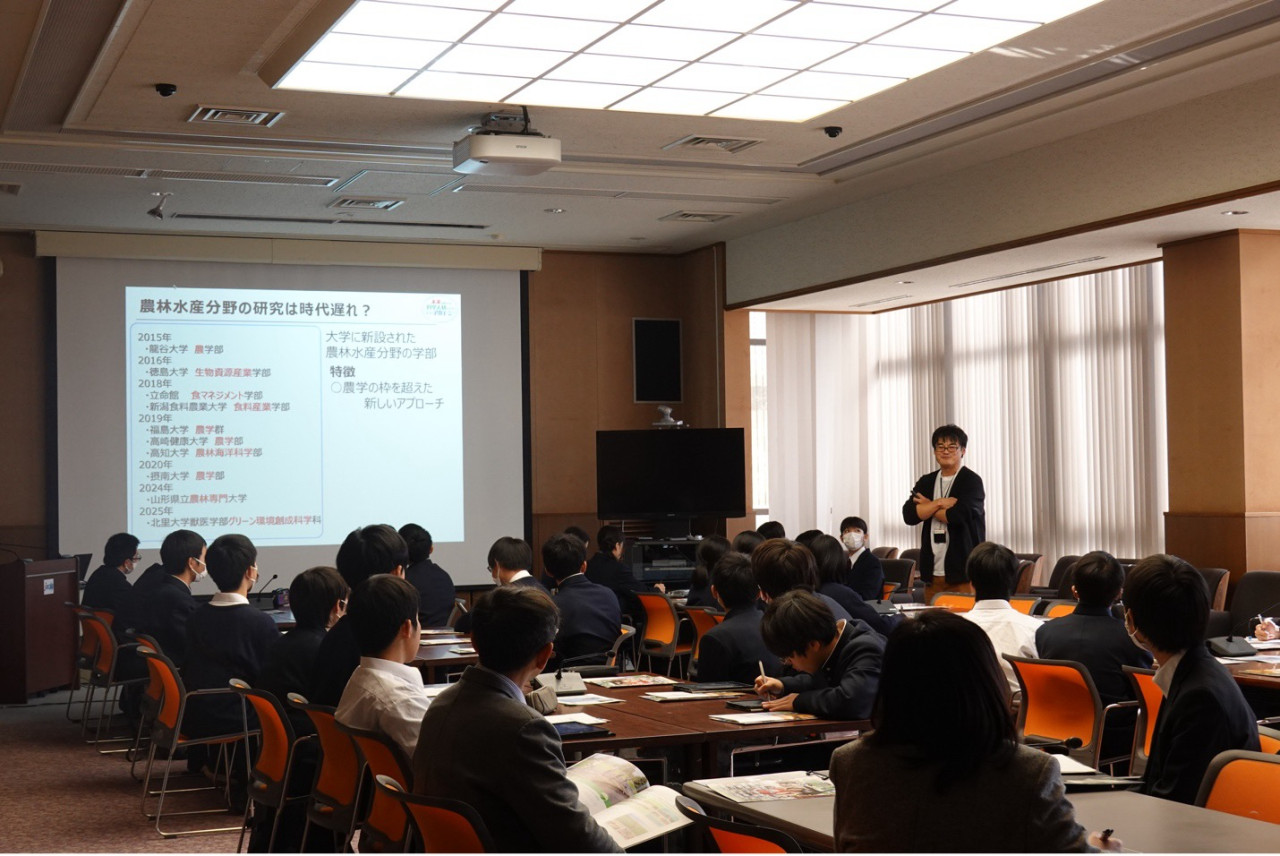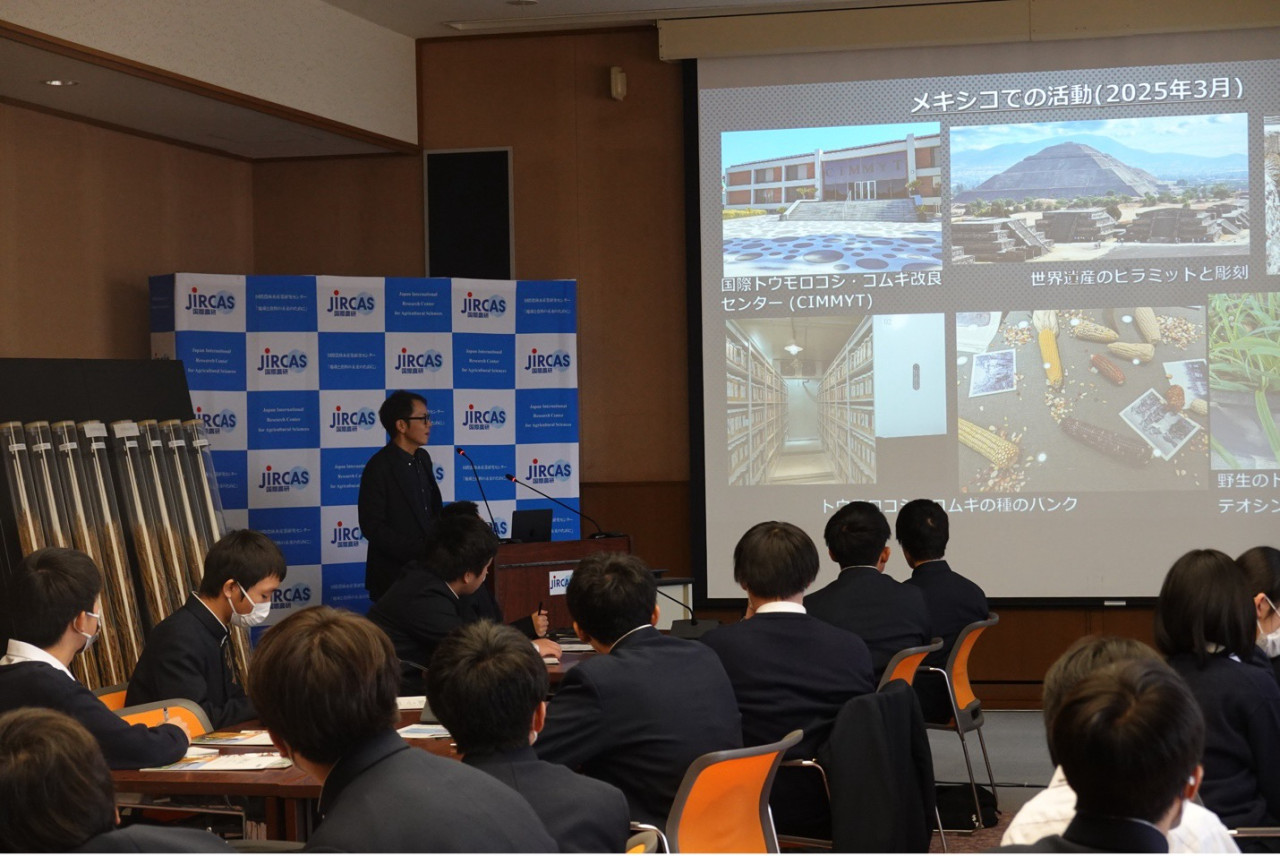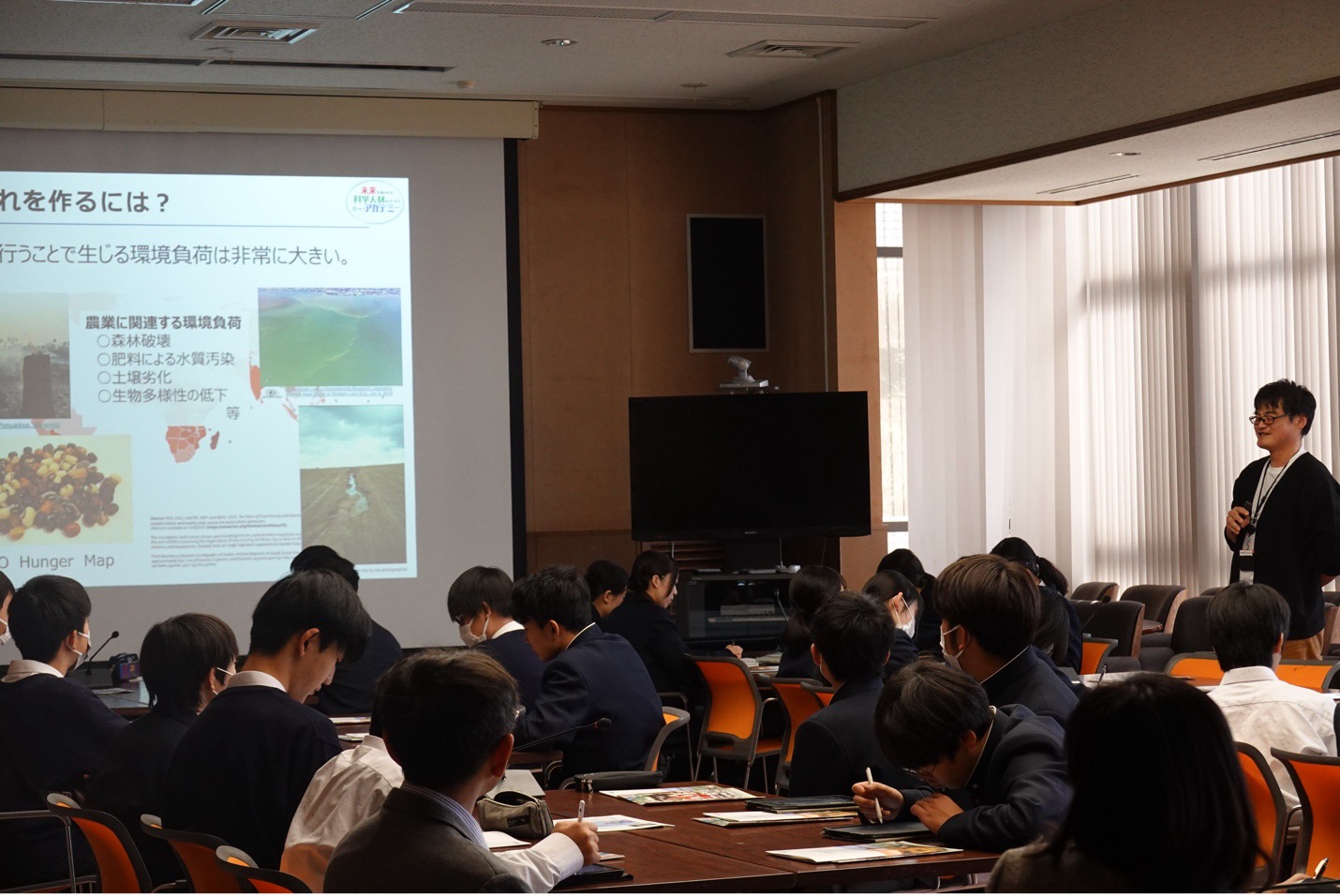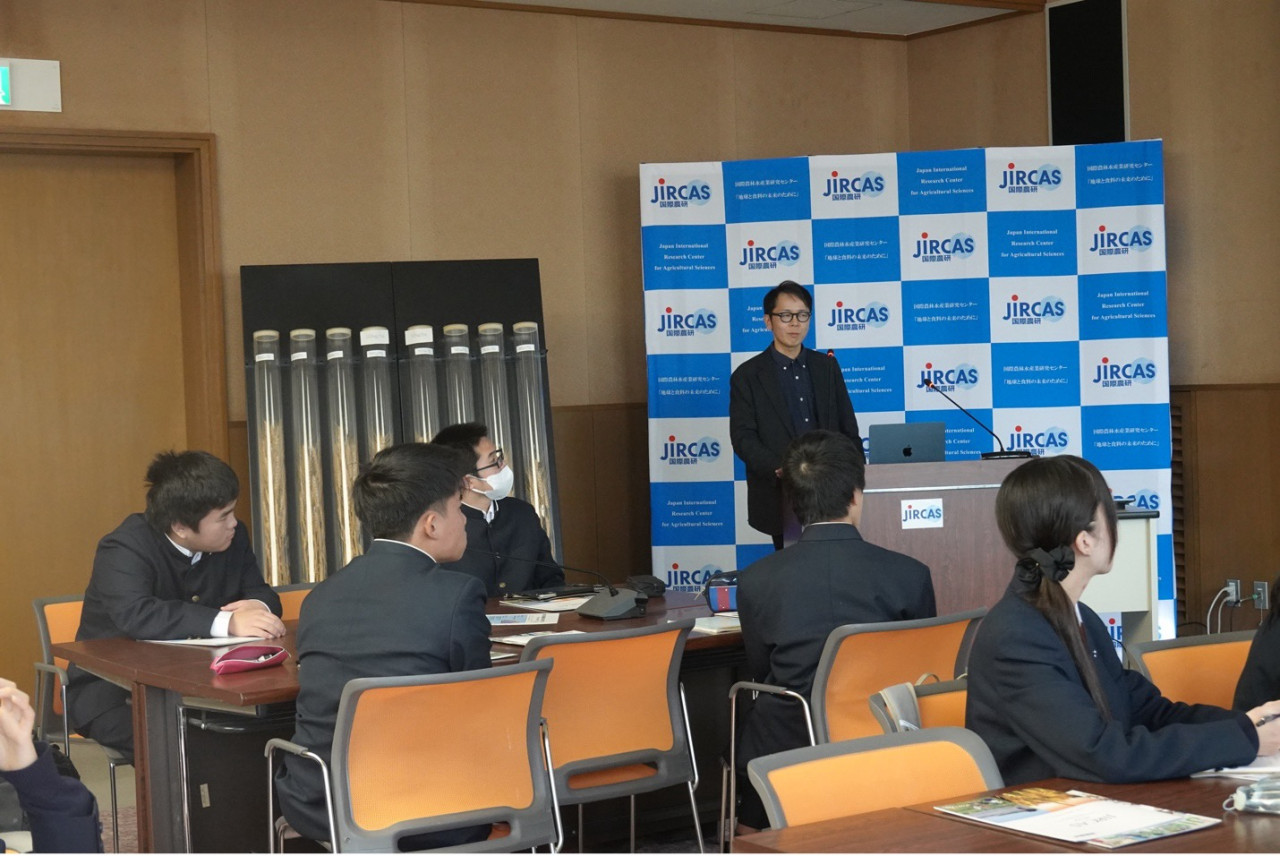
On Friday, November 14, 2025, the Japan International Research Center for Agricultural Sciences (JIRCAS) welcomed 28 first- and second-year students from Saitama Prefectural Inagakuen Comprehensive Upper Secondary School for the 21st session of the “Future Science Talent Academy.” The school is implementing a science program to deepen students’ interest in science and broaden their awareness of future career paths, and the visit to JIRCAS was part of this initiative.
The session began with an introduction to JIRCAS’s research activities and international collaborations, explaining—using concrete examples and data—how research in agriculture, forestry, and fisheries conducted together with partners around the world contributes to the food systems and daily lives of people in Japan. The presentation also highlighted the current state of Japan’s food production and global food production and distribution, prompting students to consider the significance of Japan’s cooperation in research and technology development in developing countries.
This was followed by a lecture from Senior Researcher OTAKA Junnosuke of the Biological Resources and Post-harvest Division. He introduced one of JIRCAS’s major research achievements—the globally recognized “biological nitrification inhibition (BNI)-enhanced wheat”—using real samples. Dr. Otaka explained how developing BNI-enhanced wheat could significantly reduce nitrogen fertilizer use. He also described, with photographs, why BNI had long remained a scientific mystery and how JIRCAS researchers ultimately uncovered its existence.
He then presented his own research in which he became the first in the world to identify a BNI substance in maize, explaining the challenges and data that led to the discovery. He also discussed ongoing efforts to identify BNI substances in minor cereals and explained how strengthening BNI functions in crops could help boost global food production.
In the latter part of the session, Dr. Otaka spoke about his career path, sharing what inspired him to pursue research and conveying the excitement of international collaborative research that involves discussions with experts across many fields. Students asked sharp questions—such as whether using BNI-enhanced crops might affect ecosystems—which even surprised Dr. Otaka. He explained that such questions are crucial when considering the practical application of research and crop breeding, and that careful examination is needed going forward.
Through this visit, students deepened their understanding of the potential of science, the social significance of research, and the importance of international cooperation. It was a valuable opportunity for them to reflect on their future goals and career aspirations. JIRCAS will continue to provide opportunities for young people to experience real research environments and to further stimulate interest and curiosity in science and technology.