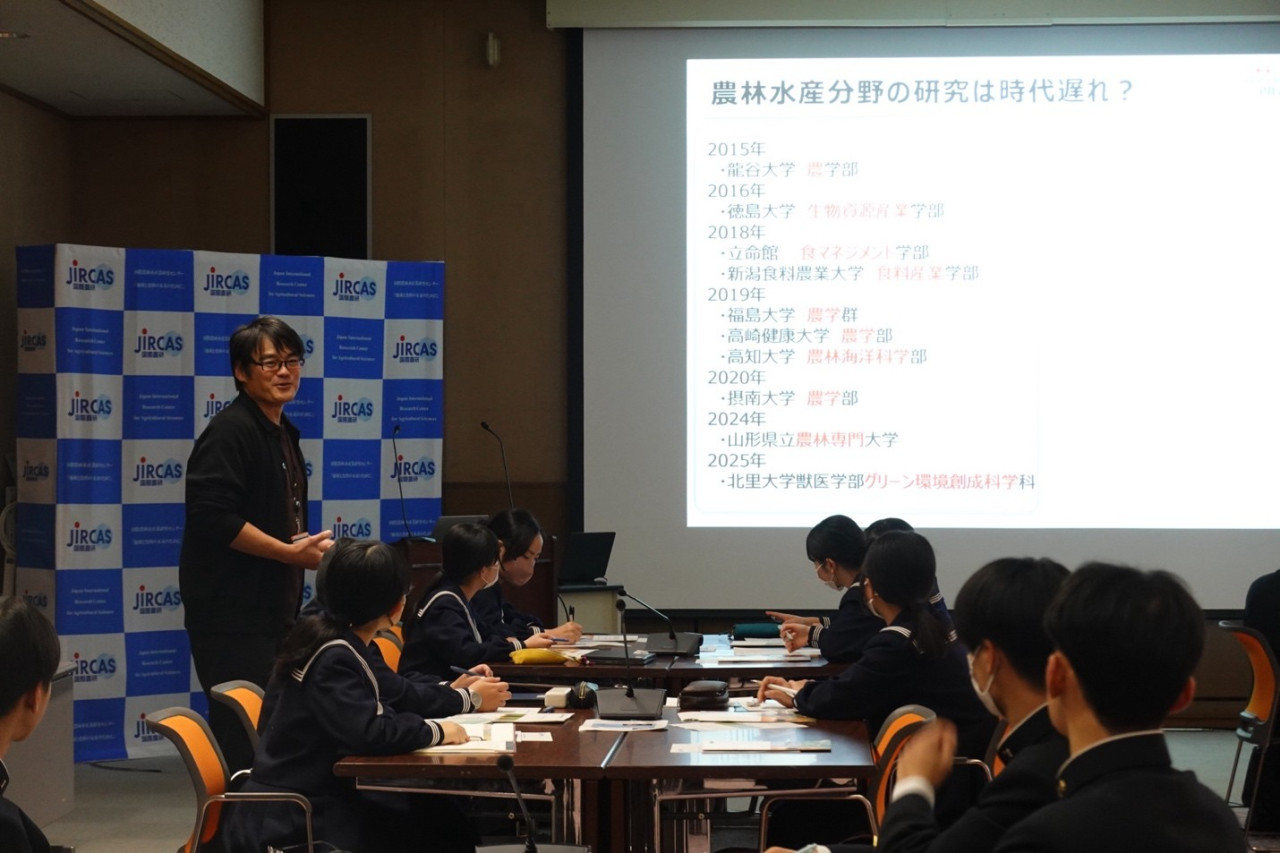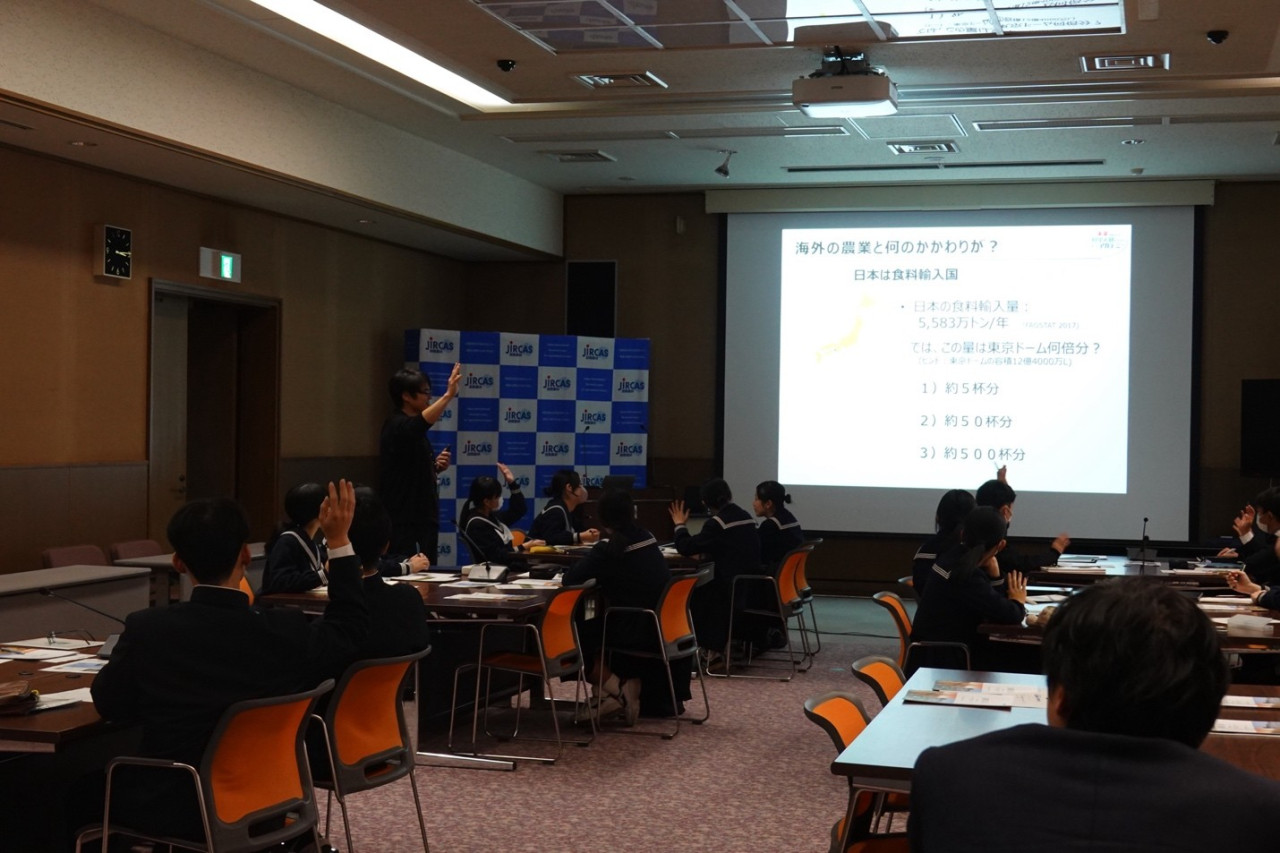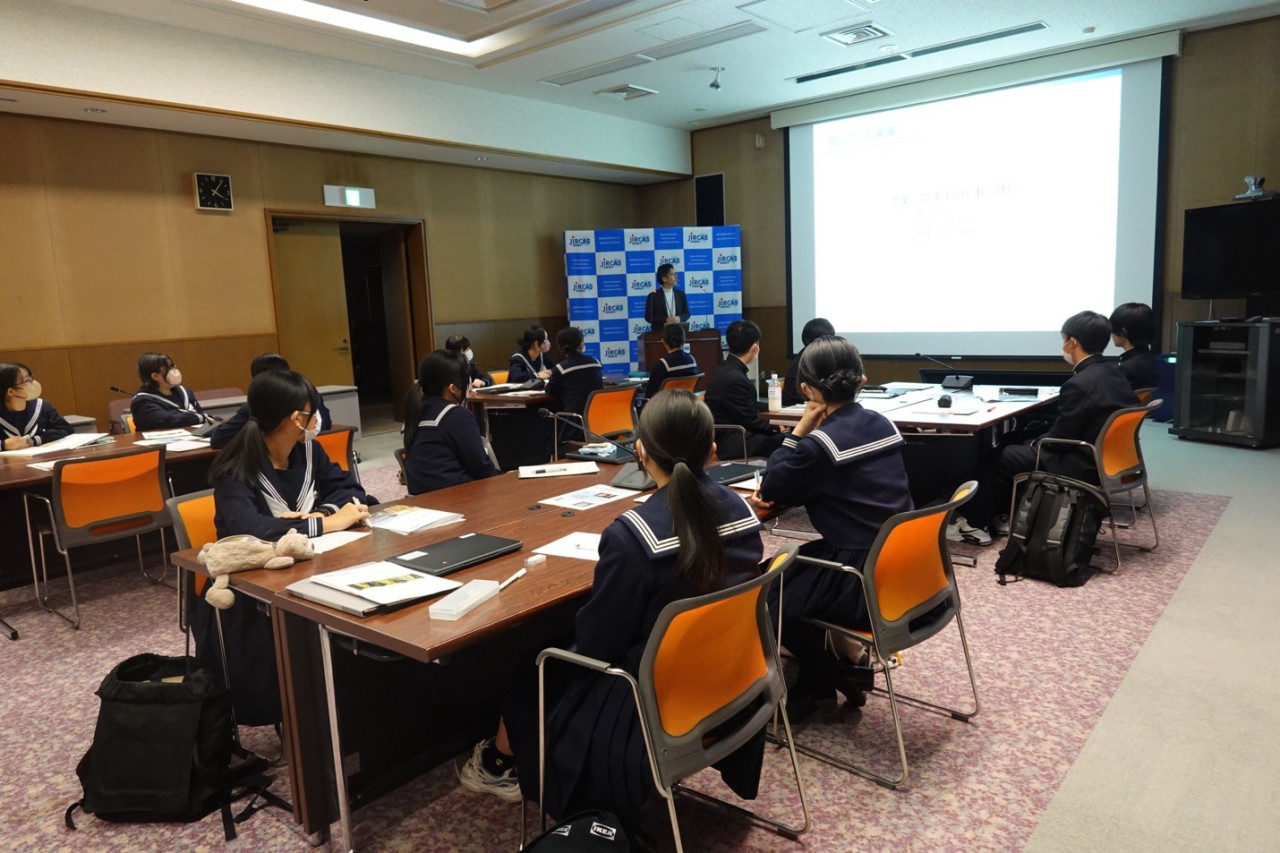




On Thursday, December 11, 2025, the Japan International Research Center for Agricultural Sciences (JIRCAS) welcomed 19 first-year students from Kumamoto Prefectural Uto High School for the 26th session of the Future Science Talent Academy. As part of its Super Science High School (SSH) program, the school conducts an SSH Future Experience Learning program (Kanto Study Tour) aimed at strengthening science and mathematics education and fostering scientific literacy. This visit was conducted as part of that program.
At the beginning of the session, participants were introduced to JIRCAS’s research activities and its international collaborative research framework. The lecturers explained how research in agriculture, forestry, and fisheries—conducted in cooperation with partners around the world—contributes to the food supply and daily lives of people in Japan. By addressing the current state of food production in Japan as well as global food production and distribution, the session provided students with an opportunity to think about the significance of Japan’s support for research and technological development in developing countries. The lecturers also explained the types of problem-solving professionals currently in demand, as well as global human resources and science, technology, and innovation (STI) professionals.
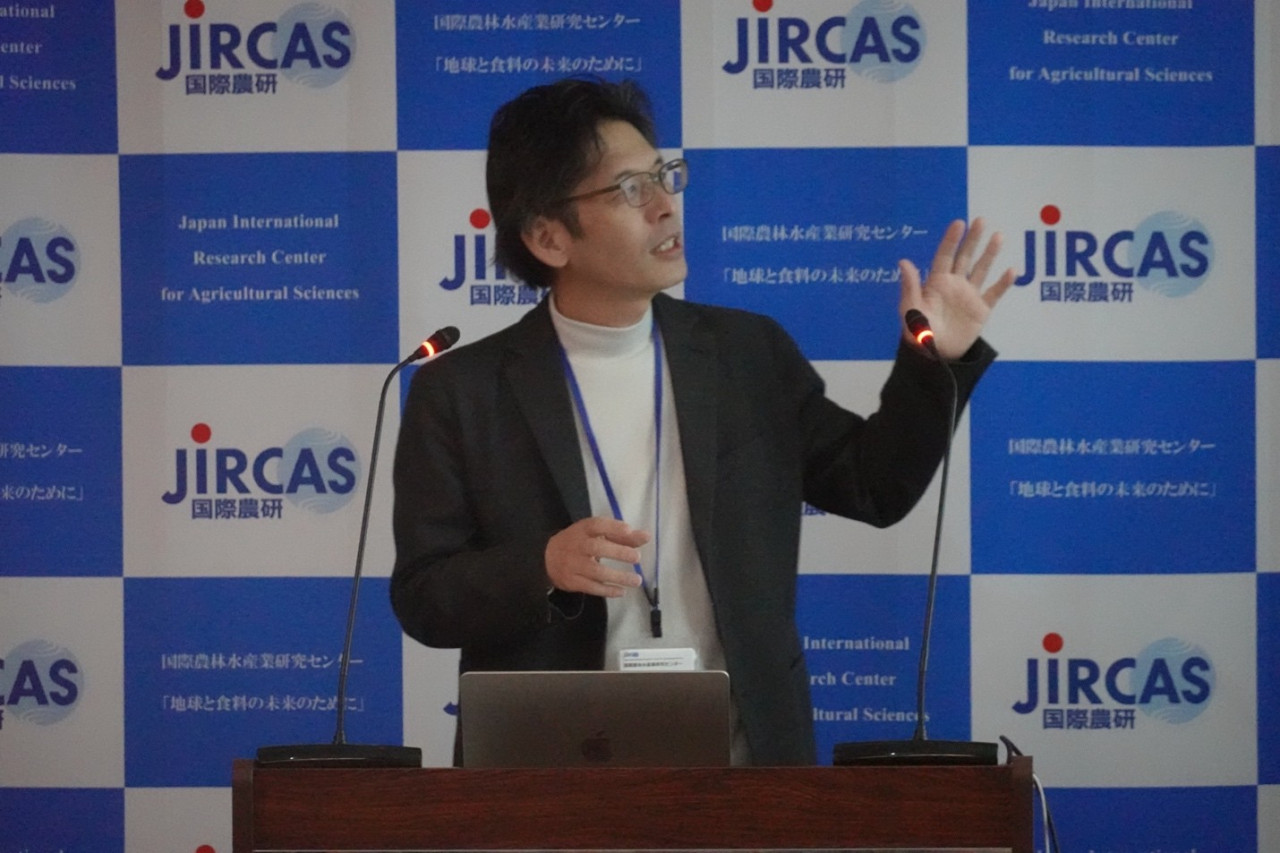
This was followed by a lecture by Dr. ISHIZAKI Takuma, Head of the Research Planning Section in the Research Planning and Management Office, on the application of plant biotechnology in agricultural research. Dr. Ishizaki explained how he was attracted to the term "biotechnology" and decided to study at the Faculty of Agriculture. He said that while learning about the use of various biotechnologies to elucidate plant physiological functions, he encountered genetic engineering research and became drawn into the world of research. He shared real-life experiences, including the joy of achieving research results during his graduate school days, the anxieties his classmates felt as they entered the workforce, and the joy he felt when he joined JIRCAS as a researcher.
He also introduced his work at JIRCAS on genetically modified rice for Africa, specifically research involving the introduction of the DREB gene to enhance drought tolerance in the “NERICA (New Rice for Africa)” rice variety group. He spoke frankly about the excitement of seeing rice he had developed being grown in fields in Colombia, as well as the disappointment that the variety ultimately did not reach practical application.
Dr. Ishizaki, who has stepped away from hands-on research and now working in the Research Planning and Management Office, also spoke about the importance of work that supports research, such as making research results more visible, disseminating information, and creating a system that allows researchers to work together as a team.
During the Q&A session, students asked insightful questions such as, “As food problems become more serious, which JIRCAS technologies should we pay attention to over the next five years?” and “When conducting research overseas, what challenges arise due to differences in language and environment?” While explaining the step-by-step nature of research and the time required for practical application, the lecturers provided detailed explanations—using actual samples from the exhibition space—of technologies currently attracting particular attention and being actively developed for real-world use, such as “BNI-enhanced wheat” and “technologies that turn unused biomass into resources.” They also gave detailed explanations of the research environments in other developed and developing countries and discussed the significance of international collaborative research that leverages Japan’s technological and human-resource strengths.
Through this visit, the students deepened their understanding of the potential of science, the social significance of research, and the importance of international cooperation. It became a valuable opportunity for them to reflect on their future paths and career goals. JIRCAS plans to continue providing opportunities for hands-on exposure to research environments in order to nurture future scientific talent and further stimulate interest in science and technology.