



On Thursday, September 25, 2025, the Japan International Research Center for Agricultural Sciences (JIRCAS) held the 11th session of the Future Science Talent Academy in an online format. A total of 99 first-year students from the Junior High Division of Aichi Prefectural Meiwa Senior High School participated in the lecture, which was themed “Knowledge Needed for Biological Observation and Perspectives for Inquiry-Based Learning.”
At the school, students are currently engaged in SSH (Super Science High School) activities under the theme “Connecting to the Tidal Flats of Mikawa Bay.” Through studying environmental issues across Aichi Prefecture and the current state of Gamagōri and Mikawa Bay, students learn the basics of biological observation through fieldwork at tidal flats and work on setting their own research themes. This lecture was conducted as part of those activities, providing students with a valuable opportunity to cultivate a research-oriented perspective.
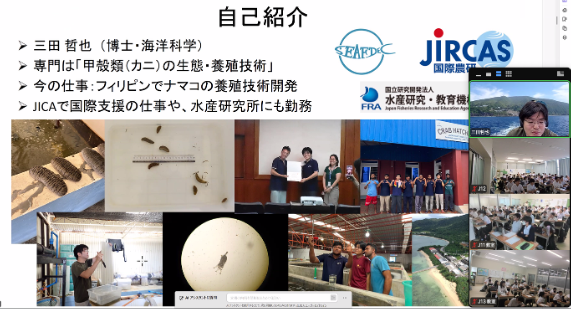
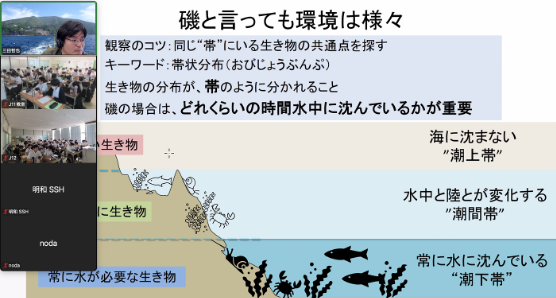
At the beginning of the lecture, an overview of JIRCAS was introduced, and Dr. SANDA Tetsuya (Senior Researcher, Fisheries Division) spoke about what inspired him to pursue his research career. He then explained in an easy-to-understand manner—using concrete examples—basic knowledge such as “What is a rocky shore?” and “What kinds of organisms can be observed there?”, as well as tips, safety precautions, and etiquette for observing organisms in coastal environments.
While observing tidal flats and rocky shores can be fun, Dr. Sanda emphasized that becoming too absorbed can sometimes lead to unexpected dangers. He carefully conveyed to students the importance of cooperation and safety awareness during fieldwork.
Even though the lecture was conducted online, it was made interactive through quizzes and real-time Q&A tools. Many questions were submitted by students, and Dr. Sanda responded to each one attentively. When asked, “What is your favorite marine creature?” he replied with a smile, “I’m interested in large crustaceans such as swimming crabs (gazami).”
As an example of research, Dr. Sanda shared how he became interested in tropical hermit crabs found on the coast of Chiba, and how his undergraduate thesis examined their relationship with global warming through field observations. Ten years later, these hermit crabs have now been found in more regions, clearly showing the effects of climate change. Students reflected on the environmental changes that might occur in the next 10 or 20 years, deepening their appreciation of the social relevance of scientific research.
By the end of the session, so many questions were submitted that they could not all be addressed within the scheduled time. Dr. Sanda sincerely responded to each inquiry, illustrating how valuable this experience was for students to develop a scientific mindset and strengthen their motivation for inquiry-based learning.
It is hoped that the knowledge and perspectives gained from this lecture will be applied in the tidal flat field study scheduled for October, leading to deeper and more meaningful inquiry activities. JIRCAS plans to continue providing such learning opportunities and contributing to the development of future generations of scientific talent.