



Pick Up
1540. Thailand’s Culture of Eating Flowers
Related Research Program
Information

1540. Thailand’s Culture of Eating Flowers
In Thailand, flowers have traditionally been incorporated into everyday meals. From home cooking and regional dishes to traditional desserts, a wide variety of flowers add color and flavor to the Thai table. Flowers provide distinctive aromas, textures, and colors, enhancing not only the taste of food but also its visual appeal.
Thanks to Thailand’s tropical climate, a diverse range of plants grows throughout the year. Local communities have long made use of wild and cultivated plants as food sources. To document this rich plant diversity, JIRCAS maintains the “Thai Local Vegetable Database”. In this article, we highlight several plants from the database whose flowers are commonly used in cooking.
Edible Flowers in Thailand
Sano (โสน)
Scientific name: Sesbania javanica
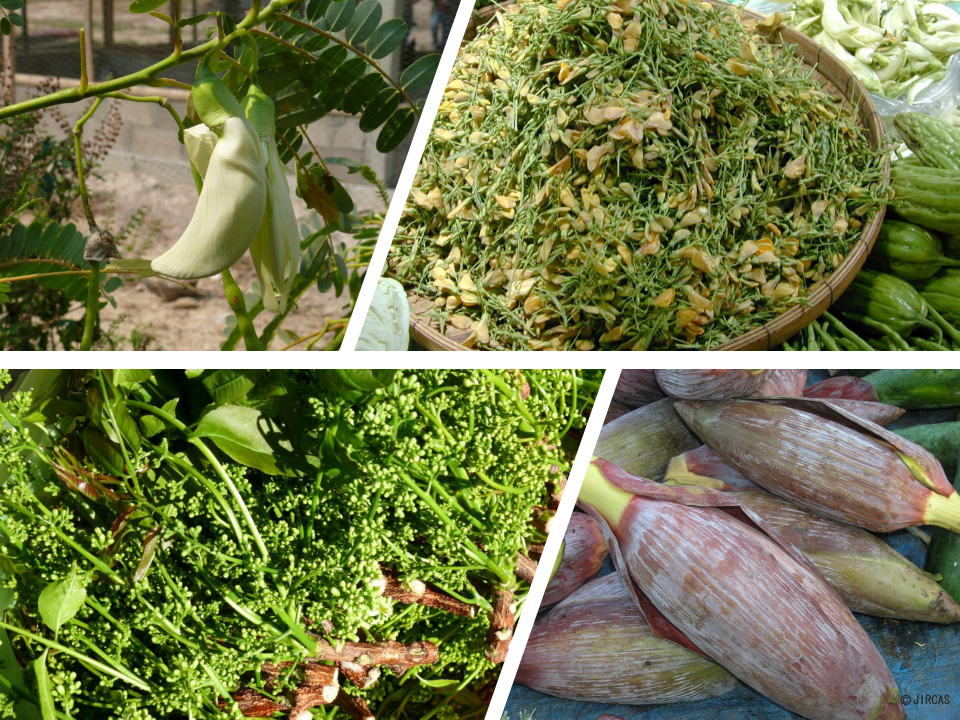
Sano is a member of the legume family that commonly grows in wetlands and along rice-field embankments. The plant reaches about 2–3 meters in height and produces bright yellow flowers. At the cafeteria next to the Southeast Asia Liaison Office, these flowers were used as an ingredient in “kai jiao” (Thai-style omelet). The flowers also contain carotenoid pigments and are used to give a yellow color to desserts such as “khanom bua loi” (glutinous rice flour dumplings served in sweet coconut milk).
*Interestingly, the Sano flower is also the provincial flower of Ayutthaya Province in central Thailand.
Khae (แค)
Scientific name: Sesbania grandiflora (L.) Desv.
Known in Japan as “Shirogochō”, Khae is one of the most common edible flowers in Thailand. It bears large white or red flowers with a mild bitterness. Before cooking, the bitter stamens are removed. The flowers are often blanched and served with “nam prik” (Thai chili dip). They are also used in “gaeng som” (sweet-and-sour curry), deep-fried with pork or shrimp, or mixed with flour and fried as fritters.
Kluai (หัวปลี)
Scientific name: Musa spp.
The banana blossom is a large flower bud that is treated as a vegetable in Thailand. It is widely used in regional cuisines and is known for its slight bitterness and crunchy texture. Banana blossoms are commonly added to Thai curries and are also thinly sliced and served fresh alongside “Pad Thai”.
Sadao (สะเดา)
Scientific name: Azadirachta indica A. Juss.
Known internationally as neem, Sadao flowers have a distinct and intensely bitter taste. This bitterness is traditionally believed to have digestive and fever-reducing properties. Sadao is one of Thailand’s most popular indigenous vegetables. A well-known dish is “Yam Sadao Kung Sod”, a salad made with fresh shrimp and neem flowers.
While opportunities to eat flowers are limited in Japan, flowers are a familiar and appreciated food ingredient in Thailand. Thai people skillfully make use of nature’s bounty, incorporating the colors, aromas, textures, and nutritional qualities of flowers into their daily meals. When visiting Thailand, be sure to try some dishes featuring edible flowers and experience this unique aspect of Thai food culture for yourself.
Reference: Thai Local Vegetable Database (JIRCAS)
https://www.jircas.go.jp/ja/database/thaivege
Contribution: Norihito Kanamori, Southeast Asia Liaison Office