



Pick Up
1535. The Future of Food Shaped by AI: Next-Generation Food Innovation Envisioned
Related Research Program
Information

1535. The Future of Food Shaped by AI: Next-Generation Food Innovation Envisioned
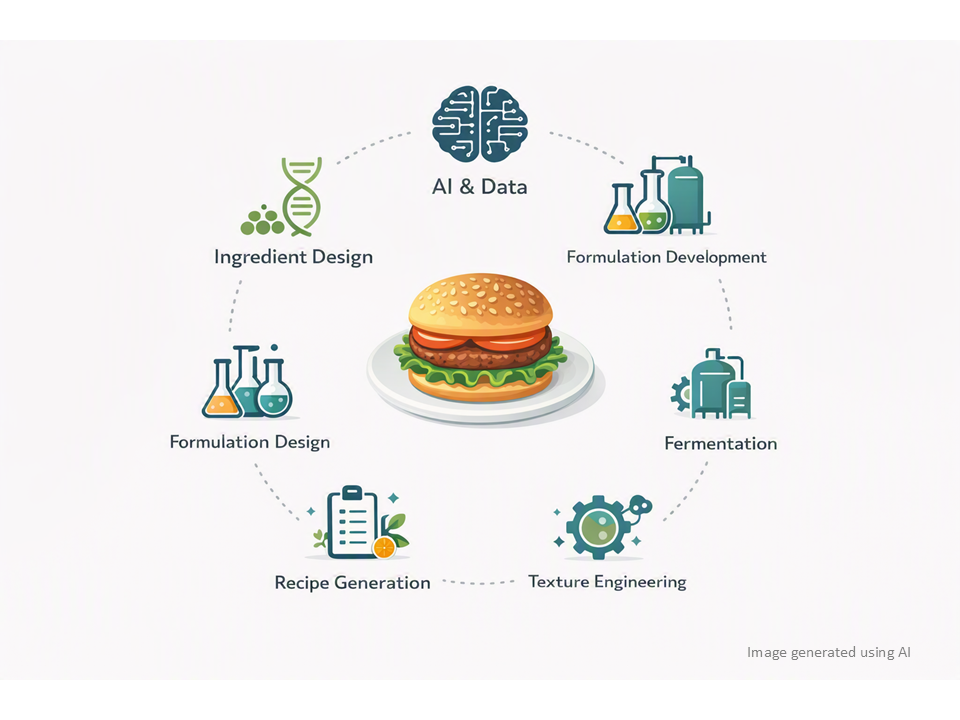
The foods we consume every day are developed through a process that relies far more on experience and trial-and-error than many people realize. Creating new food products involves numerous stages—from ingredient selection and formulation design to fermentation, manufacturing, and sensory evaluation—each requiring significant experimentation, time, and resources. At the same time, global food systems are major contributors to greenhouse gas emissions and biodiversity loss, highlighting the urgent need for more sustainable approaches to food production. A recent review article published in Nature Food explores how artificial intelligence (AI) could serve as a powerful catalyst for transforming food development from an experience-driven practice into a predictive, design-oriented science.
The authors focus particularly on alternative proteins, including plant-based, fermentation-derived, and cultivated foods, as a high-impact testing ground for AI applications. By learning relationships between molecular structures and functional properties, AI can predict the behavior of proteins, lipids, and other food components, helping researchers identify promising ingredients and formulations. This approach has the potential to dramatically reduce the hundreds of prototype iterations traditionally required in product development and accelerate the search for foods that balance both sensory appeal and sustainability. Beyond formulation, AI is increasingly being applied across the entire innovation pipeline, including fermentation optimization, real-time production control, and the prediction of flavor, aroma, and texture.
Importantly, the authors emphasize that deploying AI should not be viewed as an end in itself. When applied indiscriminately, AI can generate low-quality outputs, increase environmental burdens, and even erode consumer trust. These risks are particularly significant in the food sector, where products directly affect human health, safety, and cultural values. The goal is therefore not to use AI everywhere, but to apply it thoughtfully where it can demonstrably reduce time, cost, and uncertainty. The review strongly advocates for responsible AI adoption that combines computational capabilities with human expertise and judgment.
Under this framework, AI is evolving from a simple efficiency tool into an intellectual partner in food innovation. In manufacturing, digital twins are enabling more efficient process optimization and quality control. In research and development, “self-driving laboratories” that combine robotics and AI are beginning to automate cycles of experimentation, analysis, and refinement. Meanwhile, large language models (LLMs) are being explored for generating recipes that simultaneously consider nutritional value, environmental impact, allergen constraints, and individual preferences. Such advances could ultimately support highly personalized food experiences tailored to each consumer’s needs and values.
Looking ahead, the authors identify four strategic priorities for the emerging field of AI-driven food science: treating food as a programmable biomaterial; advancing scientific machine learning that embeds physical, chemical, and biological principles; developing autonomous research infrastructures that combine AI with robotics; and creating deep reasoning models capable of integrating nutrition, sustainability, and consumer preferences into food design decisions. While the food industry has long relied on empirical knowledge and iterative experimentation, this review suggests that AI is paving the way for a future in which food development becomes increasingly predictive, programmable, and data-driven. Achieving a sustainable and healthy food future will depend not on overestimating or underestimating AI, but on fostering effective collaboration between human expertise and artificial intelligence.
Reference
Datta, B., Buehler, M.J., Chow, Y. et al. Artificial intelligence for food innovation. Nature Food (2026). https://doi.org/10.1038/s43016-026-01380-7
Contributor: IIYAMA Miyuki, Strategic Coordination Office