



Pick Up
1517. Atmospheric CO₂ Concentration Reaches 432 ppm, Setting a New Record High
Related Research Program
Information
1517. Atmospheric CO₂ Concentration Reaches 432 ppm, Setting a New Record High
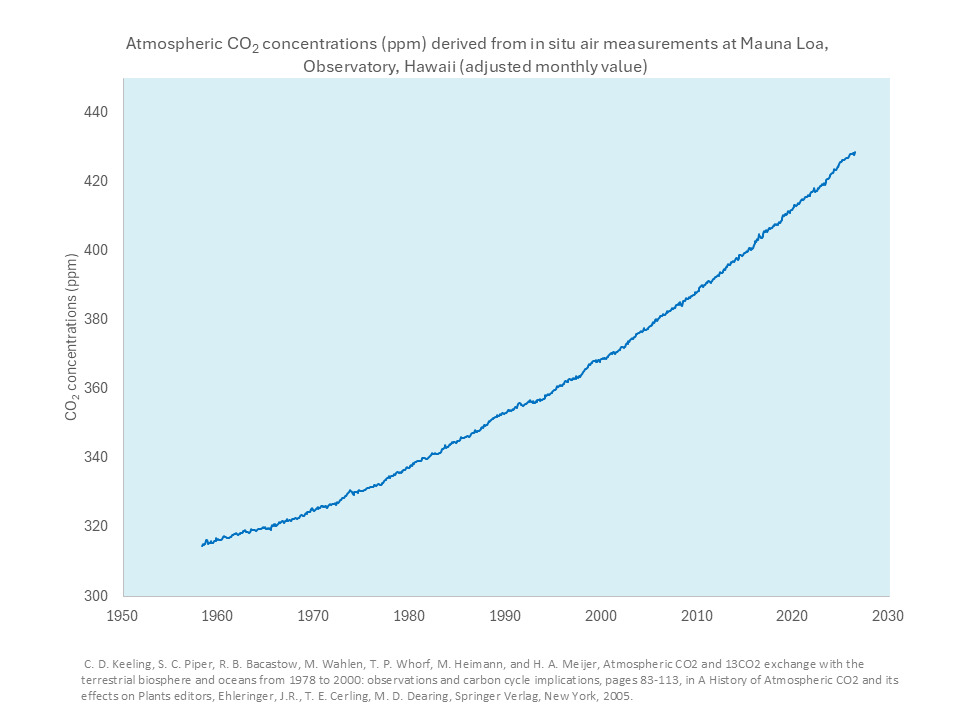
Scientists at the Scripps Institution of Oceanography at the University of California San Diego have reported that atmospheric carbon dioxide (CO₂) concentrations at the Mauna Loa Observatory reached 432 ppm in May 2026, marking a new record high. This represents an increase of 1.8 ppm from 430.2 ppm in May 2025, continuing the long-term upward trend. Independent measurements by the National Oceanic and Atmospheric Administration (NOAA) also reported a consistent value of 432.3 ppm, confirming the robustness of the observations.
Ralph Keeling, Director of the Scripps CO₂ Program, emphasized the seriousness of the situation, stating that “atmospheric CO₂ has continued its relentless rise over the past year, moving us further into a high-CO₂ world.”
The Mauna Loa Observatory, located at an elevation of approximately 3,400 meters on the island of Hawaii, is widely regarded as the global benchmark site for monitoring atmospheric CO₂, representing large-scale conditions across the Northern Hemisphere. Continuous measurements began in 1958 under Charles David Keeling, who recorded an initial concentration of 313 ppm. His work led to the creation of the well-known “Keeling Curve,” which captures both seasonal variability and the long-term increase in CO₂ levels.
Atmospheric CO₂ concentrations exhibit clear seasonal cycles—declining during spring and summer as vegetation absorbs CO₂, and rising during autumn and winter as plants decay. Alongside this seasonal pattern, a steady year-on-year increase has been consistently observed. NOAA has independently conducted continuous observations since 1974, and the Mauna Loa dataset remains one of the most reliable long-term climate records in the world.
In November 2022, an eruption of the Mauna Loa volcano disrupted access to the observatory when lava flows covered part of the access road. Despite this, monitoring continued through temporary relocation to Mauna Kea and the installation of instruments via helicopter. Access has since been restored, and regular operations have largely resumed.
CO₂ is one of the primary greenhouse gases, trapping heat in the atmosphere and contributing to rising surface temperatures. This warming drives extreme weather events such as heatwaves, droughts, and wildfires, as well as increases in heavy precipitation and flood risks. In addition, CO₂ absorbed by the oceans leads to ocean acidification, posing serious threats to marine organisms such as corals, shellfish, and other calcifying species.
Data from Mauna Loa, together with global observations, are incorporated into NOAA’s Global Greenhouse Gas Reference Network, providing a critical foundation for climate research and policymaking worldwide.
These latest findings underscore that atmospheric CO₂ concentrations continue to rise unabated, suggesting that delays in mitigation efforts are increasing long-term climate risks. Continued monitoring and strengthened efforts to reduce emissions will be essential going forward.
Contributor: IIYAMA Miyuki, Strategic Coordination Office