



Pick Up
1476. Copernicus: March 2026 Was the Fourth Warmest on Record
Related Research Program
Information
1476. Copernicus: March 2026 Was the Fourth Warmest on Record
On April 10, 2026, the Copernicus Climate Change Service (C3S), Europe’s climate monitoring agency, released its latest analysis of global temperatures and ocean conditions for March 2026.
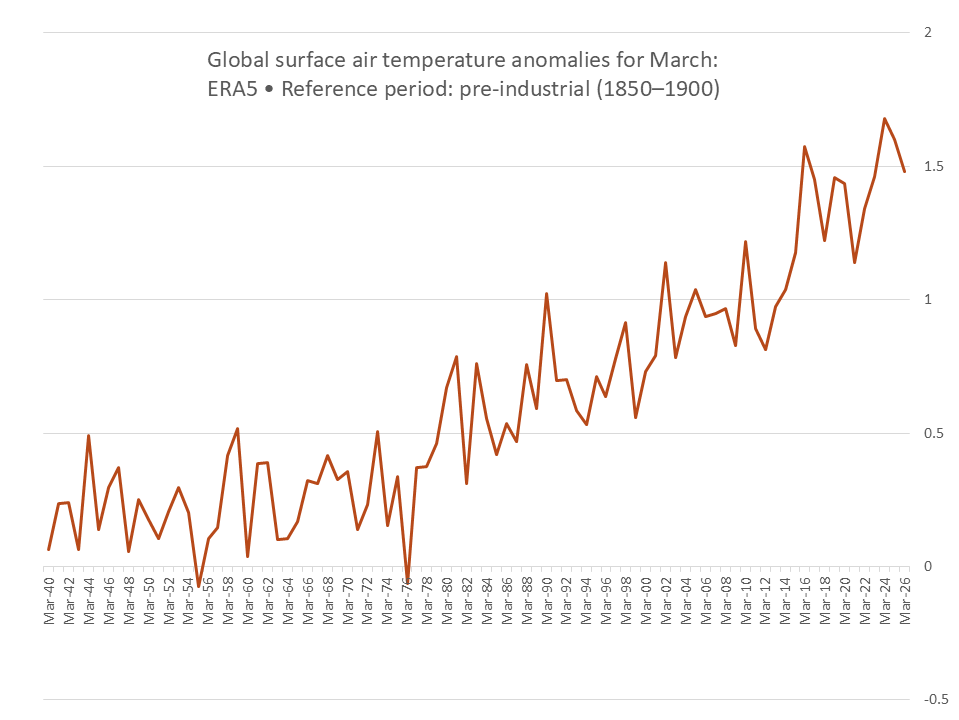
According to the report, the global average temperature in March 2026 ranked as the fourth highest on record, reaching 1.48°C above pre-industrial levels. This highlights the continued warming trend in recent years and suggests that the pressure on the climate system is becoming increasingly intense.
One of the most notable findings concerns the state of the oceans. Sea surface temperatures were the second highest on record for March, once again approaching the record levels observed in 2024. In addition, many climate centers are forecasting a transition toward El Niño conditions in the latter half of the year, which could further drive global temperatures upward.
In Europe, March 2026 was the second warmest March ever recorded. Temperatures were significantly above average across much of the continent, while widespread dry conditions prevailed. However, this followed an unusually cold and exceptionally wet February, during which flooding occurred in many areas. This sharp contrast highlights the growing instability and variability of the climate.
Similar extreme patterns were observed in other parts of the world. The western United States and Mexico experienced an unusually early heatwave along with dry conditions, while regions such as Canada and Alaska saw below-average temperatures. This contrast illustrates the increasing divergence in temperature patterns across the Northern Hemisphere.
In the Arctic, sea ice extent reached its lowest level on record for March. Even at the time of year when sea ice typically reaches its maximum, it remained at historically low levels, underscoring the ongoing impacts of global warming.
Precipitation patterns were also uneven, with dry and wet extremes occurring simultaneously in different regions. Much of Europe experienced drier-than-average conditions, while areas such as northern Europe and parts of the Mediterranean saw heavy rainfall that led to flooding. This coexistence of drought and intense rainfall is a key indicator of a more unstable climate system.
Commenting on the findings, the director of Copernicus noted that while each of these indicators is significant on its own, taken together they paint a picture of a climate system under sustained and accelerating pressure.
Overall, the report makes clear that what we are witnessing is not just a steady rise in temperatures, but a broader and more complex shift involving the oceans, ice, and hydrological cycles. The year 2026 may prove to be a critical one in understanding the future trajectory of our climate.
Contributor: Miyuki IIYAMA, Strategic Coordination Office