



Pick Up
1436. Copernicus: 2026 Begins With Extreme Weather Events in Both Hemispheres, Was the Fifth-Warmest January on Record
Related Research Program
Information

1436. Copernicus: 2026 Begins with Extreme Weather Events in Both Hemispheres, Was the Fifth-Warmest January on Record
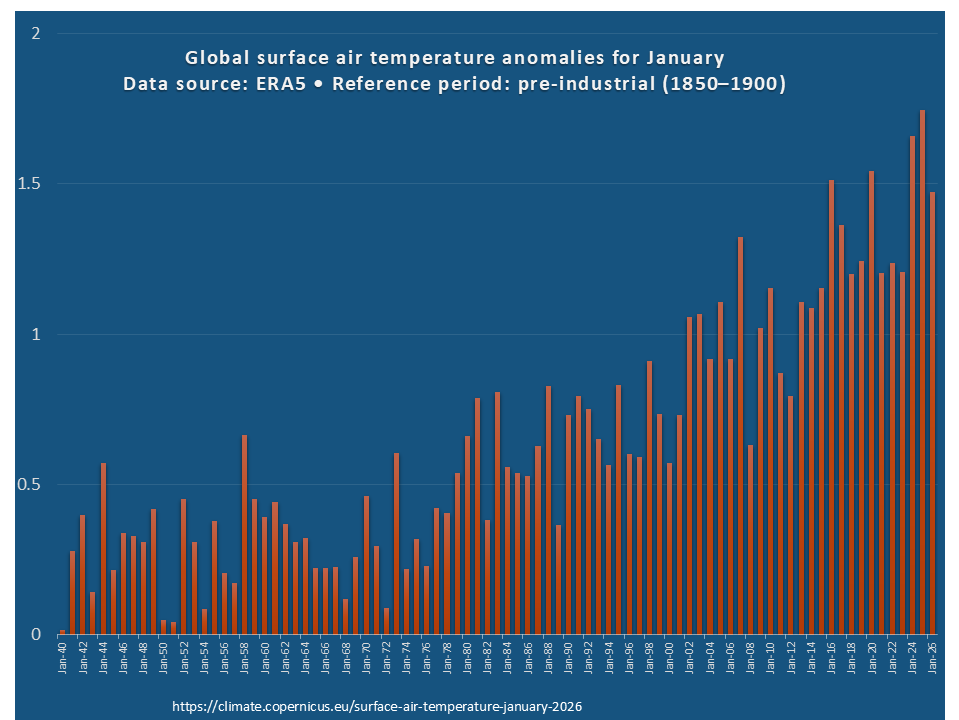
According to the Copernicus Climate Change Service (C3S), January 2026 was the fifth-warmest month on record, with an average surface temperature of 12.95°C, 0.51°C higher than the January average from 1991 to 2020. The Copernicus Climate Change Service also reported that January 2026 was 0.28°C cooler than the hottest January on record in 2025, while still 1.47°C higher than the estimated average temperature from 1850 to 1900, used to define pre-industrial levels.
January 2026 saw contrasting temperature extremes recorded between the Northern and Southern Hemispheres, reminding us that the climate system can sometimes simultaneously bring extreme cold in some regions and extreme heat in others. While human activities continue to drive long-term warming, these recent events highlight the importance of resilience and adaptation to prepare society for future climate risks, including increased extreme weather events.
During the last week of January, a severe cold snap hit the Northern Hemisphere as a stronger-than-normal meandering of the polar jet stream forced frigid Arctic air into mid-latitudes, funneling icy air into Europe and North America. As a result, the average land temperature in Europe in January 2026 was -2.34°C, 1.63°C lower than the January average from 1991 to 2020, making it the coldest January since 2010.
Despite this cold snap, January temperatures remained above average in many parts of the world. The warmest temperatures were in the Arctic, particularly in most of the Canadian Arctic Archipelago, Baffin Bay, Greenland, and the Russian Far East. Above-average temperatures were also recorded in southern South America, North Africa, Central Asia, and much of Australia and Antarctica. In the Southern Hemisphere, record-breaking heatwaves led to extreme weather, resulting in severe wildfires and deaths in Australia, Chile, and Patagonia in the second half of January. Heavy rains in South Africa during the last week of January caused severe flooding, particularly in Mozambique, with devastating effects on lives and livelihoods.
The mean sea surface temperature (SST) between 60°S and 60°N in January 2026 was 20.68°C, the fourth-highest on record for the month and 0.29°C lower than the January 2024 record. Subtropical regions, including the Norwegian Sea, and large areas of the northeastern North Atlantic experienced record high temperatures for this time of year. Large parts of the North Pacific continued to record average sea surface temperatures well above normal. Meanwhile, in the central and eastern equatorial Pacific, average sea surface temperatures were roughly at or below the 1991-2020 average, reflecting a weak La Niña phenomenon. Below-normal sea surface temperatures were also recorded in the Arabian Sea, the Indian Ocean, the central South Pacific, and the Tasman Sea.
Contributor: IIYAMA Miyuki, Information Program